
European Economic
and Social Committee
Ukrainian employers call on the EU to stop business with Russia
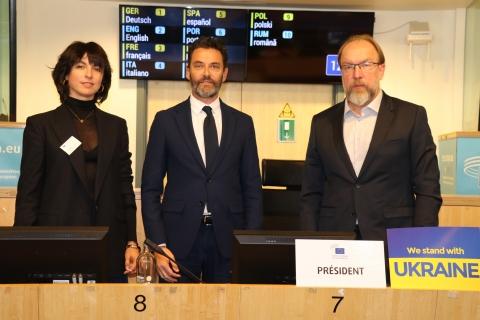
23 March 2022 - Invited by the EESC Employers’ Group to discuss the impact of Putin’s aggression on Ukraine and the reconstruction of the country after the war, Ukrainian business representatives urged EU companies to stop all commercial activities in Russia.
“Doing business with Russia is bad business,” said Gennadiy Chyzhykov, President of Ukrainian Chamber of Commerce and Industry, encouraging European businesses to stop working with Putin. “Every euro paid to Russia funds Putin war's crimes and ends innocent civil lives. The faster we cut these links, the more lives we will save.”
Mr Chyzhykov warned European employers that their companies and assets in Russia could be nationalised and appropriated by the Russian regime.
“Europe must support Ukraine through more sanctions on Russia, stopping economic activity with Russia,” insisted Igor Zhovkva, Deputy Head of Office of President Volodymyr Zelensky, underscoring that all money earned through this trade can only back the Russian military machine.
Despite the war, businesses remain active, but the Ukrainian economy took a hit: 30% of businesses stopped and 50% are in a precarious situation, Ukrainian employers said. Thirty-two percent of microbusinesses have reserves for several months, 24% have no reserves at all, said Anna Derevyanko, Executive Director of the European Business Association Ukraine, stressing that the majority of businesses continue to pay full salaries and provide humanitarian aid to Ukraine.
“We understand that EU sanctions to Russia have an impact on the EU economy, but this is not as important as the thousands of human lives that are being lost,” Zhovka added.
The EU imports 40% of its gas from Russia and Russia accounted for just under 30% of the EU’s crude oil imports and just over 15% of oil products. While the United States, Canada and the United Kingdom have announced embargoes or phase-out measures for Russian energy in the wake of the war in Ukraine, the European Union has held back, instead launching a new energy strategy, REPowerEU. This aims to reduce by nearly two thirds the EU’s gas imports from Russia by the end of 2022, and to make Europe independent from all Russian fossil fuels well before 2030.
Expert Pauline Weil (Bruegel) explained that while stopping Russian gas imports would be difficult and costly, but feasible, it will likely be less painful for the EU to manage a complete interruption of Russian oil and coal imports.
Employers’ Group president Stefano Mallia stressed that “we are all conscious that there is no other alternative than the one to stop commercial activity with Russia. We know that there are no quick fixes and peace has a price and we must be ready to pay the price for peace.”
The debate also focused on the reconstruction of the Ukrainian economy and infrastructure. The acceleration of the accession of Ukraine to the EU will facilitate the reconstruction of the battered country.
“Guaranteeing the entrance for Ukraine in the EU would be huge not only for the country but also for its businesses,” said Anna Derevyanko.
Mr Zhovkva called for the establishment of a EUR €500 billion fund for the reconstruction of Ukraine. At the moment, he said, damage from the war has already exceeded $600 billion.
“Despite the ongoing war, we are already thinking about post war reconstruction. We hope to rely on Europe as our partners to build up our country from the ruins,” said Mr Zhovkva. “Today Ukraine fights not only for its freedom, but also for its right to exist as a European nation,” he added.
For more information: Daniela Vincenti +32 497412095
For more information on ways to support Ukrainian businesses, please contact:
Oksana Myronko (oksana.myronko@eba.com.ua, +38 063 638 68 71)