
European Economic
and Social Committee
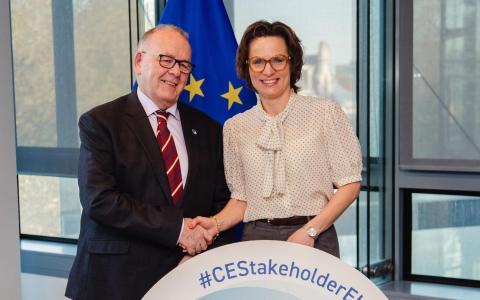
Accelerating the transition to a circular economy is essential not only for sustainability and competitiveness, but also for strengthening Europe’s strategic autonomy. This was the central message of the annual conference of the European Circular Economy Stakeholder Platform, a joint initiative of the European Commission and the European Economic and Social Committee, held on 22–23 April.
The event brought together policymakers, businesses, civil society and regional actors to exchange views and contribute to the upcoming Circular Economy Act. This initiative aims to create a single market for secondary raw materials, boost the availability of high-quality recycled materials and stimulate demand across the EU.
Speakers stressed the urgency of action in the context of climate challenges, geopolitical uncertainty and resource dependency.
'In times of instability, circular economy is not a choice, it’s a necessity. Dependencies have a cost, as oil shocks keep reminding us. Circularity means reclaiming value, strengthening resilience, and building Europe’s economic autonomy', said Jessika Roswall, Commissioner for Environment, Water Resilience and a Competitive Circular Economy.
'The strong cooperation between the European Commission and the European Economic and Social Committee is at the heart of this platform. It reflects a shared conviction: that Europe’s transition to a circular economy cannot be delivered by institutions alone. It must be shaped, challenged and owned by those who make our economy work every day', said Séamus Boland, EESC President.
Author of the 'Report on the Future of the Single Market' and the President of the Jacques Delors Institute Enrico Letta highlighted that without a strong circular economy, Europe risks increasing its reliance on external suppliers for critical raw materials.
Despite progress, Europe’s circularity rate reached only 11.8% in 2023, underlining the need to scale up efforts. The European Commission has set a target to double this rate by 2030 as part of its industrial strategy.
Discussions also explored synergies between the circular economy and the bioeconomy, focusing on local value creation, resource efficiency and resilience. The conference reinforced the importance of cooperation between institutions and stakeholders to deliver a competitive and fair circular Europe. (ks)