In this overview the European Economic and Social Committee (EESC) shares its opinions on the European Commission’s proposals for the Multiannual Financial Framework (MFF) 2028-2034, bringing together the perspectives of organised civil society on the future direction of the EU budget.
Public debate in the ECO Section on the "The international role of the euro: A European safe asset for a new geopolitical era?". This public debate will explore the opportunities and challenges associated with strengthening the international role of the euro and discuss the economic, financial and geopolitical arguments for and against the creation of a European safe asset.
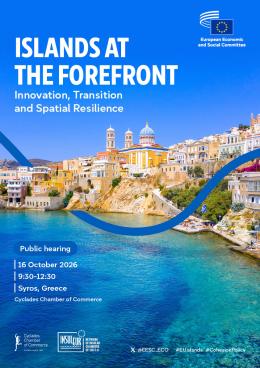
As part of the preparation of the EESC opinion on an EU Strategy for Islands, the European Economic and Social Committee, in cooperation with INSULEUR, will hold a public hearing in Syros, at the heart of the Cyclades. The hearing aims to bring together local and regional authorities, organised civil society, businesses, academia and citizens to exchange views on both the challenges and the untapped opportunities facing Europe's islands. Beyond discussing issues such as connectivity, demographic change, access to services and climate resilience, the event will highlight the unique assets of islands like Syros, including their strategic location, cultural heritage, blue economy potential, innovation capacity, renewable energy opportunities and sustainable tourism. The insights gathered will contribute directly to the EESC opinion by ensuring that the voices, experiences and aspirations of island communities are reflected in future EU policies and in the implementation of the first European Strategy for Islands which was adopted in June 2026.
As Europe seeks to strengthen its competitiveness in an increasingly fragmented global economy, the challenge is not only to boost productivity and innovation, but also to preserve the foundations of its social market economy. This high-level conference will examine how the EU can mobilise savings and investment, maintain sustainable public finances, and deepen Economic and Monetary Union to support long-term growth, resilience and convergence.
rue Belliard 101, Jacques Delors building, room JDE 63, 9:30-11:00
Brussels
Belgium
EESC, room JDE 63, 9:30-11:00
The policy debate brings together stakeholders to assess how National and Regional and Partnership Plans will work in practice. In a workshop setting connected to the European Economic and Social Committee, participants from civil society, social partners and institutions will exchange perspectives on transparency, inclusiveness and impact. The discussion aims to highlight gaps, share best practices and strengthen the role of organised civil society in shaping and monitoring the implementation of NRPPs in the EU.
In the context of the creation of a Savings and Investments Union that benefits EU citizens, financial literacy positions as an enabler. In this debate we put-together the voices of the European Commission and local organisations to exchange on their projects and policy proposals.
Public debate in the ECO Section on the The Multiannual Financial Framework after 2027 - Assessing progress and outstanding challenges. The event will take stock of developments in the negotiations since the Commission presented their proposals for the next Multiannual Financial Framework and discuss outstanding challenges.
The European Economic and Social Committee (EESC) invites you to attend our public hearing on how using artificial intelligence and digitalisation in tax administration can strengthen legal clarity, cross-border comparability, economic development and tax certainty.
The public hearing will focus on the capacity to reduce fragmentation and compliance burdens, while facilitating compliance and collection across Member States. The hearing will bring together policymakers, stakeholders and experts from across countries and organisations to discuss on digitizing the EU tax system.