The European elections proved that the pro-European majority still holds, but also showed that voters across the EU demand urgent political and legislative responses to the challenges raised in the electoral campaign. Otherwise, the pro-European majority may risk losing support as citizens may increasingly turn their backs on the mainstream political forces.
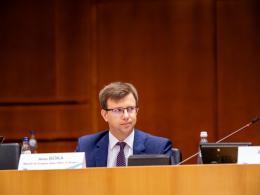
At the July plenary session of the European Economic and Social Committee (EESC), Committee president Oliver Röpke hosted a debate with the Hungarian Minister for European Union Affairs,János Bóka, who presented the main priorities of the Hungarian Presidency of the Council of the EU.
589th Plenary session, with the following guests: Roberta Metsola, President of the EP (tbc);János Bóka, Minister of EU Affairs of Hungary; Nicolas Schmit, EU Commissioner for Jobs and Social Rights, Maxime Cerutti, Director of Social Affairs at Business Europe, Tea Jarc, Confederal Secretary of the EU Trade Union Confederation (ETUC), Rareș Voicu, President of the EU Youth Forum and Nicoletta Merlo, EESC Member; with Teresa Ribera, Minister for the Ecological Transition and the Demographic Challenge of Spain (tbc), Svenja Schulze, Federal Minister for Economic Cooperation and Development of Germany (tbc); Saadia Zahidi, Managing Director, World Economic Forum
Only nine EU countries criminalise forced sterilisation as a distinct offence, while 13 allow it to be performed on persons with disabilities – and in three of those countries that includes minors. When it comes to the sexual and reproductive health rights of women with disabilities, the EU is far from being a union of equality, an EESC hearing revealed
After the European elections, what agenda for the EU?
In this issue:
Our members share their expectations and proposals for the EU agenda 2024-2029
Guest articles by László Bercse (Vice-President, Inclusion Europe), Rareș Voicu (President, European Youth Forum) and Radu Caragea-Szucs (Vice-President, Funky Citizens)
Special interview with EESC Vice-President Aurel Laurenţiu Plosceanu on the European elections
Report on our recent conference on 'The State of Health in the EU'
Interview with rapporteur Stoyan Tchoukanov on the EESC opinion 'Promoting autonomous and sustainable food production: strategies for the Common Agricultural Policy post-2027'