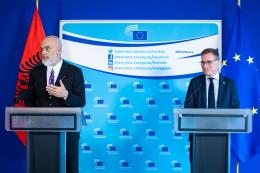
In a meeting and a joint press point at the European Parliament today, 19 September, Prime Minister Edi Rama of Albania and EESC President Oliver Röpke reaffirmed their commitment to strengthening cooperation between Albania and the European Union, with a focus on the role of civil society.
In its effort to lead global climate action, the European Union should set an ambitious target for 2040, aiming to reduce net greenhouse gas emissions by 90%, in line with its broader goal of achieving climate neutrality by 2050. This target, endorsed by the European Economic and Social Committee (EESC) at its September plenary session, aligns with the scientific consensus on the need to limit global warming to 1.5°C.
The EU-Türkiye Civil Society Joint Consultative Committee established in 1995 is composed of members from the EESC and members representing organised civil society in Türkiye. Its objective is to contribute to the dialogue among civil society organisations in Türkiye and the EU and to issue reports and recommendations to the Turkish authorities and the EU institutions.