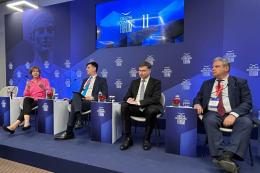
At this year’s Delphi Economic Forum, an EESC Employers' Group delegation, led by President Sandra Parthie and composed of members Winand Quaedvlieg, Marcin Nowacki, Michal Pinter, Kristi Sober, and Katalin Sule, joined political, business, and academic leaders to talk about economic growth, geopolitics, and sustainability.
As spring blooms in Brussels, I want to take a moment to reflect on Your Europe, Your Say! (YEYS), the EESC’s flagship event for youth, which welcomed almost 140 young people from all EU Member States, the candidate countries and the UK.
As spring blooms in Brussels, I want to take a moment to reflect on Your Europe, Your Say! (YEYS), the EESC’s flagship event for youth, which welcomed almost 140 young people from all EU Member States, the candidate countries and the UK. It was not only a meeting of young people, but also a space for dialogue, collaboration and action. It showed that in the EESC, young people are taken seriously and given the opportunity to help shape the next EU Youth Strategy.
This year’s theme, Meaningful Connections, Active Participation and Democratic Engagement, was more than just a theme. It reflected young people’s experience of being heard and of having the opportunity to step up and develop their ideas. Something that makes me especially hopeful is that this year’s edition of YEYS attracted a strong interest not only from young people from the Member States, but especially from candidate countries and Ukraine, showing that their hearts beat in the EU.
Over two days, the participants worked on developing 17 proposals, with topics ranging from healthcare to digital awareness to youth opportunities. Through a vote, three proposals were chosen: Go big or NO home, exploring the increasingly difficult housing market, Think before you click: make privacy sexy again!, on digital-awareness and Nothing about us without us, encouraging young people to use their voice.
These three proposals show one thing: our young people want to shape the future. They want to use their voice and their passion to change the status quo. YEYS allows them to learn and to connect with other young people who are just as passionate as them. Once again, the participants have shown me that they understand the issues that shape the future and strive to improve the lives of people not only from the European Union, but from all around the world.
The EESC has been advocating for young people for years. The Committee was the first EU institution to introduce the EU Youth Test, a policy impact assessment tool designed to ensure that young people’s perspectives are considered in EU policymaking. Young people are directly involved in the consultation process on the EESC opinions that are selected for their relevance for young people. The Youth Test is now one of the 48 initiatives nominated for the European Ombudsman 'Award for Good Administration', under the category 'Excellence in diversity and inclusion'.
In 2023, the EESC set up the Youth Group, Initially envisaged to coordinate the EESC’s youth-related initiatives, its mission today goes beyond its formal mandate. In this issue, Youth Group president Nicoletta Merlo writes about the group’s ambition to become a hub where young people’s concerns, ideas and proposals can be heard and transformed into concrete policy recommendations.
We understand that young people are the future. We must not forget that they are our present too.
This is why I am very happy that this month’s newsletter will shine a spotlight on youth. We are taking a closer look at YEYS, bringing you the messages of our young speakers and members, while giving the floor to key issues facing the next generation. By exploring housing insecurity, political and civic education, the growing gender gap in support of far-right parties, intergenerational fairness, and the mental health of young people, we highlight the defining challenges for the generation, as identified by the YEYS participants themselves.
Looking ahead to May, we invite you to experience this spirit of engagement firsthand. The EESC will host an open-door, festive celebration for Europe Day, offering an opportunity to discover the workings of the Committee and learn how complex debates are turned into opinions. We hope to welcome you there.
And last but not least, I am happy to announce this year’s Connecting EU seminar, the EESC’s flagship communication event for civil society communicators. It will take place on 6 and 7 July at the University of Sofia, Bulgaria. Entitled In defence of European values: the power of civil society, the 2026 Connecting EU seminar will focus on Europe’s ability to uphold its core values as its economic priorities shift and pressure on democratic trust and civic space intensifies – and on how civil society can defend them. Mark your calendars and join us in Sofia this July!
As part of European Youth Week 2026, the European Economic and Social Committee (EESC) highlighted its long‑standing commitment to meaningful youth participation through direct engagement with young people and a range of concrete policy tools designed to strengthen their influence on decision‑making.
Display date
2 months 1 week ago
Instrument for Agile and Rapid Defence Innovation – AGILE
Young people are often told their political turn later will come later. But they are the ones who will live longest with the consequences of decisions taken today. When political choices risk causing long-term harm and cannot easily be reversed, democratic safeguards such as intergenerational commissions and age-weighted referendums may be needed to ensure that concerns and interests of young people are not sidelined, says Nicola Mulkeen, Lecturer in Political Philosophy at UK's Newcastle University, in an EESC interview.
Young people are often told their political turn later will come later. But they are the ones who will live longest with the consequences of decisions taken today. When political choices risk causing long-term harm and cannot easily be reversed, democratic safeguards such as intergenerational commissions and age-weighted referendums may be needed to ensure that concerns and interests of young people are not sidelined, says Nicola Mulkeen, Lecturer in Political Philosophy at UK's Newcastle University, in an EESC interview.
Your research highlights the significant risks that ageing demographics pose to democratic processes. Could you explain the specific mechanisms by which an older electorate can systematically disadvantage younger generations?
In ageing democracies, older people make up a larger share of the electorate and they also tend to vote in higher numbers. This gives them more power to shape election outcomes. Politicians are usually most responsive to the groups that are largest and most able to influence public debate. The result is a political system that can become skewed towards the interests of older voters while younger people’s concerns are more easily delayed or ignored.
This would be less troubling if the decisions made under these conditions were easily reversible. Many are not. If a government delays climate action because the immediate political costs seem too high, younger generations will live with more extreme weather and deeper insecurity. If biodiversity is destroyed, the damage to ecosystems and food systems may be impossible to repair. If a government borrows to avoid present sacrifice, younger people will be left paying the bill through higher taxes, weaker services, and less freedom to respond to problems of their own. When military conscription is imposed, it is the young who are required to train, prepare to fight, and perhaps die.
So, it is not enough to say that young people will have their political turn later. By then the damage might already have been done. Some harms cannot be undone. Others can only be reversed at very great cost. Younger people are therefore not just temporarily less powerful. They are the ones who will live with the consequences the longest when they had the weakest voice.
In your paper, you propose age weighted referendums and intergenerational commissions as a dual mechanism for addressing intergenerational tensions. Could you explain how these solutions could work in practice?
My proposal is aimed at political decisions that may cause significant long-term harm and are difficult to undo. The idea is to create stronger electoral safeguards in exceptional cases where younger and future generations will carry the weight of those decisions.
In practice, the first safeguard would be an intergenerational commission, or commissioners working across government departments. This would be an independent public body made up of experts and youth representatives. Its role would be to identify laws or policies that create serious long-term risks of harm. The aim is to bring these cases out of the ordinary election cycle, where short-term pressures dominate, and to make their long-term implications clearer.
If the commission judged that a proposal created a serious risk of harm or injustice, it could trigger a targeted age-weighted referendum. One example would be a government deciding whether to approve major new oil extraction or delay climate action. In that case, everyone would still vote, but younger people’s votes would carry greater weight because they are the ones most directly exposed to the long-term consequences. The point is to level things up. Younger people are often politically weaker even though they may have more at stake in long-term decisions.
Beyond your proposed reforms, what other policy interventions, whether at EU or national level, do you see as most promising for rebalancing intergenerational equity? Are there examples from member states that you'd highlight as models worth scaling?
Beyond age-weighted referendums and intergenerational commissions, the most promising interventions are those that make long-term thinking part of ordinary democratic decision-making. No single reform can solve the problem. What is needed is a broader approach that improves the political standing of younger people, strengthens legal protections for future generations, and makes governments answerable for the long-term effects of their choices.
Some reforms can easily be introduced. Civic and democratic education is one. If younger people are to participate meaningfully in public life, they need knowledge and institutional support. Expanding youth representation also matters. Introducing youth quotas in legislatures could help address the current imbalance. Judicial review also matters where governments adopt laws that threaten the basic conditions future generations will need, such as climate stability.
There are already useful examples. Wales is often highlighted because its Well-being of Future Generations Act encourages public bodies to consider long-term consequences. At EU level, the appointment of a Commissioner for Intergenerational Fairness suggests these questions are receiving more serious attention. Germany’s 2021 Constitutional Court ruling on climate policy is a really important example because it recognised that governments should not be free to pass harmful burdens on to younger and future generations. None of these examples is a complete solution, but they show that democratic systems can be redesigned to take longer-term responsibilities more seriously.
Your work focuses on structural reform, but we have seen that social change also requires a shift in attitudes. What do you see as the most effective ways to build intergenerational solidarity rather than framing this as a zero-sum conflict between age groups?
I think it’s really important not to frame intergenerational fairness as a conflict between the young and the old. The deeper problem is that many political systems are structured for the short term. They respond to immediate pressures and electoral demands more easily than to long-term risks. This means that they often fail to give proper weight to young people. If we want to build intergenerational solidarity, we need to move away from the language of trade-offs.
One of the best ways to do that is to recognise that properly investing in younger people is not a loss for older generations. In ageing societies, younger generations will be central to sustaining the institutions and services on which everyone depends. They will make up a large part of the workforce, support public finances, and provide care. So, investing in education, healthcare, and work opportunities for young people should be seen as a way of strengthening society. It is not about favouring one group over another.
Nicola Mulkeen is a Lecturer in Political Philosophy at Newcastle University. Her work sits at the intersection of politics, philosophy, and economics, with a particular focus on intergenerational justice and institutional reform for younger and future generations.
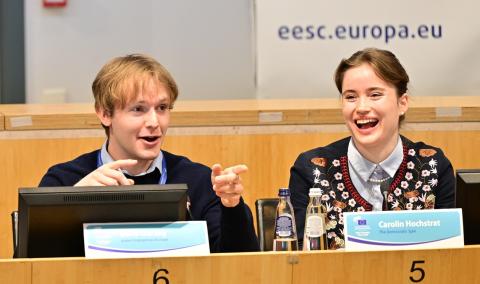
Be architects of Europe’s present, not just its future, and join forces with other young people to make your voice heard! These were the words young activists and speakers Carolin Hochstrat and Boris Gurzhy left with 2026 YEYS-ers in Brussels. If you missed their speeches at Your Europe, Your Say (YEYS), Carolin and Boris recap their messages in EESC Info.
Be architects of Europe’s present, not just its future, and join forces with other young people to make your voice heard! These were the words young activists and speakers Carolin Hochstrat and Boris Gurzhy left with 2026 YEYS-ers in Brussels. If you missed their speeches at Your Europe, Your Say (YEYS), Carolin and Boris recap their messages in EESC Info.
Carolin Hochstrat: Young people are often introduced with the phrase: 'You are the architects of Europe's future.' And while well-intentioned, I'd push back on that framing ─ because you are not only the architects of tomorrow's Europe. You are already part of Europe today. That was the foundation of my message to the YEYS participants, built around three core ideas.
First: when people tell you that you're too young, they're wrong. You are already a member of society, already shaping the communities around you. The idea that engagement starts at some future threshold, when you're older, more experienced, more credentialed, is a myth. You are already here, and that means you are already relevant.
Second: discomfort is a signal, not a warning. If you want to change the status quo, you have to challenge it. And challenging the status quo is unsettling, for you, and for those around you. But when you notice that people are reacting, that something is shifting, that emotions are being stirred, that's not a sign to stop. That's a sign you're on the right track.
Third: you will never feel fully ready, and that's okay. There is no perfect moment to raise your voice or take your seat at the table. What matters is that we need your voice. Your generation's issues deserve space in policy rooms, not as a footnote to older agendas, but as central concerns in their own right.
It can feel daunting. But we are fighting together for a stronger Europe, and that is worth stepping beyond your comfort zone!
Boris Gurzhy: My message to the participants of YEYS 2026 was simple: make your voice count by joining forces with others. At a time when demographic change is reshaping many European societies, it is more important than ever that young people are not only heard, but are actively involved in shaping the future.
In my opinion, the most effective ways to take part in public discussion and create real impact is through organised civil society. That is why I encouraged participants to look closely at the opportunities already available in their city or country: youth organisations, student-led initiatives, NGOs and other spaces where young people can come together around shared ideas and concerns.
These experiences allow young people to meet each other, learn from one another, develop responsibility and strengthen their collective voice. They show that participation is not only about speaking up once, but about building communities that can be heard consistently and effectively.
Explore what already exists and get involved. And where such opportunities do not yet exist, create them yourselves. It does not have to be a Junior Enterprise; it can be any form of organised youth initiative. What matters is that young people come together, take ownership, and make their perspectives visible in society.
Carolin Hochstrat is a political communicator and Co-Founder of The Democratic Spin, a strategic communications consultancy for democratic impact. In her work, she advises institutions and democratic actors on how to translate complex policies into narratives that resonate with younger generations in a digital public sphere. She has gained professional experience in the European Parliament, the German Bundestag and in political journalism. Alongside her advisory work, she is an EU content creator engaging young Europeans online.
Boris Gurzhy studies Business Administration and Statistics at Humboldt University Berlin. He joined a Junior Enterprise in his first year in university and later became involved with Junior Enterprises Europe (JE Europe), a network representing 35,000+ students across 325 Junior Enterprises in 16 countries. He now serves as Treasurer & Head of Public Affairs at JE Europe, representing young entrepreneurs at European institutions.