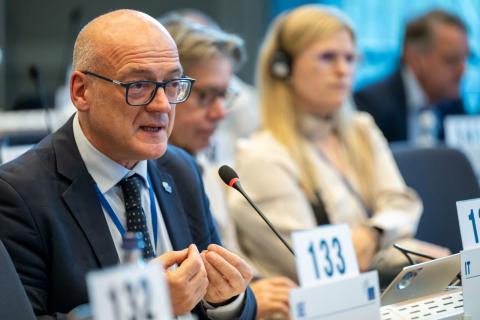
During the meeting, the EU DAG will receive an update from DG Trade on the EU-Korea FTA and the implementation of the TSD Chapter. EU DAG members and DG Trade will report back from the Civil Society Forum and workshop held in September 2024. In addition to that, European Chamber of Commerce in Korea (ECCK) will make a presentation on this year's ECCK White Paper, and the EU DAG will discuss current situation in South Korea in light of the geopolitical situation with Professor Ramon Pacheco Pardo.
The EESC supports efforts to develop a more human-centred and future-proof industrial ecosystem. At the same time, it calls for an in-depth debate on Industry 5.0 and its social and economic implications.
The EESC supports efforts to develop a more human-centred and future-proof industrial ecosystem. At the same time, it calls for an in-depth debate on Industry 5.0 and its social and economic implications.
Industry 5.0 aims to place social and environmental issues at the heart of business processes, advancing beyond Industry 4.0’s focus on digitalisation and automation. The EESC recently adopted an opinion titled Industry 5.0 - how to make it happen, advocating for a people-centred industrial model that values human skills and creativity.
Industry 4.0 largely overlooked the human impact of automation and paid limited attention to environmental priorities like waste reduction, circularity, and green energy. The EESC stresses that Industry 5.0 should address these gaps, prioritising democratic values, social equity, and sustainable competitiveness. Giuseppe Guerini, rapporteur for the opinion on Industry 5.0, argues that digital transformation should contribute to a ‘New Industrial Clean Deal’, where human factors and creativity play a central role.
Industry 5.0 brings people back into the core of production, viewing their knowledge and skills as essential to competitive advantage. It balances automation with human creativity, using collaborative robots for repetitive tasks, allowing workers to focus on design, planning, and customer service. This shift also emphasises worker health, safety, and support for those displaced by automation.
The EESC calls on the EU institutions to support a future-proof, human-centred industrial ecosystem rooted in social justice and inclusive competitiveness. While backing Industry 5.0, the EESC stresses the need to define its economic, social, and technological impacts further. Existing European policies, such as the Green Deal, AI Act, and Skills Agenda, provide a foundation for this vision but should be updated to align with Industry 5.0 principles.
For Industry 5.0 to succeed, the social partners and workers must be involved at all levels. This inclusive approach will foster a collaborative work environment that combines human and machine strengths, making workplaces more innovative, engaging, and sustainable.(gb)
October and November were marked by the failure of two top global environment summits: COP16 – the UN Convention on Biological Diversity and COP29 – the UN climate conference, both focusing on finance which is desperately needed for nature preservation and for mitigating climate change. We asked the EESC representatives at this year's COPs – Peter Schmidt, Diandra Ní Bhuachalla and Arnaud Schwartz – to share their thoughts on what is at stake if the world fails to act on climate.
October and November were marked by the failure of two top global environment summits: COP16 – the UN Convention on Biological Diversity and COP29 – the UN climate conference, both focusing on finance which is desperately needed for nature preservation and for mitigating climate change. We asked the EESC representatives at this year's COPs – Peter Schmidt, Diandra Ní Bhuachalla and Arnaud Schwartz – to share their thoughts on what is at stake if the world fails to act on climate.