By Sandra Parthie, President of the EESC Employers’ Group
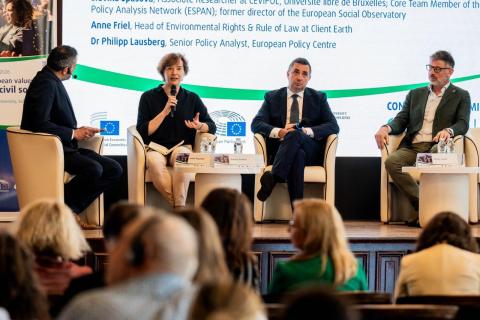
This fundamental question was at the heart of the roundtable discussion at the EESC Connecting EU seminar on ‘Made in the EU: competitive, social and sustainable’, held in Sofia on 6 July 2026. The discussion highlighted a simple but often overlooked reality: Europe’s economic strength, social cohesion and environmental ambitions are deeply interconnected.
This fundamental question was at the heart of the roundtable discussion at the EESC Connecting EU seminar on ‘Made in the EU: competitive, social and sustainable’, held in Sofia on 6 July 2026. The discussion highlighted a simple but often overlooked reality: Europe’s economic strength, social cohesion and environmental ambitions are deeply interconnected.
By Sandra Parthie, President of the EESC Employers’ Group
As Europe’s social model depends on Europe’s productive capacity, the ‘Made in the EU’ strategy must keep investment, production, jobs and value creation in Europe. Companies must be able to invest and scale up in Europe if we want to maintain quality jobs, finance social protection and deliver on the green transition.
This can happen only if companies have the right framework conditions: affordable energy, modern infrastructure, efficient telecommunications networks, faster permitting, and a truly integrated single market.
As businesses increasingly relocate investment and production outside the EU, Europe must create the conditions that encourage them to stay, grow and manufacture here. Recent investment decisions also demonstrate the value of strengthening Europe’s industrial base through cross-border cooperation. For example, German company Rheinmetall has announced plans to invest in Romania to manufacture tanks, creating industrial capacity and jobs within the EU while deepening cooperation between Member States. This shows how a strong European industrial ecosystem can combine investment, production and innovation across borders, reinforcing both competitiveness and resilience.
In addition, without profitable and innovative companies creating value, there is little to redistribute and little capacity to finance social progress.
This is why competitiveness and sustainability are not opposing goals, but mutually reinforcing pillars of a sustainable and modern European economy. This means that Europe does not need to choose between competitiveness and its social and environmental ambitions. Rather, competitiveness is what makes those ambitions achievable. A credible ‘Made in the EU’ strategy should therefore support strategic production, innovation and investment while maintaining Europe’s high standards and values.
Europe’s future prosperity will depend on its ability to create the conditions for businesses to succeed, workers to thrive and sustainable growth to flourish. A stronger, more competitive Europe is not an alternative to a Social Europe, it is its precondition.
The Industrial Accelerator Act is a timely initiative. We welcome its objective to strengthen Europe’s industrial base and support the transition to a low-carbon economy. For the EESC, the key priority now is clear: accelerate decarbonisation without undermining competitiveness.
rue Belliard 101, Jacques Delors building, room JDE 63, 9:30-11:00
Brussels
Belgium
EESC, room JDE 63, 9:30-11:00
The policy debate brings together stakeholders to assess how National and Regional and Partnership Plans will work in practice. In a workshop setting connected to the European Economic and Social Committee, participants from civil society, social partners and institutions will exchange perspectives on transparency, inclusiveness and impact. The discussion aims to highlight gaps, share best practices and strengthen the role of organised civil society in shaping and monitoring the implementation of NRPPs in the EU.
Shadow Report on Chapter 23 for the period between October 2024 – September 2025
This Shadow Report consolidates into a single coherent document all findings, conclusions, and recommendations resulting from the monitoring of the areas contained within Chapter 23 – Judiciary, Fight against Corruption and Fundamental Rights in the Republic of North Macedonia. This is the jubilee tenth such report published by the European Policy Institute (EPI) – Skopje, taking into account the comments and opinions of state institutions and non-governmental organizations.