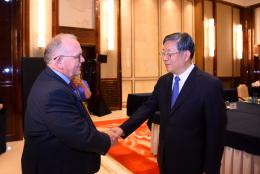
A competitive and decarbonised industry is essential for Europe’s prosperity. The Industrial Accelerator Act can help unlock investment, strengthen strategic value chains and secure quality jobs, writes Konstantinos Diamantouros, member of the EESC’s Employers’ Group and rapporteur for the opinion on the Industrial Accelerator Act.

A competitive and decarbonised industry is essential for Europe’s prosperity. The Industrial Accelerator Act can help unlock investment, strengthen strategic value chains and secure quality jobs, writes Konstantinos Diamantouros, member of the EESC’s Employers’ Group and rapporteur for the opinion on the Industrial Accelerator Act.

The next EU budget will have to do more than allocate funding: it will need to help mobilise investment, strengthen competitiveness and support Europe's long-term priorities in a changing geopolitical and economic landscape. Our surprise guest Professor Danuta Hübner reflects on how the next MFF can become a catalyst for public and private investment and deliver a budget fit for the future.

The next EU budget will have to do more than allocate funding: it will need to help mobilise investment, strengthen competitiveness and support Europe's long-term priorities in a changing geopolitical and economic landscape. Our surprise guest Professor Danuta Hübner reflects on how the next MFF can become a catalyst for public and private investment and deliver a budget fit for the future.

The European Commission's new Gender Equality Strategy for 2026-2030 aims to advance equality between women and men across the EU and address persistent challenges such as gender pay gaps, unequal caring responsibilities and gender-based violence. We asked Juliane Marie Neiiendam, rapporteur for the EESC opinion on the Gender Equality Strategy 2026-2030, for the Committee’s key recommendations to ensure that the strategy is effective, accessible and delivers concrete results.

The European Commission's new Gender Equality Strategy for 2026-2030 aims to advance equality between women and men across the EU and address persistent challenges such as gender pay gaps, unequal caring responsibilities and gender-based violence. We asked Juliane Marie Neiiendam, rapporteur for the EESC opinion on the Gender Equality Strategy 2026-2030, for the Committee’s key recommendations to ensure that the strategy is effective, accessible and delivers concrete results.

Dear readers,

There are moments when we are reminded why communication matters. For me, this year’s Connecting EU seminar was one of them. Held at Sofia University ‘St. Kliment Ohridski’ and co-organised with the Economic and Social Committee of the Republic of Bulgaria, the EESC’s top annual communication event brought together press and communication officers from employers’ associations, trade unions and civil society organisations, as well as journalists, EESC members and representatives of European institutions.

Dear readers,

There are moments when we are reminded why communication matters.

For me, this year’s Connecting EU seminar was one of them.

Held at Sofia University ‘St. Kliment Ohridski’ and co-organised with the Economic and Social Committee of the Republic of Bulgaria, the EESC’s top annual communication event brought together press and communication officers from employers’ associations, trade unions and civil society organisations, as well as journalists, EESC members and representatives of European institutions.

For 18 years, this seminar has given those of us who communicate Europe a chance to step away from our daily work, exchange ideas and discuss the issues dominating Europe’s public debate. This year, those conversations felt more timely than ever.

Europe is changing. The assumptions that shaped our continent for decades are being challenged by a rapidly changing geopolitical landscape, growing security concerns and increasing pressure on democratic institutions. It was against this backdrop that we chose to focus this year’s discussions on one central question: how can civil society help defend Europe’s values?

We talked about Europe’s economy and how we can best align competitiveness, social rights and sustainability. We discussed democracy at a time when disinformation, foreign interference and political polarisation are putting pressure on public debate across the continent. And because communication itself is changing, we also explored how artificial intelligence can help communicators do their work better, rather than replace it.

What stayed with me most was not that everyone agreed. Quite the opposite. There were different views, lively debates and challenging questions throughout the seminar. But there was also a shared understanding that good communication is not about slogans or easy answers. It starts with listening. It requires honesty. And it only works if people feel they are part of the conversation.

I would like to thank our colleagues at the Economic and Social Council of the Republic of Bulgaria for their outstanding partnership, as well as Sofia University ‘St. Kliment Ohridski’ for welcoming us into such an inspiring setting.

I hope everyone who joined us left Sofia with new ideas, new contacts and renewed motivation for the work they do every day. I know I certainly did.

For those of you who missed this year’s Connecting EU, we will soon publish a special edition of EESC Info with the main highlights of the seminar. You can also rewatch all the discussions at the event web page. And keep an eye on our social media channels for interviews with our panelists.

You can also catch up with all the EESC news we bring you in this issue. Our surprise guest is former Polish MEP, Commissioner and Minister Danuta Hübner, often referred to as Madame Europe, who unpacks for us the new proposal for the EU budget.

In the meantime, I think we all deserve a relaxing summer break! Wherever this summer takes you – to the coast, the countryside, the mountains or simply closer to home – I hope you find time to rest, recharge and return with fresh ideas. I look forward to continuing the conversation in autumn.

Have a wonderful summer!

Europe’s industry is under pressure. Global competition is intensifying, while companies face rising costs, regulatory complexity and investment uncertainty. In this context, the Industrial Accelerator Act (IAA) is a timely initiative. 

By Konstantinos Diamantouros

Europe’s industry is under pressure. Global competition is intensifying, while companies face rising costs, regulatory complexity and investment uncertainty.

By Konstantinos Diamantouros

In this context, the Industrial Accelerator Act (IAA) is a timely initiative. The EESC welcomes its objective to strengthen Europe’s industrial base and support the transition to a low-carbon economy. For the EESC, the key priority now is clear: accelerate decarbonisation without undermining competitiveness.

The IAA supports the EU’s ambition to increase manufacturing to 20% of GDP by 2035. This is essential to preserve Europe’s industrial capacity, skills and technological leadership. 

However, achieving this goal requires more than targets. It requires a business-friendly framework that enables companies to invest, innovate and grow in Europe. The proposal rightly focuses on simplifying and accelerating permitting procedures, which is a crucial step forward. But companies also need access to energy, infrastructure and skilled workers, as well as better coordination between EU and national rules. Without these conditions, projects will still face delays and higher costs.

A balanced “Made in EU” approach

The EESC supports the creation of a European preference for the sectors included in the scope of the proposal, i.e. aluminium, steel and concrete. On the contentious issue of the geographical scope, it understands the need for maintaining equal access to FTA partners, especially at a time when the EU is boosting its FTA network to strengthen value chains and reduce dependencies.  

At the same time, however, an open definition of the Made in EU approach must be based on clear criteria and fairness to ensure a level playing field. It should ensure effective reciprocity with third countries and avoid distorting competition within the Single Market. This should include free access to third countries' public procurement markets, mirroring of carbon costs through the effective implementation of CBAM, strict enforcement of the foreign subsidies regulation and, last but not least, ensuring that third countries not included in the IAA do not circumvent the rules via FTA partners. 

Public procurement can play a role and social conditionalities should apply, provided they are agreed at national level by social partners. However, they should not be the only driver. Private demand and market-based incentives are equally important to scale up low-carbon solutions and they should be promoted on a voluntary basis.

Last but not least, the EESC supports the creation of a Foreign Direct Investment screening mechanisms for strategic technologies, i.e. electric vehicles, critical raw materials, batteries and solar PVs.  It stresses nevertheless that a competitive industry depends also on people, and as such emphasises that the IAA should better reflect the need for skilled workers, training and quality jobs

The Industrial Accelerator Act is a step in the right direction, but to deliver results,it must remain pragmatic, balanced and business-oriented. Only then can Europe secure its industrial future and lead the green transition.

Konstantinos Diamantouros is a member of the EESC Employers' Group and Rapporteur for the Opinion INT/1119 Industrial Accelerator Act.

Minutes of the 251st INT Section meeting

Download — EESC-2026-01621-00-00-PV-TRA.docx — (Minutes)

The EESC is urging the EU to adopt a dedicated long-term strategy and boost funding for its eastern border regions, warning that they face growing security, economic and demographic pressures that existing policies cannot fully address. In an opinion adopted at its June plenary, the EESC calls for regions bordering Russia, Belarus and Ukraine to be recognised as strategic frontlines rather than peripheral areas. 

The EESC is urging the EU to adopt a dedicated long-term strategy and boost funding for its eastern border regions, warning that they face growing security, economic and demographic pressures that existing policies cannot fully address. In an opinion adopted at its June plenary, the EESC calls for regions bordering Russia, Belarus and Ukraine to be recognised as strategic frontlines rather than peripheral areas. 

It recommends that there be a dedicated funding stream in the next EU budget, more investment in transport, energy and digital infrastructure, measures to boost competitiveness and address demographic decline, and greater involvement of local authorities and civil society.

"The challenges require more than incremental reform and call for a long-term strategic framework beyond the current budget cycle", said rapporteur Katrina Zarina. Co-rapporteur Ionut Sibian added that eastern border regions were "strategic assets whose resilience underpins EU security, cohesion and long-term prosperity". The plenary debate featured Belarusian opposition leader Sviatlana Tsikhanouskaya, Lithuanian Vice-Minister of Finance Neringa Rinkevičiūtė-Laurinaitienė, and European Commission Deputy Director-General Hugo Sobral, who all stressed the strategic importance of strengthening the EU's eastern frontier. The EESC argues that investing in these regions is essential not only for their development, but also for Europe's security, resilience and long-term prosperity. More.

The EESC is calling for a stronger role for the social partners and civil society in shaping national reforms through the European Semester. In an information report and resolution adopted at its June plenary, the EESC proposes a European code for structured consultations and mandatory assessments of partnership practices to improve transparency, participation and democratic legitimacy.

The EESC is calling for a stronger role for the social partners and civil society in shaping national reforms through the European Semester. In an information report and resolution adopted at its June plenary, the EESC proposes a European code for structured consultations and mandatory assessments of partnership practices to improve transparency, participation and democratic legitimacy. 

Based on consultations involving stakeholders from all 27 Member States, the EESC report found broad support for the 2025 country-specific recommendations but highlights persistent implementation gaps, insufficient stakeholder involvement and an imbalance between economic priorities and social objectives. 'We reiterate our call for the establishment of a European code setting out how to conduct consultations within the framework of the European Semester,' said rapporteur Gonçalo Lobo Xavier. Rapporteur Andrea Mone stressed that stronger government action is needed to improve the design, implementation and evaluation of reforms, while rapporteur Luca Jahier said that closer links between the European Semester and the next EU budget should preserve 'flexibility, multilevel governance and national ownership' and rely on positive incentives rather than punitive conditionality. The EESC also supports closer links between the European Semester and the next EU long-term budget, provided safeguards protect subsidiarity, national ownership and democratic accountability. It advocates positive incentives to support reforms rather than punitive conditionality, arguing that stronger partnerships with the social partners and civil society are essential for more effective policy-making. More here.

The EESC has called for the European Semester to evolve into a more results-oriented framework that strengthens sustainable competitiveness, social inclusion and economic resilience while ensuring that reforms deliver tangible benefits for citizens. 

The EESC has called for the European Semester to evolve into a more results-oriented framework that strengthens sustainable competitiveness, social inclusion and economic resilience while ensuring that reforms deliver tangible benefits for citizens. 

Speaking at the Annual European Semester Group Conference on 30 June, participants stressed that the Semester will play a key role in linking national reforms and investments with the next EU long-term budget. 

'The European Semester should evolve beyond a coordination mechanism into a genuine delivery framework,' said European Semester Group president Gonçalo Lobo Xavier. EESC President Seamus Boland added that lasting European prosperity depends on advancing 'prosperity, economic resilience and social cohesion together', while ECO section president Elena Calistru stressed the need for a coherent framework that better connects reforms, investments and public resources. The conference also highlighted the importance of strengthening the role of the social partners and civil society, arguing that meaningful stakeholder participation is essential for effective economic governance and the successful implementation of future EU reforms and investments. More here. 

Priorities including housing, competitiveness, tech regulation, and more effectively including citizens in democratic decision-making among areas of joint work launched.

Priorities including housing, competitiveness, tech regulation, and more effectively including citizens in democratic decision-making among areas of joint work launched.

The European Economic and Social Committee (EESC), the EU body representing organised civil society, officially launched its cooperation with the Irish Government for the upcoming Irish Presidency of the Council of the European Union at a high-level event in Dublin Castle. The event brought together Taoiseach Micheál Martin TD, Minister of State for European Affairs Thomas Byrne TD and EESC President Séamus Boland.

The Irish Government has asked the EESC to contribute to several key presidency priorities, including housing, competitiveness, digital regulation, tackling poverty and the EU's approach to livestock policy. The aim is to ensure that the perspectives of civil society, employers and workers are reflected in EU policy-making. The presidency is particularly significant as it will coincide with the first Irish presidency of the EESC.

The Taoiseach highlighted the importance of dialogue between governments and society, stating: 'The ability of governments, employers, trade unions and organised civil society to engage constructively with one another is fundamental to democratic stability and to effective policy-making. The EESC is a vital link between civil society and the European institutions.'

He added: 'The voice of civil society matters. It matters because Europe cannot succeed through institutions alone. It succeeds when citizens feel ownership of the European project – when workers, farmers, entrepreneurs, voluntary organisations and local communities all feel that they have a stake in shaping Europe’s future.'

Minister Byrne underscored the role of citizen engagement in the presidency's priorities of competitiveness, security and values. 'Europe succeeds when people feel heard and represented. The work of the EESC remains central to that effort,' he said, adding that the Committee plays a valuable role in ensuring that a wide range of societal voices are heard in European decision-making.

EESC President Séamus Boland welcomed the shared agenda: 'I am very pleased that these areas of joint engagement – from democratic participation and equality, to competitiveness, small businesses, housing and digital fairness – reflect an EU Council Presidency that seeks to combine economic ambition with a strong social and citizen-centred dimension.' He added that the Committee particularly appreciates the emphasis on inclusive policy-making and democratic resilience.

As part of this cooperation, the EESC will prepare eight exploratory opinions for the Irish presidency covering democratic participation, equality and competitiveness, the EU livestock strategy, inter-generational poverty, simplification, the Single Market Strategy, the Digital Fairness Act and affordable housing construction. These opinions will support policy discussions and legislative work during the presidency.

The programme also included an exchange of views on the Irish presidency with Minister Byrne and a discussion on Maintaining Core Values in a New Europe, featuring representatives of business, trade unions, farming organisations, youth groups, environmental organisations and wider civil society.