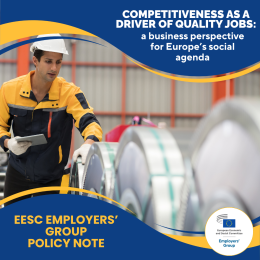
Europe’s social model depends on a strong and competitive economy. Quality jobs are created and sustained by economically successful enterprises operating in a favourable business environment — and European businesses are committed to delivering exactly that when the conditions allow for it. However, companies cannot offer quality employment if they are over-regulated, under-capitalised and unable to grow. Competitiveness, productivity growth, innovation and skills are therefore not separate from the social agenda: they are the foundation of Europe’s resilience, prosperity and social model.
Undermining democracy will not make the European Union more competitive. In an increasingly challenging geopolitical landscape, building resilience to disinformation, fostering critical thinking and empowering civil society are essential to safeguarding European values, an EESC conference for civil society communicators concluded.
Undermining democracy will not make the European Union more competitive. In an increasingly challenging geopolitical landscape, building resilience to disinformation, fostering critical thinking and empowering civil society are essential to safeguarding European values, an EESC conference for civil society communicators concluded.
‘In defence of European values: The Power of Civil Society’ was the theme of the Connecting EU seminar held by the European Economic and Social Committee (EESC) and the Economic and Social Council of the Republic of Bulgaria in Sofia on 6 to 7 July. The event examined how Europe can uphold its core values amid growing geopolitical uncertainty, economic pressures and declining public trust in democratic institutions.
‘Can Europe align competitiveness and the social model that has long set it apart? Can its democracy withstand growing pressure from foreign interference, disinformation and populism? And if democracy is not something we can take for granted, how do we defend it? After all, democracy survives only if people believe it can still improve their lives,’ said Marija Hanževački, the EESC Vice-President for Communication, opening the seminar.
During the opening session, EESC President Séamus Boland stressed the central role of democratic participation and civil society: ‘Democracy weakens when citizens feel unheard, when public debate becomes polarised and when civil society is pushed to the margins.’ He added: ‘The answer cannot ever be less democracy. The answer must be deeper democracy: defending independent media, protecting civic space and supporting social and civil dialogue.’
Zornitsa Roussinova, President of the Economic and Social Council of Bulgaria, highlighted how the council had helped counter disinformation during the debate on Bulgaria’s adoption of the euro by providing reliable information through the media.
In a keynote speech, journalist and author Dave Keating argued that Europe remained overly dependent on the United States and called for deeper European integration and a stronger sense of European identity to strengthen the EU’s strategic autonomy.
The first panel, Europe’s New Economic Compass: Balancing Competitiveness, Social Rights and Sustainability, brought together representatives of the EESC’s three groups. While participants agreed that Europe must become more competitive, views differed on how to achieve this. Some argued for simplifying regulation to support businesses, while others warned that competitiveness should not come at the expense of social rights, environmental protections or living standards.
The second panel, Europe’s Democratic Compass: Can Trust and Resilience Be Restored?, focused on disinformation and manipulation in the digital sphere. Antoinette Nikolova, Director of the Balkan Free Media Initiative, presented research on online manipulation during Bulgaria’s parliamentary elections. Speakers stressed the importance of media literacy, critical thinking and stronger civil society engagement to counter increasingly sophisticated disinformation campaigns.
The seminar concluded with interactive sessions on artificial intelligence in communication. David Grunewald, AI strategist and trainer, advocated the use of European AI models to strengthen data sovereignty, resilience and long-term economic competitiveness.
A competitive and decarbonised industry is essential for Europe’s prosperity. The Industrial Accelerator Act can help unlock investment, strengthen strategic value chains and secure quality jobs, writes Konstantinos Diamantouros, member of the EESC’s Employers’ Group and rapporteur for the opinion on the Industrial Accelerator Act.
A competitive and decarbonised industry is essential for Europe’s prosperity. The Industrial Accelerator Act can help unlock investment, strengthen strategic value chains and secure quality jobs, writes Konstantinos Diamantouros, member of the EESC’s Employers’ Group and rapporteur for the opinion on the Industrial Accelerator Act.
The next EU budget will have to do more than allocate funding: it will need to help mobilise investment, strengthen competitiveness and support Europe's long-term priorities in a changing geopolitical and economic landscape. Our surprise guest Professor Danuta Hübner reflects on how the next MFF can become a catalyst for public and private investment and deliver a budget fit for the future.
The next EU budget will have to do more than allocate funding: it will need to help mobilise investment, strengthen competitiveness and support Europe's long-term priorities in a changing geopolitical and economic landscape. Our surprise guest Professor Danuta Hübner reflects on how the next MFF can become a catalyst for public and private investment and deliver a budget fit for the future.
The European Commission's new Gender Equality Strategy for 2026-2030 aims to advance equality between women and men across the EU and address persistent challenges such as gender pay gaps, unequal caring responsibilities and gender-based violence. We asked Juliane Marie Neiiendam, rapporteur for the EESC opinion on the Gender Equality Strategy 2026-2030, for the Committee’s key recommendations to ensure that the strategy is effective, accessible and delivers concrete results.
The European Commission's new Gender Equality Strategy for 2026-2030 aims to advance equality between women and men across the EU and address persistent challenges such as gender pay gaps, unequal caring responsibilities and gender-based violence. We asked Juliane Marie Neiiendam, rapporteur for the EESC opinion on the Gender Equality Strategy 2026-2030, for the Committee’s key recommendations to ensure that the strategy is effective, accessible and delivers concrete results.