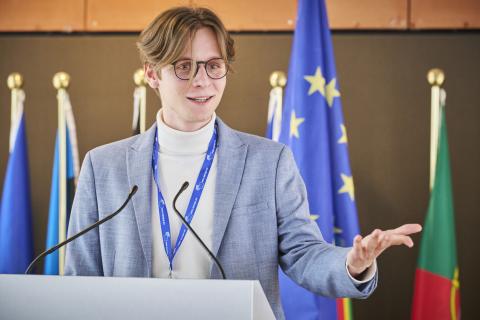
‘We teach students that facts must be verified, but opinions should be respectfully discussed. True critical thinking respects a plurality of views’, says Richard Vaško of the Slovak Debate Association (SDA), winner of the EESC’s Civil Society Prize on combatting polarisation with its Critical Thinking Olympiad. Richard, whose project won the first prize, spoke to us about the Olympiad and why teaching critical thinking is crucial in today’s polarised, disinformation-driven world.
‘We teach students that facts must be verified, but opinions should be respectfully discussed. True critical thinking respects a plurality of views’, says Richard Vaško of the Slovak Debate Association (SDA), winner of the EESC’s Civil Society Prize on combatting polarisation with its Critical Thinking Olympiad. Richard, whose project won the first prize, spoke to us about the Olympiad and why teaching critical thinking is crucial in today’s polarised, disinformation-driven world.
Could you describe one game or round of the Critical Thinking Olympiad? Can you give an example of a task or question?
In the school and regional rounds of the Critical Thinking Olympiad, students take part in one-to-two-hour-long tests, with full access to the internet and online fact-checking tools, in which they solve a series of tasks. The challenges focus on media literacy, detecting manipulation and bias, interpreting data and studies, identifying logical fallacies and formulating their own arguments.
For example, in a recent round, students were asked to write an argument on whether ‘security cameras should be installed in schools to increase safety’ – a timely issue in the Slovak public discourse. Another task required them to analyse a viral TikTok video promoting a conspiracy theory about Taylor Swift and identify typical features of conspiratorial thinking. In a third challenge, they had to decide which of the two videos was AI-generated and which was authentic.
All previous tests are publicly available in Slovak at www.okm.sk.
What are you trying to achieve with the CTO? What prompted you to start the project?
Our goal is to help students at the age when they begin using social media and consuming digital content to develop the skills to navigate this space critically, responsibly and thoughtfully. Through regular feedback after each round and through e-learning courses available for preparation, students gain transferable habits and tools that they can apply in everyday life. Ultimately, we aim to nurture a generation of young people who are informed, resilient against disinformation and capable of leading a fact-based, constructive dialogue.
We launched this project in response to a critical gap in our education system: media literacy and critical thinking are still vastly underrepresented in formal curricula. Over half of Slovak students never learn how to evaluate whether information is trustworthy. Only 16% of Slovak youth regularly verify information from the media. As a result, 56% of the population tends to believe conspiracy theories or outright lies. We wanted to change that by introducing a scalable and impactful action to schools across the country.
Why do you think developing critical thinking is so important in the current context? Do we stand a chance of winning the war against fake news?
Fake news has always existed in some form, but we are now living in an era of unprecedented information overload. With social media as the primary information source for many young people, anyone can easily spread disinformation, misinformation or hate speech. Learning how to filter and navigate this chaotic information landscape has become a crucial life skill.
Nonetheless, we will never fully ‘win’ the war against fake news – it’s a moving target, constantly evolving. But what we can do is equip young people with the tools to better orient themselves in this environment, to ask good questions and to think before they share.
Have you received any feedback about your project? Can you give an example?
We collect detailed feedback after each round, and the responses are overwhelmingly positive. For instance, 93% of teachers whose students participated in the Olympiad said that it helps build their students’ resilience against disinformation and hoaxes. Moreover, our Net Promoter Score – a key metric of user satisfaction – reached +76 in the last round, which is considered excellent.
What advice would you give to other civil society organisations in terms of achieving results with such activities or programmes?
Every country and context are different, and local organisations know best what works for their communities. But the following are a few principles that have worked well for us:
Firstly and most importantly, we don’t tell young people what to think. True critical thinking respects a plurality of views. If students feel that their opinions are being dismissed or dictated to, they disengage. We teach them that facts must be verified, but that opinions should be respectfully discussed.
Second, accessibility and inclusivity are key. Unless we ‘burst the bubble’ and reach beyond elite schools, we won’t have real impact. Our programme is free, fully online, low-barrier and also available in the language of our largest ethnic minority. This year, 53% of participants came from vocational high schools.
Third, thinking about scalability from the beginning and leveraging new technology to achieve it. We use AI to grade open-ended responses, which allows us to maintain a high-quality educational experience without resorting to multiple-choice testing. While the digital age has brought serious challenges, it also provides us with powerful tools to address them.
Richard Vaško has been with the Slovak Debate Association (SDA) since he was 12. He won the Slovak National Debate League in high school and represented Slovakia at the World Schools Debating Championships. He graduated top of his class in Law, Politics and Philosophy at the University of Warwick, UK, and is now studying for an MPhil in Education (Knowledge, Power, Politics) at the University of Cambridge.
Since 2021, Richard has worked at the SDA, where he founded and now coordinates the Critical Thinking Olympiad. He has also worked with the Slovak Ministry of Education’s Strategic Communication team (StratCom) and co-authored teacher training handbooks on media literacy for the National Institute of Education and Youth. He conducts research and organises a multi-ethnic summer school for disadvantaged children with the Mathias Bel Institute, an NGO focused on ethnic minorities and marginalised Roma communities in Slovakia.
In a debate with Michael McGrath, Commissioner for Democracy, Justice, the Rule of Law and Consumer Protection, the EESC warned about ongoing efforts to silence, discredit and weaken those who stand up for democracy, social justice and fundamental rights, and expressed its readiness to join forces with the Commission to protect Europe’s civil society and fight polarisation
In a debate with Michael McGrath, Commissioner for Democracy, Justice, the Rule of Law and Consumer Protection, the EESC warned about ongoing efforts to silence, discredit and weaken those who stand up for democracy, social justice and fundamental rights, and expressed its readiness to join forces with the Commission to protect Europe’s civil society and fight polarisation
The European Economic and Social Committee (EESC) is ready to play a hands-on role in the European Commission’s future Civil Society Strategy, which is being prepared to strengthen democracy and civic space and unite divided communities across the EU. With growing attacks on civil society groups and independent media, the EESC is committed to pushing back and helping protect the foundations of a free and open society.
‘The EESC stands firm in its commitment to defend, protect and empower civil society. As the House of European Civil Society, we will not be passive observers. We will actively push back against efforts to weaken civic space. We will advocate for stronger support, better protection and greater recognition of civil society’s role in strengthening our democracies,’ stressed EESC president Oliver Röpke at the EESC plenary session on 27 March, which hosted a high-level debate on depolarising societies with Commissioner McGrath.
Mr Röpke said that NGOs and grassroots movements were increasingly grappling with democratic backsliding, restrictive legislation, smear campaigns and strategic lawsuits which are intended to silence dissent and are part of a broader effort to discredit and weaken those who advocate for democracy, social justice and fundamental rights.
Referring to the recent accusations against environmental NGOs made by some MEPs, Mr Röpke warned that it was particularly alarming that the attacks were not only coming from outside our institutions: in some cases, they were coming from inside them.
Commissioner McGrath said that the EESC was uniquely placed to make a very valuable contribution to the Commission’s efforts to strengthen democracy and bridge divisions in society. He felt that the best way to tackle polarisation was by empowering Europeans and making them feel represented: ‘If we achieve this, we will succeed in bringing our communities, societies and Union closer together. Whatever we do, we know that the engagement of civil society organisations will continue to be crucial.’
The new EU Civil Society Strategy, announced in the Commission’s 2025 work programme, will support, protect and empower civil society organisations and human rights defenders.
The plenary debate also put forward the key takeaways from the EESC’s Civil Society Week 2025, which took place under the banner Strengthening cohesion and participation in polarised societies. Speakers included Brikena Xhomaqi, Co-chair of the Liaison Group who presented the Week’s key demands, Civil Society Prize winner Richard Vaško of the Slovak Debate Association and youth activist Kristýna Bulvasová, who presented the main recommendations from the EESC’s annual youth event, Your Europe, Your Say! (YEYS).(ll)
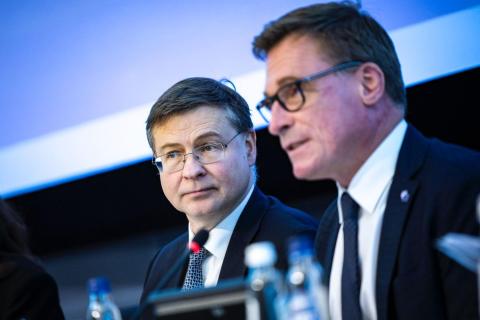
The European Economic and Social Committee (EESC) has called for the European Commission’s 2025 Work Programme – which sets out the EU’s legislative and policy priorities — to focus on economic resilience, social fairness and sustainability. In a plenary debate with Commissioner for Economy and Productivity Valdis Dombrovskis, the EESC — which plays a crucial role in shaping the work programme — reaffirmed its commitment to helping develop an agenda that tackles urgent challenges while building a more inclusive and forward-looking European Union.
The European Economic and Social Committee (EESC) has called for the European Commission’s 2025 Work Programme – which sets out the EU’s legislative and policy priorities — to focus on economic resilience, social fairness and sustainability. In a plenary debate with Commissioner for Economy and Productivity Valdis Dombrovskis, the EESC — which plays a crucial role in shaping the work programme — reaffirmed its commitment to helping develop an agenda that tackles urgent challenges while building a more inclusive and forward-looking European Union.
In December 2024, the EESC presented its contribution to the work programme under the theme ‘Moving Forward Together: A Bolder, Simpler, Faster Union.’ This vision seeks to address the EU’s economic and geopolitical challenges head on. Each year, through extensive consultations and recommendations, the EESC refines the work programme to ensure it best serves European citizens and businesses.
EESC President Oliver Röpke welcomed the strong collaboration with the European Commission. While recognising the Commission’s efforts, he called for a more ambitious and inclusive approach. ‘We remain committed to shaping policies that promote economic stability, social equity and democratic values,’ he said.
MrDombrovskis reaffirmed that the Commission’s work programme for the next five years aims to boost economic competitiveness and security. ‘Taking action to cut red tape is an important element of building this more competitive Europe. Our simplification agenda is about making sure that our rules help achieve — rather than impede — our economic, social, environmental and security goals,’he said.
Key priorities for 2025
Economic growth and competitiveness
The work programme focuses on structural reforms, the new multiannual financial framework (MFF) and stronger capital markets. The EESC advocates a broader approach to economic resilience, tackling sluggish growth, the cost-of-living crisis and rising geopolitical uncertainty.
Smarter regulation, not just less
The EESC supports the Commission’s commitment to reducing administrative burdens but warns that regulatory simplification must not come at the expense of social protection or environmental standards.
Driving innovation and investment
With a strong emphasis on digital networks, AI and quantum technologies, the work programme prioritises the EU’s technological leadership. The EESC urges the Commission to create conditions that prevent capital outflows and foster long-term investment in Europe.
A fairer and greener Europe
Addressing challenges such as skills shortages, food security and sustainable finance, the work programme aims to strengthen social and environmental sustainability. The EESC stresses the importance of policies that promote social cohesion and a just digital transition.
Preparing for enlargement and the future
As the EU gears up for potential enlargement beyond 2028, the work programme outlines plans for financial and political stability. The EESC insists that civil society perspectives must be integrated to ensure policies meet the needs of all Europeans. (tk)
By Antonio García Del Riego, EESC Employers' Group member
Europe finds itself at a critical juncture as it faces historic challenges, from the green transition to war at its doorstep and intensifying global competition. Meeting these challenges will require more than policy declarations. It will require money and the ability to mobilise it, channel it, and multiply it. In short, it requires a strong, competitive and autonomous financial system. Unfortunately, that is not what we have.
By Antonio García Del Riego, EESC Employers' Group member
Europe finds itself at a critical juncture as it faces historic challenges, from the green transition to war at its doorstep and intensifying global competition. Meeting these challenges will require more than policy declarations. It will require money and the ability to mobilise it, channel it, and multiply it. In short, it requires a strong, competitive and autonomous financial system. Unfortunately, that is not what we have.
Finance is the bloodstream of any modern economy. Every new factory, electric vehicle, hospital expansion or clean tech start-up depends on someone taking the risk to fund it. And in Europe, that 'someone' is often a bank. SMEs, which make up 99% of EU companies, depend overwhelmingly on bank credit to grow, invest, and export. Yet, the very institutions that form the core of our financing ecosystem are at risk of being outcompeted and overregulated.
Europe often talks about 'strategic autonomy' in energy, defence, and digital infrastructure, but rarely is financial autonomy part of the conversation. It should be.
Today, over 60% of investment banking in Europe is handled by just four American banks. The upcoming Basel IV rules will be applied in full in the EU, but not in the US, UK, or Japan. This asymmetry puts European banks at a competitive disadvantage. If we want European banks to finance the twin transitions and support strategic sectors, they must compete on equal footing.
The Capital Markets Union must move beyond rhetoric and become a true single market for savings and investments. To get there, we need smart, proportionate, and enabling regulation that protects stability and consumers, but also unleashes growth and competitiveness. This means:
proportionality;
technology-neutrality; and
outcome-based rules.
Europe cannot afford to be naïve. In a world shaped increasingly by power politics and economic blocs, financial strength is sovereignty. The United States and China understand this. So should we.
Minutes of the 226th meeting of the REX Section of 10 March 2025
In its own-initiative opinion, the European Economic and Social Committee (EESC) stresses that phasing out fossil fuel subsidies (FFSs) is a necessary step in Europe's green transition. The goal is to reduce the environmental impact of the energy system while maintaining competitiveness and easing the cost-of-living crisis. However, the process must be fair, realistic, and adapted to the specific needs of sectors such as agriculture.