underlines that social media platforms and AI algorithms decisively shape public debate and the information seen by Europeans;
emphasises that the information space in Central and Eastern Europe (CEE) is particularly vulnerable: disinformation is tailored to local languages and content, and takes advantage of the dominance of Russian-language content on the Internet due to algorithmic choices;
believes that, while instruments like the Digital Services Act, the AI Act, and the European Media Freedom Act aim to enhance transparency and accountability, enforcement is uneven and gaps remain. Linguistic and narrative biases – such as the continued use of the term ‘post-Soviet countries’ – further distort diverse identities and histories;
supports the development of frameworks ensuring visibility for high-quality, locally rooted content from Eastern Europe;
advocates stronger media literacy, algorithmic accountability, and cross-border cooperation to counter disinformation and uphold democratic values.
History loves its 'firsts' but breaking barriers means standing alone. Every woman in power knows this, and lately it's been getting even harder.
Kamala Harris has spoken again and again about walking into rooms where no one looked like her. That is the essence of being 'the first'. Yes, it's a triumph – a crack in the glass ceiling – but it is also an exhausting act of endurance. Every man who came before her in the White House had dozens of look-alikes in the history books. Harris did not. In the list of her predecessors, we find five Johns, three Thomases and three Charleses, but not one woman.
To be the first is to be conspicuous. To have no blueprint. To blaze a trail while constantly explaining yourself and defending your right to even be there.
Men in suits are rarely asked why they want power. 19th-century historian and unabashed misogynist Heinrich von Treitschke declared that 'authority is male. That goes without saying,' and this way of thinking lingers. As historian Mary Beard notes, the default image of power remains male. As Pierre Bourdieu put it, male dominance endures precisely because it never has to explain itself.
For women, the price of entry is steeper. Along with the grit and talent needed for any extraordinary career, 'firsts' endure relentless scrutiny of their very presence. The bar is higher, the patience thinner, the margin for error smaller. Faith Whittlesey's old line still rings true: 'Ginger Rogers did everything Fred Astaire did, but she did it backwards and in high heels.'
For decades, women's politics was patronised, treated as a niche of 'soft issues'. However, it was women such as Elisabeth Selbert, Käte Strobel and Simone Veil who planted the seeds of modern democracy: gender equality, public health, inclusive marriage laws and bodily autonomy. Far from marginal, these policies shaped the societies we live in. Still, even in the 1990s, German Chancellor Gerhard Schröder could wave off the Ministry for Family Affairs as 'all that fuss' ('Gedöns').
The common argument against gender quotas is that 'lawmakers represent everyone'. But women are not a 'special interest', they are half the population. And history shows that when women hold office, there are advances in women's rights – maternity protections, gender equality clauses, legalised abortion, criminalisation of marital rape. The record is clear.
Christine Lagarde once quipped: 'If it had been the Lehman Sisters, not the Lehman Brothers, the world might look different today.' She wasn't arguing that women are better, but that diversity is. Different voices disrupt groupthink. Excluded from male networks, women built new strategies – and with them, new possibilities.
That's why 'firsts' still matter. We still have not seen a female German Bundespräsidentin, no female US president, no female French president.
And right now, it feels as though women's way of doing politics is being shoved aside by a return to broad-shouldered bravado – embodied, not least, by the new occupant of the White House. In the fall of 2024, Kamala Harris – America's first female vice-president – ran against Donald Trump to become its first female president. She lost.
The question now is not just what comes next, but who. Harris's mother put it best: 'Kamala, you may be the first to do many things, make sure you're not the last.'
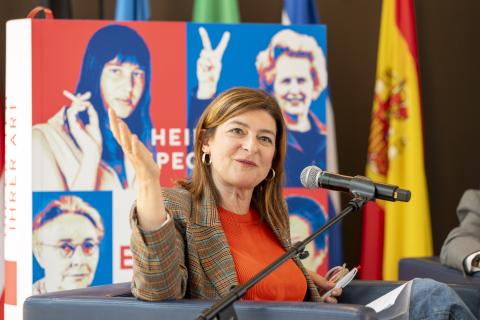
Our surprise guest is German author Dr Heike Specht, who this summer presented her book, The First Ones of Their Kind, at the EESC Women's Forum. The book tells the stories of women who were the first to step into high political office – and whose bravery and vision opened doors for generations to come. For EESC Info, Dr Specht reflects on what it's like to be a 'first' – as a woman in politics.
Our surprise guest is German author Dr Heike Specht, who this summer presented her book, The First Ones of Their Kind, at the EESC Women's Forum. The book tells the stories of women who were the first to step into high political office – and whose bravery and vision opened doors for generations to come. For EESC Info, Dr Specht reflects on what it's like to be a 'first' – as a woman in politics.
Heike Spechtstudied history and literature in Munich. She earned her doctorate researching the family of Lion Feuchtwanger, the famous German Jewish author persecuted under the Nazi regime. She worked for several years in publishing, as an editor. Author of several books, she now lives in Zurich and works as a freelance writer. In October 2025, her first novel 'Die Frau der Stunde' (The Woman of the Hour) will be released. You can read more about her work on her website.
Start-ups and scale-ups are often described as the beating heart of Europe’s innovation economy. They are the restless challengers, the ventures that turn fresh scientific discoveries or bold ideas into products and services with the potential to transform industries. From Parisian AI labs to Stockholm’s green technology pioneers, these young firms symbolise Europe’s capacity to compete globally, and strengthen its resilience and strategic autonomy. When they succeed, they create jobs, attract investment, and inject dynamism into sectors.
Start-ups and scale-ups are often described as the beating heart of Europe’s innovation economy. They are the restless challengers, the ventures that turn fresh scientific discoveries or bold ideas into products and services with the potential to transform industries. From Parisian AI labs to Stockholm’s green technology pioneers, these young firms symbolise Europe’s capacity to compete globally, and strengthen its resilience and strategic autonomy. When they succeed, they create jobs, attract investment, and inject dynamism into sectors.
Yet their role in the EU economy remains precarious. Unlike in the United States or parts of Asia, too many European start-ups never fully graduate into global champions. Instead, they fall into what we entrepreneurs call the 'valley of death' – that fragile stage between early innovation and market success. If start-ups are vital to the EU economy as engines of innovation, their ability to scale up determines whether Europe reaps the rewards at home or loses them abroad.
For start-ups and scale-ups to fulfil their potential, a number of conditions for growth must be met. The first is a regulatory landscape that works with, not against, entrepreneurs. Right now, complexity and administrative burdens are cited as the number one obstacle by European founders. Excessive paperwork, payment delays, and fragmented rules across Member States drain time and energy that should be devoted to innovation. Simplifying regulations and truly harmonising the single market would allow Europe’s start-ups to act on a continental rather than merely national stage.
The second condition is access to funding that grows with ambition. Many European ventures secure initial seed capital, but financing often dries up during the critical scaling phase. As a result, too many founders turn to foreign investors or relocate entirely. If Europe wants its brightest ideas to flourish locally, it must unlock capital at scale – through dedicated EU investment vehicles, deeper capital market integration, and tax systems that encourage long-term risk-taking. Without this financial backbone, the EU risks becoming a talent incubator for ecosystems elsewhere.
A third requirement is talent. Europe’s start-ups face an acute shortage of skilled workers, whether in advanced tech fields, entrepreneurship, or research. Visa hurdles and slow procedures for highly skilled workers from outside the EU only add to the challenge. To compete globally, Europe must both attract international experts and invest in its own long-term pipeline – through stronger STEM education, entrepreneurial training, and flexible labour markets that reward mobility and innovation. Put simply, ideas are abundant, but without people to build them, they remain unrealised.
Finally, start-ups need access to cutting-edge infrastructure and markets. World-class research labs, supercomputers, and digital networks are no longer luxuries but prerequisites in the race for technological leadership. Equally, Europe’s internal market is still failing to live up to its promise: 70% of SMEs operate only within their home country, with only a quarter exporting to another EU state. Turning the potential of the single market into concrete market power would dramatically expand opportunities for scaling businesses.
If Europe is serious about making start-ups and scale-ups the drivers of prosperity, it must go beyond celebrating innovation and start building the conditions that allow it to grow. There have been encouraging first steps, such as the EU’s start-up and scale-up strategy and scoreboard, that suggest momentum – but they must translate into lived reality for founders.
Europe has everything it needs to lead – what it lacks is the political will. The time for half-measures is over. If Europe dares to match the ambition of its entrepreneurs, it can turn today’s start-ups into tomorrow’s global champions, shaping not only markets but the future itself.