The opinion identifies poverty as a multidimensional issue that affects housing, education, healthcare, access to energy and digital inclusion. Tackling this complexity requires coordination across the local, national, European and international levels. The social economy is a vital yet underused driver of change. Rooted in solidarity and democratic governance, social economy organisations foster inclusive ecosystems, social innovation and support for vulnerable groups. However, to unlock its potential we need to overcome barriers such as insufficient legal recognition, fragmented funding and limited institutional support. The absence of an integrated European strategy has further undermined collective anti-poverty efforts.
How could these issues be addressed? What are the three main recommendations?
To address these challenges, the opinion advocates a tripartite approach. Locally, social economy organisations must deliver tailored solutions through partnerships, ambassador roles and grassroots innovation. Nationally, governments should fulfil their duty to guarantee fundamental rights by creating supportive legal and fiscal frameworks. At European level, a unified strategy must integrate the social economy into broader transitions such as the social, digital and climate agendas. This requires both robust financial support that optimises the EU cohesion and resilience funds, and a European social economy fund. Aligning with global frameworks such as the UN Sustainable Development Goals (SDGs), global and thematic resolutions and OECD recommendations will amplify the social economy’s systemic impact and enable transformative change.
How can the new EU Anti-Poverty Strategy advance the fight against poverty, social exclusion and discrimination?
The EU Anti-Poverty Strategy offers a pivotal opportunity to address global objectives such as SDG 1 (End poverty in all its forms everywhere) and SDG 10 (Reduce inequality within and among countries), while preparing a vision for a post-2025 Europe centred on well-being. The policies must tackle economic, social and environmental disparities, and at the same time prioritise local initiatives, as communities are best placed to deliver effective solutions. National governments must ensure universal access to essential services such as housing, healthcare and education. The EU should lead by fostering cross-border collaboration and redefining prosperity through metrics of well-being and equity over GDP. Institutionalising the social economy as a cornerstone of this transition will ensure inclusive and just outcomes for all.
Piotr Sadowski, a committed civil society leader and an advocate for social justice, has been elected as the new co-chair of the Liaison Group of the European Economic and Social Committee (EESC). He will serve alongside the EESC President, jointly steering the Group’s efforts to promote civil dialogue and participatory democracy across the European Union.
Poverty has become an undeniable reality in Europe, with over 1 in 5 households facing the risk of poverty or social exclusion. The EU's current policy agenda, driven by deregulation and competitiveness goals, starkly contrasts with citizens' pressing concerns.
Poverty has become an undeniable reality in Europe, with over 1 in 5 households facing the risk of poverty or social exclusion. The EU's current policy agenda, driven by deregulation and competitiveness goals, starkly contrasts with citizens' pressing concerns. A recent Eurobarometer survey underscores this disconnect, revealing that many working people are finding it increasingly difficult to afford basic necessities such as housing, heating, and food due to soaring living costs.
The quality of employment is a critical factor in determining people's living conditions. Having a job does not guarantee protection against poverty. In 2023, 8.3% of the EU-27 working-age population lived at risk of poverty, with incomes below the poverty threshold. Certain groups are disproportionately affected, such as workers with precarious contracts, and young people who are often trapped in low-paid jobs and vulnerable to exploitative practises.
The prevalence of in-work poverty highlights the need for better job quality, fair wages, and stronger social protections to ensure that employment provides a pathway out of poverty. Europe needs a proactive social agenda pushing for legislative initiatives, investments, and action programmes necessary to ensure quality jobs across all sectors and regions. This includes the implementation of key existing legislation such as the Minimum Wage Directive, which, if properly applied, will not only ensure that basic rates of pay meet the cost of living but also that more workers benefit from genuinely fair wages negotiated through collective bargaining.
The European Pillar of Social Rights (EPSR), established in 2017, seeks to uphold fairness, inclusivity, and equal opportunities across Europe. Effective implementation of its action plan is crucial for addressing poverty and enhancing living standards. To assess progress, the EESC's Workers' Group commissioned a study evaluating the state of implementation of the EPSR and its Action Plan in 2024, focusing on directives central to the EPSR framework, such as the Transparent and Predictable Working Conditions Directive, the Work-Life Balance Directive, the Adequate Minimum Wages Directive, and the Gender Balance on Company Boards Directive. Its results show that some progress has been achieved, but much work remains ahead of us.
By Sandra Parthie, president of the EESC Employers' Group
Reducing poverty in Europe begins with investing directly in people’s potential. Today, over 94 million Europeans remain at risk of poverty or social exclusion. Children and young adults are particularly vulnerable, and their marginalisation represents not only a human tragedy but also a waste of talent.
By Sandra Parthie, president of the EESC Employers' Group
Reducing poverty in Europe begins with investing directly in people’s potential. Today, over 94 million Europeans — more than 21% of the population — remain at risk of poverty or social exclusion. Children and young adults are particularly vulnerable, and their marginalisation represents not only a human tragedy but also a waste of talent.
Indeed, fighting poverty cannot be disconnected from the engine that drives opportunity — economic growth. Anti-poverty policies must go hand in hand with strategies that foster competitiveness. A favourable business environment — one that encourages investment, job creation, and entrepreneurship — is the surest path to sustainable poverty reduction.
Employers are calling for measures that open up employment pathways and expand opportunities, rather than policies that rely solely on redistribution or short-term assistance. Tackling poverty requires creating conditions for people to participate in and benefit from the labour market.
Empowering entrepreneurship
Reducing barriers to entrepreneurship is vital for our economies. Entrepreneurs drive innovation, create jobs, improve household incomes, and frequently provide affordable goods and services in underserved communities. At the same time, however, their interests are often underrepresented and they face structural hurdles such as limited access to finance, excessive bureaucracy, and inadequate entrepreneurial education. This is especially true for young entrepreneurs, whose entrepreneurial ambitions are not sufficiently supported. Removing these barriers must be a priority if Europe is serious about upward mobility and long-term competitiveness.
The single market as a social tool
A functioning EU single market is one of the most powerful levers against poverty. Fully integrating the internal market could unlock over EUR 2.8 trillion in additional GDP by 2030. According to the IMF, even partial removal of internal barriers could lift EU GDP by around 7% without requiring additional budgetary resources. These gains would support both innovating and manufacturing regions, strengthening cohesion across the Union.
This is a transformative opportunity: poverty is best overcome not with ever-increasing subsidies, but by unlocking growth, innovation, and an entrepreneurial spirit within Europe’s social market economy.
Reducing poverty by empowering people to work, innovate, and succeed is both a moral imperative and an economic necessity.
The EESC has adopted an opinion on the European Commission’s proposals to amend the EU Securitisation Regulation and prudential rules for banks. While supporting efforts to revitalise the securitisation market and channel more finance into the real economy, the Committee warns against repeating past mistakes.
The EESC has adopted an opinion on the European Commission’s proposals to amend the EU Securitisation Regulation and prudential rules for banks. While supporting efforts to revitalise the securitisation market and channel more finance into the real economy, the Committee warns against repeating past mistakes and stresses the need for strong safeguards to protect households, small businesses and financial stability.
Securitisation can help free up bank capital to support Europe’s green, digital and social transitions. The EESC also backs greater transparency, including standardised ESG reporting in securitisation templates. However, it cautions that freed-up capital must be monitored to ensure it benefits the real economy rather than being returned to shareholders.
The Committee underlines that investor protection, prudential standards and supervision must not be weakened. It opposes loopholes or automatic exemptions for publicly guaranteed tranches, which could expose taxpayers to risk, and calls for consistent EU-level supervision, full transparency across transactions and closer cooperation between supervisors and tax authorities.
The EESC concludes that securitisation can contribute to Europe’s investment needs only if it remains transparent, properly regulated and aligned with the EU’s broader economic and social objectives. (tk)
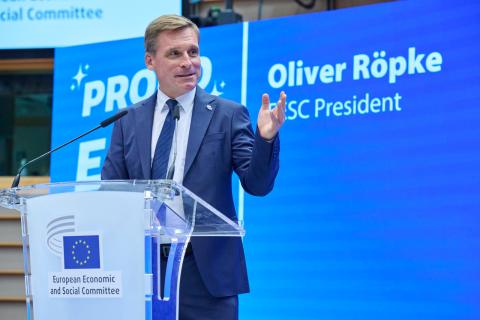
At its September plenary in Brussels, the EESC brought together EU leaders, civil society, youth representatives and international partners to mark the close of President Oliver Röpke’s 2023–2025 term of office.
At its September plenary in Brussels, the EESC brought together EU leaders, civil society, youth representatives and international partners to mark the close of President Oliver Röpke’s 2023–2025 term of office. The ceremony, held in the European Parliament hemicycle, celebrated recent achievements while reflecting on the challenges shaping Europe’s future.
European Commissioner Maroš Šefčovič underlined the Committee’s importance as the 'house of European civil society' and emphasised its role in European policymaking: 'You advocate for a competitive Europe based on the EU’s social model and supported by the green transition, showing how civil society helps bring all these elements together.’
Speakers at the ceremony warned of geopolitical uncertainty, polarisation and extremism, but also highlighted the EESC’s ability to unite voices in defence of democracy.
Youth participation featured prominently, with the Youth Test cited as a concrete achievement. European Youth Forum President Răres Voicu stressed the need to counter extremism, while youth delegates called for stronger ownership of the democratic process.
Enlargement was another key theme, with Albanian Prime Minister Edi Rama thanking the Committee for ensuring candidate countries felt like equals. ‘Europe’s strength lies in its people and in dialogue, not in arguing with its gods alone. Under your presidency, you converted me into a believer in social dialogue, and you ensured that our voices from the Western Balkans echoed here and were not just whispers. The EESC is the place where we Albanians, so often treated as second-class citizens of Europe, felt like equals. Europe thrives as a whole, and only as a whole,’ Mr Rama said.
Tributes were paid to President Röpke’s leadership on youth and enlargement, and to long-serving members. Concluding, he thanked EESC staff for their dedication and urged the Committee to continue reinforcing democracy, supporting enlargement and placing civil society at the heart of the European project. (tk)
With Russia’s war of aggression against Ukraine and mounting climate risks, Europe’s preparedness has shot to the top of EU and national agendas.
The European Economic and Social Committee (EESC) has welcomed the European Commission’s new Preparedness Union Strategy, calling it a long-overdue shift to an 'all-hazards, whole-of-government and whole-of-society' approach to crises ranging from wildfires and floods to cyberattacks and full-scale armed aggression. But the EESC warned that the plan must come with clear, long-term financing and a real role for organised civil society if it is to succeed.
In its opinion on the Strategy, adopted at its September plenary session following a debate with civil defence and humanitarian experts, the EESC stressed that solidarity, public trust and social unity are just as vital as new rules and tools.
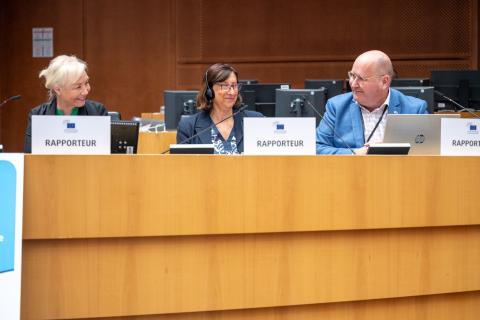
'Preparing for crises means strengthening the ability of our democracies to face new global challenges without compromising their fundamental values. Only a Europe firmly anchored in peace, freedom and democratic participation can ensure lasting resilience and citizens’ trust,' stressed the rapporteurs of the opinion, Tomas Arvidsson, Giulia Barbucci and Ariane Rodert.
Jessika Bohr from the Swedish Ministry of Defence said: 'We find ourselves in a new security reality where the security situation in Europe is dire. The threats we face are complex, cross border and increasingly antagonistic. In this context, preparedness is not optional. It is essential.'
Magali Mourlon from the Red Cross EU Office, warned: 'Societal preparedness needs to take into account the fact that society is not homogeneous, and we must leave no one behind.'
'Societies are not made resilient by regulations alone. They are resilient when citizens, volunteers, youth workers, civil society organisations and communities are empowered and recognised as part of Europe's preparedness fabric,' said Piotr Sadowski, Secretary-General of Volonteurope.
In the opinion, the EESC backed 'preparedness by design' across EU policies, meaning that preparedness must be built into the fabric of laws. At the same time, the EU and national governments must also keep investing in social cohesion and progress, which are vital to prevent and resolve conflicts. The EESC also asked the Commission to clarify who does what at EU, national and local levels and to stick to a firm rollout timetable.
On financing, the EESC flagged a gap: the Strategy asks a lot of Member States without spelling out what funding is available. Stable, long-term financing is essential without undermining key EU policies such as agriculture, cohesion and the Solidarity Fund. (ll)
The EESC adopted an opinion on the New Pact for the Mediterranean, a month ahead of its official launch by the European Commission. The Committee calls for bottom-up processes ensuring that the Pact has a direct, positive impact on all people, especially young people.
The European Economic and Social Committee (EESC) adopted an opinion on the New Pact for the Mediterranean, a month ahead of its official launch by the European Commission. The Committee calls for bottom-up processes ensuring that the Pact has a direct, positive impact on all people, especially young people.
The opinion was adopted at the EESC September plenary session, after the debate on the state of play of the new pact for the region, with the Director of the Commission’s Directorate-General for the Middle East, North Africa and the Gulf, Stefano Sannino.
Mr Sannino explained that the New Pact is based on three pillars: people; economic cooperation and security; resilience and migration management.
EESC member and rapporteur for the opinion, Thomas Wagnsonner, said: ‘We regard the New Pact as a development model with joint partnerships on equal footing and business opportunities that should lead to sustainable economic growth and innovation with high-quality jobs, especially for young people and women, in inclusive and socially stable societies in the Mediterranean region’.
Similarly, Lidija Pavić-Rogošić, EESC member and co-rapporteur, said: ‘For real impact, action is needed, including civic co-authorship, civic engagement and monitoring carried out with communities – where prosperity is human-centred, accountability is collective and solidarity is lived, not just words."
Young people at the heart of the New Pact
The Pact seeks to focus on people and develop a people-centred agenda so that it can bring tangible results for societies. Notably, almost half the population (47%) in the region are under 24 years old.
Pablo Pastor from the Anna Lindh Foundation and President of the Mediterranean Youth Council, a guest speaker at the EESC plenary debate, said: ‘We cannot afford to make the same mistakes as in the last thirty years. We cannot adopt a paternalistic view of the Mediterranean. We cannot sign agreements that are not respected’.
The Pact envisages the establishment of a Mediterranean university. Through education, training and upskilling, more and better working opportunities can be offered to the region's young people, creating the conditions for a prosperous future. (mt)
At its September plenary session, the EESC adopted a resolution on Defending the EU’s values and strengthening its future in the new geopolitical order, calling for a secure, resilient and strategically autonomous EU.
At its September plenary session, the European Economic and Social Committee (EESC) adopted a resolution on Defending the EU’s values and strengthening its future in the new geopolitical order, calling for a secure, resilient and strategically autonomous EU. The text highlights the critical momentum for Europe’s strategic response to the current geopolitical challenges, underlining that civil society must keep its central role.
While presenting the resolution during the EESC plenary, EESC members and rapporteurs Elena-Alexandra Calistru, Antje Gerstein, Luca Jahier, Winand Quaedvlieg, Sophia Reisecker and Peter Schmidt raised the need to keep fighting for democracy, addressing the present challenges horizontally by involving civil society.
Main messages delivered in the resolution
Core values as pillars of strengths: The EU must continue its founding mission as a global anchor of peace, democracy and the rule of law. The appeal to defend democracy goes out to the EU institutions, governments and political parties as well as to companies, trade unions and civil society at large.
Balancing economic competitiveness and social progress: While the EU aims to improve the global competitiveness of its economy and provide regulatory simplicity and clarity, it should not leave behind social cohesion and social dialogue, ensuring that neither pure profit nor social expenditure can be the sole objective.
Commitment to multilateralism and inclusive dialogue: The EU’s power is built on cooperation and compromises, reflecting different interests. At global level, the EU needs to be part of multilateralism, while encouraging active participation from all stakeholders to maintain social cohesion and political balance (mt)