The starting point of the EESC opinion on the 2026 European Semester – Autumn Package, unanimously adopted by the EESC's Section for Economic and Monetary Union and Economic and Social Cohesion on 5 February, is that Europe's main liability is its chronic lack of investment. This gap undermines productivity, innovation and, ultimately, the continent's strategic sovereignty.
The starting point of the EESC opinion on the 2026 European Semester – Autumn Package, unanimously adopted by the EESC's Section for Economic and Monetary Union and Economic and Social Cohesion on 5 February, is that Europe's main liability is its chronic lack of investment. This gap undermines productivity, innovation and, ultimately, the continent's strategic sovereignty.
While acting with appropriate foresight is urgent, the EESC regrets that, for the second consecutive year, the Annual Sustainable Growth Survey (ASGS) is absent from the package, despite being an integrated and forward-looking analytical tool that the EU desperately needs.
In the opinion, which contains 18 recommendations on the 2026 European Semester Autumn Package, the EESC outlines a united European response to multiple crises, from geopolitical instability and the climate crisis to Europe's increasingly dramatic technological and digital gap, as well as the demographic challenges.
Our 18 recommendations can be condensed into five key political priorities that must anchor an ambitious reset of EU economic governance:
Large-scale investments ─ Europe needs a common fiscal capacity, supported by targeted European debt issuance, and permanent macroeconomic stabilisation instruments modelled on the success of the SURE instrument. Without a significant leap in investments in infrastructure, technologies, welfare (including housing policies) and human capital, Europe will not be able to compete.
Integrated capital markets ─ Financial fragmentation is a political and economic obstacle. The Committee proposes a radical solution: it calls on the Commission to assess whether a regulatory framework like the US National Securities Markets Improvement Act (NSMIA) of 1996 could be a model for simplifying cross-border access, reducing regulatory fragmentation and, finally, creating a true single European capital market, instead of 27 siloed systems. Only in this way can European savings finance European investments.
Strengthened economic and social governance ─ The EU's response must combine competitiveness and social equity. The Macroeconomic Imbalance Procedure (MIP) and the debt sustainability analysis (DSA) methodology must be reviewed, the Social Scoreboard strengthened and well-being indicators introduced, as proposed by the Joint Research Centre. Governance structures must treat social convergence and investment on an equal footing with fiscal surveillance. Regulatory simplification must not overlook the benefits of the European social model and must avoid jeopardising 'green' investments, which are so crucial for collective competitiveness and resilience.
Human capital as strategic infrastructure ─ The EESC views the new recommendation included in the Commission's package very positively because training, skills and mutual recognition of qualifications are not optional – they are a strategic necessity. However, it is time to move from words to action, providing clear binding investment guidance to Member States in next spring's country-specific recommendations.
European cooperation on defence ─ Strengthening autonomous defensive capability is essential, but uncoordinated national spending risks inefficiency, dependence on non-EU suppliers and, ultimately, more unsustainable debt. The EESC calls on the Commission to strengthen conditionalities for collaborative procurement, prioritise truly European projects, and anchor defence investments within a cohesive EU governance strategy, beyond the temporary escape clause for a few Member States.
Finally, the Committee underscores once again the need for a more democratic European Semester: social partners and civil society must not be passive observers, but active architects of the strategic reforms Europe needs. They must truly sit at the table ─ not be on the menu.
The EESC declares itself ready to fully support a European Semester worthy of our common ambitions – competitiveness, resilience and social and territorial cohesion – for a European sovereign sustainability.
What are the EESC’s recommendations on the 2026 European Semester – Autumn Package? Luca Jahier, rapporteur of the EESC opinion on the topic, argues that the European Semester is a turning point for completely resetting the EU’s economic strategy so that the Union can adequately respond to emerging political and economic realities. Speaking to EESC Info, he outlined the Committee’s proposals for an ambitious Semester aimed at achieving European sovereign stability.
What are the EESC’s recommendations on the 2026 European Semester – Autumn Package? Luca Jahier, rapporteur of the EESC opinion on the topic, argues that the European Semester is a turning point for completely resetting the EU’s economic strategy so that the Union can adequately respond to emerging political and economic realities. Speaking to EESC Info, he outlined the Committee’s proposals for an ambitious Semester aimed at achieving European sovereign stability.
International and run by volunteers, Rubikus.HelpUA has been helping to evacuate people from Ukraine's war zones to European countries since the earliest days of Russia's full-scale invasion. Older people, persons with disabilities and families with children are at the heart of its work. Each day, around 70 families ask for their help. The Rubikus team explains how this lifeline operates in practice.
International and run by volunteers, Rubikus.HelpUA has been helping to evacuate people from Ukraine's war zones to European countries since the earliest days of Russia's full-scale invasion. Older people, persons with disabilities and families with children are at the heart of its work. Each day, around 70 families ask for their help. The Rubikus team explains how this lifeline operates in practice.
Can you explain how the process works for a Ukrainian family seeking assistance from Rubikus.helpUA, from initial contact to reaching their final destination?
Rubikus has supported Ukrainian families since the first days of the full-scale Russian invasion. To date, we have helped evacuate more than 60 000 people, including refugees from occupied territories.
The process consists of a few simple steps. A family fills out a short form on our website (providing basic contact details, approximate travel dates and a preferred destination country, if they have one). The request goes into our system. An operator reviews the information and checks that the necessary documents are in order. The case is then handed over to a coordinator, who takes responsibility for the journey from that point until the family reaches their final destination.
If people are leaving Ukraine for the first time since the start of the full-scale war and cannot afford travel costs, Rubikus may cover their tickets and, if needed, accommodation on the journey. We prioritise support for vulnerable groups, including families with children, older adults, people with disabilities and people with medical needs or pets.
How does your team support families throughout their journey, particularly vulnerable individuals?
Twice a month, Rubikus runs a free evacuation bus from Lviv to Warsaw for vulnerable groups, including families with small children, older people and families travelling with pets. Many commercial carriers will not take people with disabilities or animals, which makes this route inaccessible to many families. Our bus delivers people directly to accommodation in Warsaw, which Rubikus covers.
In addition, we operate a 'medical' bus designed for people with severe health limitations. It has 44 regular seats and seven lay-down beds and picks up passengers in several cities across Ukraine, including Odesa, Dnipro, Kharkiv, Kyiv and Lutsk, so people with serious conditions do not need to travel to Lviv first. This service is intended for those who cannot endure long journeys on commercial transport, including adults and children with disabilities and patients in advanced stages of illness.
In February 2026, one of our medical evacuations took place during severe winter conditions and ongoing ballistic attacks on Kyiv, which made the operation particularly challenging but also critically necessary. The launch of the 'medical' bus was supported by a dedicated fundraising campaign, and we aim to run these medical evacuations monthly, as they are often a matter of survival.
How do volunteers – both on the ground and remotely – coordinate to ensure families are supported effectively, and what roles are critical for the success of Rubikus.helpUA?
Each family is assigned a coordinator, who plans the evacuation route according to the family’s specific needs and limitations. Many refugees are travelling abroad for the first time and may never have used long-distance transport before. Coordinators provide step-by-step guidance throughout the journey, help families navigate transfers and border crossings and offer practical and emotional support along the way.
Behind each case, a broader volunteer team supports the process. Some volunteers handle ticket purchases and transit bookings, others organise bus charters and accommodation and on-the-ground teams assist families at key points along the route – helping them board trains, find refugee centres, obtain essentials such as baby food or access urgent medical help. This coordination helps families navigate unfamiliar systems with support at all stages of the journey.
How do you coordinate evacuations across multiple European countries, and how does your team address issues related to local policies, paperwork or language barriers?
Rubikus works with dedicated local experts for each country to which refugees are relocated. These experts continuously monitor changes in policies and requirements related to temporary protection and residency and advise the team on practical conditions in each destination country. This allows us to plan routes and placements that are realistic, lawful and sustainable for each family.
Our international team also maintains two public information resources: varenik.help, which helps compare living conditions and support systems across different countries, and the Rubikus.HelpUA Wiki page, which provides structured, country-specific guidance for refugees and those supporting them.
Looking ahead, what are Rubikus.helpUA’s plans for the future development of the project?
We aim to continue responding to the refugee situation as effectively as possible, within the limits of our resources, which come entirely from private donations. Our focus remains evacuating people from the most difficult and dangerous regions of Ukraine, including occupied territories, to countries where they can access safety and long-term support.
We plan to keep operating our evacuation buses on a regular basis, expand our network of partner organisations and continue to raise awareness about the ongoing challenges faced by Ukrainian families.
Rubikus.HelpUA is a non-profit volunteer project that helps people in Ukraine (including those in Russian-occupied territories) to evacuate to safety in European countries. It started operating in February 2022, immediately after the beginning of the Russian invasion of Ukraine, and has since helped evacuate over 60 000 people.
Debates at the European Economic and Social Committee (EESC) plenary revealed strong alignment between the Cyprus Presidency’s five priorities and the Committee’s own work programme: security and preparedness, competitiveness, openness to the world, a Union of values that leaves no one behind and a robust long-term EU budget.
Debates at the European Economic and Social Committee (EESC) plenary revealed strong alignment between the Cyprus Presidency’s five priorities and the Committee’s own work programme: security and preparedness, competitiveness, openness to the world, a Union of values that leaves no one behind and a robust long-term EU budget.
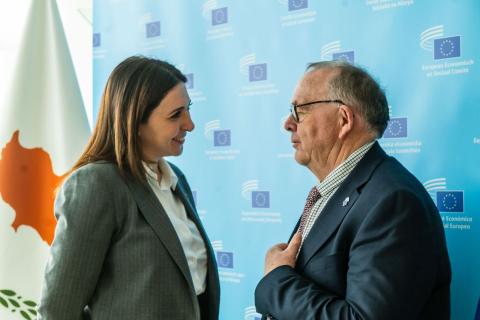
Following a presentation by Marilena Raouna, Cyprus’s Deputy Minister for European Affairs, EESC members discussed the presidency’s priorities under the motto An Autonomous Union. Open to the World. The Cyprus Presidency invited the EESC to contribute expertise through 14 exploratory opinions, providing recommendations on EU legislative proposals and strategic issues while reflecting the views of social partners and organised civil society.
The Committee will focus on tackling energy poverty through affordable and sustainable housing, boosting Europe’s water resilience via the Water Resilience Strategy and promoting social inclusion and independent living for people with disabilities. The EESC provides valuable policy experience that reflects civil society’s perspectives.
EESC President Séamus Boland noted that ‘The priorities of the Cyprus Presidency resonate closely with my programme, which focuses on opportunity, security and resilience, with the fight against poverty at its core.’ Ms Raouna underscored early cooperation with organised civil society: ‘Employers, workers and civil society organisations must remain at the heart of EU policymaking.’
Participants highlighted the challenging context of geopolitical uncertainty, climate pressures and rapid technological change. The presidency reaffirmed its commitment to comprehensive security, including water security and resilience against hybrid threats. The EESC’s EU Blue Deal initiative complements this by promoting sustainable water management.
The presidency aims to strengthen the single market, reduce administrative burdens, support SMEs and advance the green and digital transitions. Affordable energy, modern infrastructure and strong interconnections were highlighted as essential for strategic autonomy.
Affordable housing was also identified as a pressing challenge, alongside gender equality, disability rights and social inclusion. Cyprus also aims to advance discussions on the 2028-2034 multiannual financial framework. The EESC warns that underfunding would undermine cohesion, agriculture and social investment, calling for a stronger budget that ensures no region is left behind. (tk/fb)