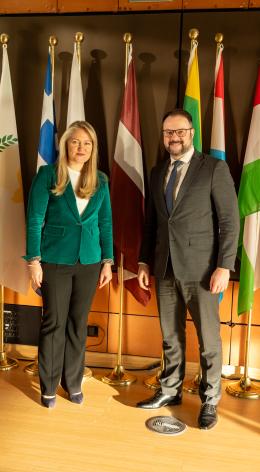
In a debate hosted in Brussels by the European Economic and Social Committee (EESC), high-level speakers underlined the strategic importance of making comprehensive use of transport to step up the European Union’s ability to respond to present and future crises.
Praised as a historic milestone upon its adoption in May 2024, the EU’s new Pact on Migration and Asylum has yet to prove its worth. But the challenges awaiting it in 2025 will not be easy: in an exceptionally uncertain geopolitical environment, the Pact’s inherent complexity and the tight deadline for its implementation will require caution and lots of balancing - an analysis by Camille Le Coz of the Migration Policy Institute Europe (MPI Europe)
Praised as a historic milestone upon its adoption in May 2024, the EU’s new Pact on Migration and Asylum has yet to prove its worth. But the challenges awaiting it in 2025 will not be easy: in an exceptionally uncertain geopolitical environment, the Pact’s inherent complexity and the tight deadline for its implementation will require caution and lots of balancing - an analysis by Camille Le Coz of the Migration Policy Institute Europe (MPI Europe)
By Camille Le Coz
The start of 2025 brings pressing questions about the future of migration policies in the European Union (EU). The new European Commission has set a clear course with its implementation plan for the new Pact on Migration and Asylum, yet shifting circumstances threaten to divert political focus and resources elsewhere. Germany’s upcoming elections have added a layer of uncertainty, alongside the fallout from the Assad regime’s collapse and the unpredictable trajectory of the war in Ukraine. Discussions around externalisation models continue, but these efforts often run as isolated political manoeuvres rather than as part of a cohesive European strategy. Meanwhile, migration remains weaponised at the Polish border with Belarus, with this instrumentalisation increasingly leading to deviations from EU law. This year will be pivotal in determining whether the European Union can pursue an approach that fosters confidence and delivers much-needed collective action, or whether it will face further fragmentation.
In May 2024, many European policymakers hailed the adoption of the Pact as a historic milestone, after years of arduous negotiations. Just ahead of the European elections, this agreement showed the bloc’s ability to unite and tackle some of its most challenging issues. Central to the Pact’s goals were addressing tensions over responsibility and solidarity, resolving the perception of a perpetual migration crisis, and harmonising discrepancies in asylum procedures across the Member States. While the new framework largely builds on the existing system, it introduces stricter measures, such as systematic screening, enhanced border asylum and return procedures, and exceptions to common rules during a crisis. The Pact also upholds greater Europeanisation, featuring mandatory solidarity, enhanced roles for EU institutions and agencies, and increased European funding and oversight.
This boost in the EU’s credibility when it comes to managing migration as a bloc could, however, be short-lived if Europeans fail to implement the new rules by May 2026. This tight deadline is particularly challenging as the Pact requires the establishment of a complex system, resource mobilisation, and the recruitment and training of staff—especially for those Member States on the front line. While Member States have drafted national action plans, much of this work has been done behind closed doors, with a lack of political messaging. This gap poses an increasing risk, as political steering is crucial for maintaining the fragile equilibrium at the EU level.
Moreover, the implementation of the new system requires the formation of coalitions of stakeholders. National asylum agencies are central to translating complex legislative texts into practical frameworks, with EU agencies—particularly the EU Agency for Asylum—already playing a pivotal role in this process. Equally important is the involvement of non-governmental organisations in order to harness their expertise and ensure access to legal counselling and oversight of the new procedures, among other things. To support these efforts, more collaborative approaches are needed, including regular consultations, robust information-sharing mechanisms, and operational task forces that convene regularly.
Meanwhile, significant attention has turned toward externalisation strategies, with an increasing number of European capitals viewing these as fixes to the EU’s migration challenges. The Italy-Albania deal has sparked numerous debates about its potential to better manage mixed migration, positioning Giorgia Meloni as a leading figure in this area across Europe. However, it has not yet yielded any results, and remains a bilateral agreement, excluding contributions from other European partners. In the meantime, other governments are coming up with other, alternative models, such as return hubs, and ways to integrate them into an EU-wide approach.
Return is precisely set to take centre stage in the political debate in the coming months. Indeed, part of the Pact hinges on improving the speed of returns, especially for individuals undergoing border procedures in frontline states. The Commission and Member States seek to tackle this urgency while leaving space to pilot return hubs, with proposals to review the Return Directive expected in March. Given the short timeline, the risk is that Europeans fail to fully reflect on the lessons learned from the ground, despite the progress made over the past decade in areas such as outreach, counselling, reintegration support, and mutual learning at the EU level. Moreover, Europe needs to be cautious that experimenting with externalisation models does not damage its relationships with countries of origin and weaken its broader standing.
This delicate balancing act is unfolding in an exceptionally uncertain environment, positioning the implementation of the Pact as a test not only for migration management but also for the broader EU project. The situation at the Polish border, in particular, highlights specific challenges in upholding binding rules under the pressure of a hostile neighbour. With regard to Syria and Ukraine, European capitals need to be prepared for unforeseen developments. In the year ahead, it will be crucial to foster strong leadership at the EU level in order to implement new rules and continue exploring innovations that align with and strengthen a joint approach. This involves focusing efforts on building resilient partnerships with priority countries and avoiding the diversion of resources to political tricks.
Camille Le Coz is Associate Director at the Migration Policy Institute Europe, a Brussels-based research institute seeking more effective management of immigration, immigrant integration, and asylum systems as well as successful outcomes for newcomers, families of immigrant background, and receiving communities.
Barbara Matejčić, a freelance journalist from Croatia, has had the 'List of Refugee Deaths' - a record of people who tried to reach safety in the EU from 1993 to the present day - printed out on her desk for a long time. This 'catalogue of refugee despair and the cruelty of Europe's border regime' has served as a reminder that she needs to do something about it.
Barbara Matejčić, a freelance journalist from Croatia, has had the 'List of Refugee Deaths' - a record of people who tried to reach safety in the EU from 1993 to present day - printed out on her desk for a long time. This 'catalogue of refugee despair and the cruelty of Europe's border regime' has served as a reminder that she needs to do something about it. In 2024, she took part in a major award-winning cross-border journalism project that confirmed over 1 000 unmarked graves of migrants across Europe over the last decade. Her story Unmarked monuments of EU's shame in Croatia and Bosnia chronicles state-linked deaths along the treacherous Balkan route.
By Barbara Matejčić
As I write this, on 13 January, in Zagreb, the odds are high that someone out there on the so-called Balkan route is dying. The temperatures are below freezing; the rivers are icy, swollen, and fast-flowing, and the mountains and forests are covered in snow. People have no other way to reach the European Union and ask for asylum, so they take high-risk routes. And they do not die 'only' because they drowned, fell fatally or froze to death. They also die because the police shoot at the boats in which they cross rivers, as happened to 20-year-old Arat Semiullah from Afghanistan, whose funeral prayer I attended in Bosnia and Herzegovina. They also die because the police refuse to respond to their repeated cries for help, as in the case of three minors from Egypt who froze to death in a Bulgarian forest in late 2024.
The root of my journalistic work on migrant deaths along the Balkan route lies in the 'List of Refugee Deaths’, compiled by UNITED, a European network of activists and non-governmental organisations. The list documents information from 1993 to the present, about who has died, where, when, how and under what circumstances, while trying to reach Europe or somewhere within Europe. Many of those on the list were refugees fleeing the wars in the former Yugoslav countries. Eleven-year-old Jasminka from Bosnia died in 1994 after her Roma family was set on fire in a refugee centre in Cologne. Lejla Ibrahimović from Bosnia took her own life on 4 December 1994 in Birmingham after the British Interior Ministry refused to grant a visa to her husband Safet. Many people on the list tragically died by suicide.
Many did so after their asylum applications were refused, or before they were due to be deported from the European country they had managed to reach or in protest of the long wait for their asylum requests to be resolved. In the summer of 1995, Todor Bogdanović from Yugoslavia was shot by French police in the mountains near the border with Italy. He was eight years old. Refugees from former Yugoslav countries crossed the borders with documents and received protection in European countries, similar to Ukrainian refugees since the war in Ukraine began. But even then, some could not cross the border legally and tried to reach safety in Western Europe by any means they could, just as non-European refugees have done over the past decade. We don't know about those deaths from the 1990s, just as we don’t know much about the ones happening today.
Twelve years ago, I printed out that list, and it has been sitting on my desk ever since as a reminder that I need to do something about it. For me, no photograph, no text, no documentary about refugees is as heart-wrenching as that bare list of dead people. Those densely written pages are a catalogue of refugee despair and the cruelty of Europe's border regime.
As a reporter, I have covered various aspects of migration, including illegal pushbacks and police violence, particularly by the Croatian police, over the past decade. I started focusing on deaths in 2023. I toured cemeteries with activists in Croatia and Bosnia and Herzegovina, sent hundreds of inquiries to state bodies, spoke to the loved ones of the deceased. It is the activists, not the police, that migrants call when their life is in danger. It is the activists who help relatives find those who have disappeared after losing contact with them. It is activists who try to identify the dead, and put up permanent gravestones. This network of compassionate people does the work that should be done by institutions.
Based in Zagreb, Croatia, Barbara Matejčić is an award-wining freelance journalist, non-fiction writer, editor, researcher and audio producer focused on social affairs and human rights in the Balkan region. She has won several awards, including the Investigative Journalism for Europe award (2024) and the European Press Prize (2024). The Croatian Journalists’ Association named her best print journalist in Croatia for her features about post-war societies in Croatia and Bosnia and Herzegovina. She writes for Croatian and international media and produces multimedia projects. She lectures in Journalism Studies at the University of VERN in Zagreb. You can find out more about Barbara's work at barbaramatejcic.com