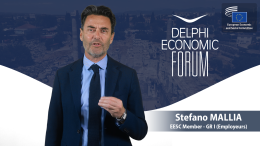
From 9 to 12 April 2025, an EESC Employers' Group delegation participated in the Delphi Economic Forum in Greece, becoming an institutional partner of this distinguished event that brings together leaders from politics, business, academia, and civil society to discuss and shape the policies for the future of Europe and the world, including related to competitiveness, geopolitics, sustainability and global trade.
This year’s prize attracted 58 applications from individuals, private businesses and civil society organisations across many European Member States, reflecting a broad geographical distribution.
This year’s prize attracted 58 applications from individuals, private businesses and civil society organisations across many European Member States, reflecting a broad geographical distribution.
They cover a large variety of topics, ranging from youth engagement and empowerment to social cohesion and inclusion, from media literacy and misinformation to human rights and gender equality.
Many initiatives tackle the problem at its roots and contribute to preventing polarisation.
Initiatives such as EUth Voices for Social Change, run by the non-profit organisation Youthmakers Hub in Greece, aims to empower young people tocultivate positive change in their communities. These projects tackle harmful polarisation, building a culture of tolerance by encouraging people to engage in constructive dialogues and to resist divisive narratives, for example through digital literacy training and podcasting.
Other projects combat polarising narratives and radicalisation. They bridge cultural, ethnic and generational gaps, address societal divisions, foster mutual understanding and cooperation, protect fundamental rights and inspire social cohesion.
DEMDIS Digital Discussion, an initiative launched by DEMDIS in Slovakia, created a new software platform to host fair digital discussion — even on controversial topics. Users vote on statements and are placed into separate opinion groups. By finding common ground, the project builds bridges between these polarised camps.
The Baltic Human Rights Society’sHuman Rights Guide is one example of the way civil society can work to uphold fundamental rights. The Guide works as a platform for human rights education, offering multilingual explanations about how human rights can and should work in specific situations in daily life.
This year’s submissions also contained several cultural and artistic approaches to tackling polarisation, such as Arty Farty’s Atlas géopolitique de la culture et des médias indépendants en Europe. This initiative highlights priority themes for a network of independent cultural and media organisations across Europe, such as inclusion, the reduction of territorial divides or the need to combat disinformation. These projects demonstrate that culture and media can play a transformative role in depolarising society.
Food, housing, energy, healthcare, education...how can Europeans maintain their standard of living these days? The cost of living is, more than ever, the primary concern of our fellow citizens, especially among young people.
On behalf of the Workers' Group, I want to express our full solidarity with the Argentinians that will take the streets on the 9th of April and the general strike of the 10th of April fighting for their social, trade union and labour rights.
The Omnibus proposal could mark an important first step towards regulatory simplification. We welcome the Commission’s initiative as a concrete move forward, which should be followed by further actions in the same direction. However, it is crucial that this process upheld the high environmental, social, and human rights standards.
Ministry of Economic Development and Technology, Warsaw (Poland)
In recent years, our businesses have operated in less stable, less predictable and less safe global environment. Yet, at the same time, global economic integration has never been deeper. This paradox is particularly evident in the complex interplay between the EU, US, and China. The Extraordinary Employers' Group meeting in Warsaw will seek to align the vision with tangible actions, with the aim to improve competitiveness and resilience, strengthening the EU open strategic autonomy.
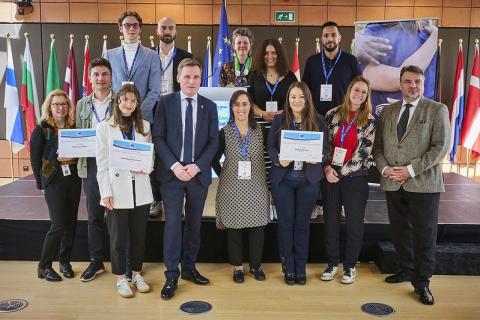
The EESC’s 15th Civil Society Prize has honoured three winners, from Slovakia, Belgium and France, for their inspiring work in tackling negative polarisation across Europe. The winners were revealed on 20 March at an award ceremony during Civil Society Week.
The EESC’s 15th Civil Society Prize has honoured three winners, from Slovakia, Belgium and France, for their inspiring work in tackling negative polarisation across Europe. The winners were revealed on 20 March at an award ceremony during Civil Society Week.
The prize money was shared among the three front-runners, with the first prize receiving EUR 14 000. The second prize went to two runners-up, each receiving EUR 9 000.
FIRST PRIZE: Slovak Debate Association in Slovakia for The Critical Thinking Olympiad
The Slovak Debate Association (SDA) is an NGO in Slovakia. Their mission is to promote open-mindedness and critical thinking, and to foster active citizenship among Slovak youth. Through a series of programmes, the SDA teaches young people to assess facts and opinions, to formulate their own arguments and to think critically about media output to find credible sources of information. In doing so, the organisation forms a space for open and public debate about key issues faced by Slovak society.
One of the most successful programmes, launched in 2021, is the Critical Thinking Olympiad (CTO). It has already been widely adopted, with almost 9 000 students from over 300 schools taking part last year. This innovative project is a competition that builds resilience against misinformation among students. Disinformation is rife in Slovakia: 61% of Slovaks distrust the media and over half believe in some conspiracy theories. The CTO works to directly confront this challenge by building media literacy and changing consumption habits among young people.
The competition is aimed at three student age groups (grades 8-13), in which participants face a range of real-world media challenges in three rounds. The tasks are designed to mirror content that students may be exposed to in their everyday lives. They analyse TikTok videos, fact-check AI-created content and evaluate Instagram posts, and try to distinguish between reality and misinformation. Students also take part in a public speaking round, where they must present their arguments to their peers.
‘The Critical Thinking Olympiad helps depolarise society by teaching thousands of students to engage with diverse perspectives, recognise cognitive biases and articulate their views constructively,’ said Richard Vaško, the founder and coordinator of the programme. ‘By strengthening critical thinking and media literacy through this skill-based intervention, we empower young people to resist misinformation and navigate societal debates with nuance.’
SECOND PRIZE: Reporters d'Espoirs in France for Prix Européen Jeunes Reporters d’Espoirs
Reporters of Hope is a French non-profit organisation formed in 2003. It kickstarted the ‘solutions journalism’ approach, now a widely practiced form of journalism that seeks answers to the challenges faced by society today. The organisation encourages journalists to adopt this positive mindset and honours the best reporting and editorial innovations of journalists and young people through a series of awards.
The Prix Européen Jeunes Reporters d’Espoirs is an initiative to both reward and train journalists in solutions journalism in the French language. The multi-faceted programme offers candidates the opportunity to learn solutions journalism through an online course run in conjunction with the Aix-Marseille School of Journalism. Each candidate is also paired up with a mentor to help improve their writing and speaking skills and trained in the art of pitching. Winners are also invited to Paris for a 48-hour learning trip during which they meet other like-minded journalists and experts from around Europe. Six winners are then awarded prizes totalling €10 000.
‘Combating polarisation is inherent in the method of solutions journalism: it consists of showing the complexity of the world, the diversity of actors who act at all levels and in all countries, together or separately, while describing the capacity for localised initiatives to spread,’ said Gilles Vanderpooten, director of Reporters d'Espoirs.
During its first three editions, the prize received over 400 applications from 25 countries. The current 4th edition is on track to exceed 300 applications. The organisation has already supported over 75 candidates to master their written and spoken French.
The idea is easily replicable, and the team is already in discussion with journalists in Spain, Italy and Belgium to partner with them and spread the prize further.
‘Our ambition is to expand the prize from the French-speaking world into other European Union languages,’ said Mr Vanderpooten. ‘This is the key to getting more and more young people involved in the ‘Europe of solutions’.
THIRD PRIZE: FEC Diversité asbl in Belgium for their project ESCAPE GAME EXTREME DROITE pour se désintoxiquer
In Europe and around the world, right-wing ideologies are taking hold. Far-right parties are gaining ground and populism is on the rise. The Belgian non-profit organisation FEC Diversité devised a way to counter these views among teachers, unions and ordinary citizens.
ESCAPE GAME EXTREME DROITE pour se désintoxiquer is an escape game that lets players ‘decontaminate’ themselves from the ideas of the far right, in a fun, engaging way. Players are informed they have been infected with far-right ideologies and must decontaminate themselves through a series of tasks. In doing so, they learn how far-right ideas are spread and amplified through society.
The game is made up of four districts, each with specific tests that players must pass. In District A, participants engage in discussions on the impact of the extreme right in the workplace, through interactions with 19 objects. In District B, players read from real testimonies of migrants to understand their journeys into Europe. In District C, audio of a ‘speech on the far right’ is accompanied by a series of images. District D sees players engage with a report on a far-right party, before completing crossword puzzles.
The immersive game includes coaches dressed in anti-gas suits and masks, with altered voices. The idea through the various challenges is to engage all five senses to truly bring the experience home and raise awareness of what is at stake for democracy in Europe.
Since its launch in June 2023, almost 1000 players have been ‘detoxified’, and word has spread among workers’ unions, organisations and schools in Belgium and beyond. Participants from France and Bulgaria have come to play the game with a view to recreating it elsewhere.
‘We are proud of having developed an innovative educational tool that tackles the issue of far-right ideas in an engaging and interactive way,’ says Malika Borbouse from FEC Diversité. ‘By fostering dialogue and collective reflection, our initiative has helped reduce tensions and promote a more inclusive society.’