Building an Inclusive Future in an Enlarged EU: The role of Social Dialogue, Civil Society and Youth Engagement
Location
Charlemagne Building, European Commission
Brussels
Belgium
As part of its ongoing Enlargement Candidate Members (ECMs) initiative, the EESC hosted a second Enlargement Forum on 17 July 2025 in Brussels. The event gathered ministers for European affairs from candidate countries, senior officials from the European Commission, social partners, and civil society representatives to discuss the role of civil and social dialogue in the EU enlargement process.
The EESC expresses its deep concern and solidarity with the editorial team at media outlet N1 following recent reports of death threats against them. According to the OSCE this is only one of many incidents in recent weeks and months targeting journalists and media outlets in Serbia. This is part of a broader and worrying trend of increasing pressure on independent media in the Western Balkans.
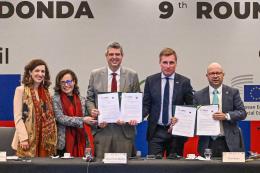
An EESC delegation of 12 members, headed by President Oliver Röpke, carried out a high-level mission to Brazil from 28 to 30 July to strengthen EU-Brazil relations and deepen civil society cooperation. The visit centred on the 9th EU-Brazil Civil Society Round Table, co-organised with Brazil’s Sustainable Economic and Social Development Council (CDESS), and included high-level meetings with key political figures.
Oliver Röpke, President of the European Economic and Social Committee, Paul Soete, Ozlem Yildirim, and Christian Moos, EESC Fundamental Rights and Rule of Law Group Presidency
Organisation
European Economic and Social Committee (EESC)
The EESC expresses its deep concern and solidarity with the editorial team at media outlet N1 following recent reports of death threats against them. According to the OSCE this is only one of many incidents in recent weeks and months targeting journalists and media outlets in Serbia. This is part of a broader and worrying trend of increasing pressure on independent media in the Western Balkans.
The European Economic and Social Committee (EESC) recently adopted an opinion welcoming the European Commission’s Industrial Action Plan, designed to help Europe’s automotive industry navigate a period of profound change. The ongoing shift towards cleaner and more digital vehicles must be carefully managed to protect jobs, support businesses, and ensure that no region or worker is left behind in the transition.