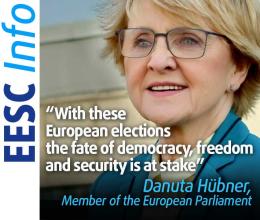
We talked to the Georgian-French journalist Régis Genté about the issues that are among top concerns when it comes to the European elections: the rise of the far right, unmotivated young voters and disinformation. A political expert on the post-Soviet area, Régis Genté reports for the mainstream media at Radio France Internationale, France 24 TV and Le Figaro.
We talked to the Georgian-French journalist Régis Genté about the issues that are among top concerns when it comes to the European elections: the rise of the far right, unmotivated young voters and disinformation. A political expert on the post-Soviet area, Régis Genté reports for the mainstream media at Radio France Internationale, France 24 TV and Le Figaro.
EESC Info:Do you think the rise of the far-right parties across Europe will have an impact on the European elections result?
I’m not an expert on the far-right in Europe at all, but looking at the surveys we have now in my country (France) I have to acknowledge that the far-right is ahead. The European elections represent a political means for European citizens to say or pass on a message about their own country to their politicians. European citizens first think about the political situation in their country and only then about the situation in Europe. So yes, the far-right parties will probably have an impact on these elections, in a context where questions about sovereignty versus European integration are on the rise.
Do you believe that young people are motivated to go to the polls for the European elections?
I will answer as an ordinary citizen who has lived in a post-Soviet territory for 22 years and as someone who also often talks to young people in Europe. I see they are not highly motivated to go to the polls. I observe the same in Georgia, where I live. Young people there are politicized, but not in favour of a pro-government party or the opposition. They want to be engaged in the political life of their country, but refuse to vote because none of the parties and their leaders truly represent them. It’s an interesting position that I respect because it may open the doors to make politics different, beyond representative democracy, beyond the parties. But, in the meantime, it leaves the political field to politicians and various political forces… without young people.
How deeply can disinformation influence the voters in the upcoming European elections?
Disinformation will be successful if its target is weak – with us, Europeans, being the target in this case. Russian disinformation doesn’t create problems; it uses existing ones. And we all understand that our societies are going through a deep political and moral crisis at the moment. It means that, unfortunately, the ground is favourable for disinformation to be efficient. But I feel that, as Europeans and as citizens of the world, we are now all more educated and experienced in how to handle the news on social media. We have learned a lot during these last ten years. We know a bit better how to filter the news on social media platforms, as we are aware that they serve as the playground for manipulation and fake news. We should not be too pessimistic, because this has already been making us the victims of disinformation. Societies are not that naïve anymore, and people are aware that countries and other political players can use social networks to manipulate public opinion. On social media, I would say, it is only a minority of people that are active; the large majority of the average population, educated people, is often silent. And this significant number of people is not swallowing every crazy thing that is written on social media.
On 20 March, the EESC adopted a resolution calling on European citizens to use their democratic right to vote and to cast their ballots in the fast-approaching European elections.
On 20 March, the European Economic and Social Committee (EESC) adopted a resolution calling on European citizens to use their democratic right to vote and to cast their ballots in the fast-approaching European elections.
‘We have gone through difficult times, but no one can deny that the EU has guaranteed peace, democracy, economic prosperity and social progress for its Member States and citizens. Thanks to the Union, we have the freedom to work, study and do business in all EU countries,’ the EESC stated in the resolution.
‘Nationalism, populism and single-state solutions are not the answer. Collaboration, cooperation and convergence are,’ the EESC said, stressing that no EU country can cope with challenges like rising inflation, wars, migration or the climate emergency alone.
The resolution was adopted at the EESC March plenary session following the debate The 2024 European elections through a civil society lens, which saw the participation of civil society activists and the national economic and social councils of France and Bulgaria.
The EESC said it wanted to mobilise its network of at least 90 million people across the EU, and make sure that Europeans headed to the polls to decide who will represent them in the European Parliament over the next five years.
EESC president Oliver Röpke told the plenary that the organisations represented by EESC members have deep roots in national civil societies: ‘We can reach out to everyone, we can get people to vote, and we must do it. It is our moral duty.’
The EESC has also joined forces with the European Parliament to help boost the turnout, which is usually much lower than in national elections, particularly in some Member States.
The EESC president stressed that against the backdrop of democracy in retreat around the world and in some Member States, the stakes seemed particularly high for the 2024 elections.
‘These elections are not the silver bullet to end our troubles, resolve our fears or alleviate citizens’ worries, but they are a legitimate way of expressing our wishes, of demanding a better future, and of holding those in power to account,’ Mr Röpke said.
Speaking at the plenary, the three Resolution rapporteurs, EESC members Christa Schweng, Cinzia del Rio and Ioannis Vardakastanis, representing the EESC Employers’, Workers’ and Civil Society Organisations’ Groups respectively, were united in their calls on Europeans to use their vote and elect representatives who will stand up for a united, democratic, sustainable and social Europe.
The EESC will adopt another resolution in July, focusing on civil society’s demands for the newly elected European Parliament and the Commission.(ll)
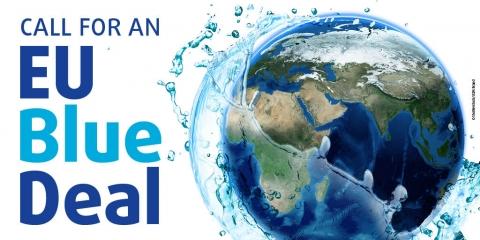
In a joint response to the European Commission's postponement of the Water Resilience Initiative, representatives of the European Economic and Social Committee (EESC), the MEP Water Group of the European Parliament (EP) and the European Committee of the Regions (CoR) sent an open letter to Executive Vice-President Maroš Šefčovič, asking the Commission to adopt a comprehensive approach to water and reiterating their call for an EU Blue Deal.
In a joint response to the European Commission's postponement of the Water Resilience Initiative, representatives of the European Economic and Social Committee (EESC), the MEP Water Group of the European Parliament (EP) and the European Committee of the Regions (CoR) sent an open letter to Executive Vice-President Maroš Šefčovič, asking the Commission to adopt a comprehensive approach to water and reiterating their call for an EU Blue Deal.
The letter reflects the shared concerns of these institutions regarding the postponement of the Water Resilience Initiative, which they view as a worrying signal regarding the EU's commitment to address Europe's escalating water challenges. The three institutions represent EU civil society, citizens and local governments, respectively.
They propose a holistic and collaborative approach that integrates water into all policies to ensure equitable social access, access for farmers, industries and infrastructure, and the social, economic and environmental aspects of water.
This shift aims to move beyond existing fragmented approaches, fostering a more comprehensive and effective standalone water strategy. This interinstitutional call urges the Commission to continue its work on the Water Resilience Initiative and make water a top EU priority in the upcoming term (2024-2029).
A properly structured civil dialogue can be a means of making European democracies more resilient to current societal challenges. Civil society organisations (CSOs) trust in the European Parliament to be the driving force when it comes to an agreement on structured civil dialogue between the Council of the European Union, the European Commission and the European Parliament, as a Parliament resolution proposed such an agreement in 2022. CSOs consider such an inter-institutional agreement a basis for developing more inclusive and qualitative policy-making.
Oliver Röpke, President of the European Economic and Social Committee
Organisation
EESC
The people and the planet cannot afford a lost decade. This is not the time to backtrack on the 2030 agenda. It is time to accelerate action and take everyone along on this journey. The world needs to move in the right direction. It is not a task to be left to future generations, nor a job to be left to incoming governments. It is our task for now.
In response to the European Commission's proposals for a comprehensive forest monitoring framework, the European Economic and Social Committee (EESC) has issued an opinion which includes cautious welcomes, recommendations, and calls for further review. The EESC emphasizes the need for sustainability, inclusivity, and respect for property rights in the proposed forest data system, while also urging attention to technical limitations and judicial considerations.