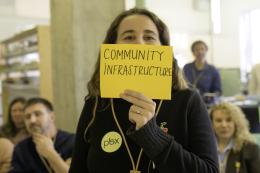
Despite recent progress, discrimination, violence and exclusion remain a daily reality for many LGBTIQ+ people in Europe. It is no longer enough to set ambitious goals; we must ensure they are properly implemented. Rights must be meaningful in practice, not only on paper, writes Juliane Marie Neiiendam, rapporteur of the EESC opinion Union of Equality: LGBTIQ+ Equality Strategy 2026-2030

Despite recent progress, discrimination, violence and exclusion remain a daily reality for many LGBTIQ+ people in Europe. It is no longer enough to set ambitious goals; we must ensure they are properly implemented. Rights must be meaningful in practice, not only on paper, writes Juliane Marie Neiiendam, rapporteur of the EESC opinion Union of Equality: LGBTIQ+ Equality Strategy 2026-2030

By the EESC Civil Society Organisations' Group

The EU needs a long-term vision that takes greater account of geographic specificities. Sustainable water management and food security must become top priorities, with food security and biodiversity going hand in hand. 

The EU needs a long-term vision that takes greater account of geographic specificities. Sustainable water management and food security must become top priorities, with food security and biodiversity going hand in hand. 

By the EESC Civil Society Organisations' Group

These are some of the main messages from a conference organised by the Civil Society Organisations’ Group of the European Economic and Social Committee (EESC) on 22 April 2026 in Larnaca. They must be considered in light of global uncertainties and growing risks to food supply chains, as well as the upcoming EU strategy for islands and coastal communities.

The conference, held under the patronage of the Cyprus Presidency of the Council of the European Union, focused on climate adaptation, food security and biodiversity, particularly from the island dimension. It also emphasised the importance of civil society, and in particular the EESC, in informing EU policies that are more efficient and that can be successfully implemented.

In his opening remarks, Cillian Lohan, President of the EESC’s Civil Society Organisations’ Group, outlined the objectives of the conference: ‘Our conference is not only about identifying challenges – which islands like Cyprus are often the first, fastest and most affected by – but also about exchanging solutions, learning from each other and strengthening cooperation between local, national and European actors.’

Mr Lohan highlighted the importance of communities’ ability to adapt, transform and thrive, even under pressure, in other words – resilience, explaining that ‘policies alone are not enough to build resilience. People – farmers, researchers, local authorities, cooperatives, consumers and civil society organisations – need to be empowered to work together.’

The issue of resilience was also addressed by Annita Demetriou, President of the Cypriot House of Representatives: ‘Resilience depends not only on the design of policies, but also on their effective implementation and the cooperation of all stakeholders. For real impact, we need synergies between different sectors and institutions.’ The genuine involvement of all stakeholders, including civil society organisations, would be crucial for the success of policies.

Ms Demetriou spoke about the legislative and parliamentary efforts of the Republic of Cyprus in this sense, emphasising that climate change, water scarcity, food insecurity and biodiversity loss are closely intertwined global challenges that no single country could tackle alone. She concluded by calling for greater European solidarity and the full integration of the ‘island dimension’ into EU policies, encouraging participants: ‘We must transform our shared challenges into concrete opportunities for sustainability, resilience and long-term prosperity.’

Ms Demetriou invited the Cypriot members of the Civil Society Organisations’ Group to present the outcomes of the conference to the House of Representatives’ Agriculture Committee.

Andreas Gregoriou, Permanent Secretary of the Cypriot Ministry of Agriculture, Rural Development and Environment, said: ‘Water resilience is no longer just an environmental concern – it is a strategic priority for Europe’s climate adaptation, food security and economic stability. From the perspective of Cyprus, strengthened EU policies must also reflect the specific realities of island and water-scarce regions, while promoting sustainable resource management and biodiversity. Building resilient agri-food systems is essential not only for sustainability, but for ensuring long-term security and stability across the European Union.’

The conference featured the presentation of two recent EESC opinions entitled EU Water Resilience Strategy and European Climate Resilience and Risk Management Integrated Framework and The Island Dimension in European Cohesion, Competitiveness and Sustainable Development Policies, both of which were prepared at the request of the Cyprus Presidency.

The event brought together around 100 representatives from institutions and civil society from across the 27 EU Member States. Participants stressed that cohesion, competitiveness and sustainability policies in particular need to take greater account of geographic specificities. Resilient communities require healthy ecosystems, fair incomes for producers, resilient local supply chains and responsible consumption. Future policies should value quality and sustainability of food supply, not just productivity.

The findings of the conference will feed into the work of the EESC’s Civil Society Organisations’ Group, whose work programme focuses, among other things, on the promotion of the sustainable agenda and building resilient communities. The event’s conclusions and recommendations will be published on the EESC website soon.

At the March Plenary, the European Economic and Social Committee (EESC) adopted an opinion on the European Commission's Battery Booster Strategy. While supporting the initiative's mission to strengthen the European battery value chain, the EESC calls for clearer prioritization, stronger implementation tools, a broader scope beyond electric vehicle batteries, and higher environmental and social standards.

Agenda of the 250th INT Section meeting

Download — EESC-2026-01174-00-00-CONVPOJ-TRA — (Agenda)

Notice of 240th TEN Section meeting on 26.5.26

Download — EESC-2026-01076-00-00-CONVPOJ-TRA — (Agenda)
-

On a mission to Moldova, European Economic and Social Committee (EESC) President Séamus Boland met with Moldova’s political leadership, civil society organisations and young people to reaffirm the EESC’s strong support for the country’s European path. 

29-30 April 2026

European Commission, Charlemagne building (Alcide De Gasperi room), 1040 Brussels

Web stream click here

Minutes of the of the 249th meeting of the INT Section

Download — EESC-2026-00767-00-00-PV-TRA — (Minutes)