President Oliver Röpke took center stage at the G20 Social Summit in Rio de Janeiro, Brazil, advocating alongside President Luiz Inácio Lula da Silva for urgent reforms in global governance, expanded social protections, and enhanced economic inclusivity. Representing European civil society, President Röpke joined international leaders to address social issues that align with the Brazilian G20 presidency's priorities: combating hunger and inequality, tackling climate change, and advancing just transitions in labor markets.
Paraphrasing Bill Clinton's 1992 campaign slogan – 'It's the economy, stupid!' which at the time very much resonated with American voters grappling with recession – seems more than appropriate today. You just have to look at the results of the latest Eurobarometer EU post-electoral survey which revealed that inflation and the economy were the main topics encouraging people to vote.
Paraphrasing Bill Clinton's 1992 campaign slogan – 'It's the economy, stupid!' which at the time very much resonated with American voters grappling with recession – seems more than appropriate today. You just have to look at the results of the latest Eurobarometer EU post-electoral survey which revealed that inflation and the economy were the main topics encouraging people to vote.
No, there is no one-size-fits-all solution and economic hardship alone cannot explain all the troubles surrounding the elections ahead. However, it is safe to say that rising prices, cost of living and the economic situation were the main voter motivators in the EU last spring and across the Atlantic a few weeks ago. Not that the writing was not on the wall: it was the main concern (followed by poverty and social exclusion) back in early 2023. While macroeconomic indicators seem to give policy makers a pat on the back, the direct impact of inflation on essential goods like food and energy remains severe, disproportionately affecting those who spend a larger share of their income on these necessities. This comes on top of the pandemic recovery and its catastrophic policy response, with many countries still reeling from the aftermath of the 2008 crisis.
Addressing the cost-of-living crisis is crucial for Europe's future, as it highlights structural issues in our societies and economies while challenging the principles that uphold the social fabric of our democracies.
believes that there has been a market failure in housing. This must be tackled by improving framework conditions like data, coordination, approval procedures and land use planning rules, establishing a fundamental right to housing, providing sufficient funding, implementing the ‘Housing First’ approach for homeless people and focusing more on the needs of young people and sustainability;
The EESC has called for a European flagship initiative for health, proposing the creation of a European Health Union and urging the European Commission to publish an Action Plan on Rare Diseases with clearly achievable targets.
The EESC has called for a European flagship initiative for health, proposing the creation of a European Health Union and urging the European Commission to publish an Action Plan on Rare Diseases with clearly achievable targets.
During a debate on ‘A European flagship initiative for health’ held at its October plenary, the EESC called for the EU to launch an ambitious initiative, aiming to build a cross-cutting health architecture within the EU. Creating a European Action Plan on Rare Diseases (ARPD) was also on the agenda.
Opening the debate, EESC President Oliver Röpke stated: ‘It is crucial that everyone living in the EU have access to quality healthcare that is affordable and accessible. We need to invest in innovative and sustainable health systems and take firm action to combat health inequalities both within the EU and globally. Rare diseases make persisting inequalities and vulnerabilities even more visible. This is why we need comprehensive European action on rare diseases.’
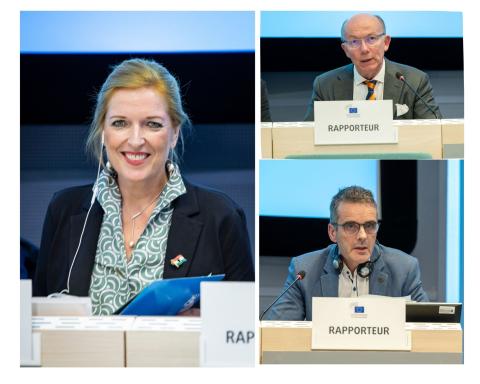
The rapporteur of the opinion on the European flagship initiative for health, Alain Coheur, said: ‘Today, we are trying to adopt a roadmap for future EU commissioners which promotes healthcare for all and protects people against future crises.’ Ágnes Cser, rapporteur of the opinion on rare diseases, added: ‘We have to come up with an action plan. However, we must not solely focus on the rare diseases action plan but on health as well – health is the key to competitiveness. Our health union cannot remain an empty phrase.’
The opinion on the European flagship initiative for health sets out strategic pillars to strengthen solidarity and cooperation between Member States on health. Among these is the establishment of a European care and healthcare guarantee which would set out multiannual health objectives at EU level. This could lead to the creation of a legally binding text (such as a directive).
Another pillar is the implementation of the One Health approach which links human, animal, plant and environmental policies. The opinion on tackling rare diseases calls on the Commission to publish a communication containing a comprehensive European Action Plan on Rare Diseases (APRD), which sets out SMART targets that can be achieved by 2030. (lm)
The EESC has outlined a vision for transforming the EU’s agriculture, fisheries and food systems to ensure resilience and sustainability in times of crisis.
The EESC has outlined a vision for transforming the EU’s agriculture, fisheries and food systems to ensure resilience and sustainability in times of crisis.
In an opinion adopted in October, the EESC called for a food system that is competitive, crisis-proof and aligned with EU environmental and social goals. It emphasised food security, a fair income for producers, environmental resilience and supporting the next generation of food producers.
‘Ensuring stable, sustainable incomes for producers is essential, as is fostering a knowledge-based food policy that encourages innovation,’ said Arnold Puech d’Alissac, President of the World Farmers’ Organisation and one of the three rapporteurs of the opinion.
To support this, the EESC proposes strengthening the farming sector’s bargaining power in price negotiations and increasing EU agriculture and fisheries funding. It also calls for future trade agreements to incorporate Green Deal and Farm to Fork standards, ensuring fair competition and high food quality.
‘Ensuring fair incomes for primary producers is critical,’ said Piroska Kállay, another rapporteur for the opinion.
To this end, the EESC called for stricter enforcement of fair trading practices and a ban on below-cost selling in order to rebalance the food supply chain. Policies promoting generational renewal, focusing on young people and women, including education, training and support for cooperatives, are also of utmost importance.
To support sustainability, the EESC recommended rewarding carbon sequestration efforts, like sustainable soil management, and preventing carbon leakage. ‘These measures would help align food production with the EU’s climate targets and global environmental commitments,’ said Joe Healy, another rapporteur.
Another proposal is a public insurance system to protect producers from climate-related disasters, ensuring food supply continuity.
The EESC called for policies to restore soil and water health, improve water efficiency and reduce usage, alongside cutting red tape and boosting transparency with digitised price and cost tracking.
Finally, the EESC recommended establishing a European Food Policy Council (EFPC) to foster dialogue on food-related issues and align food policy with broader social and environmental objectives. These proposals provide a roadmap to make the EU’s food systems more resilient, sustainable and equitable in the face of global challenges.(ks)