The EESC’s new opinion on the Union of Skills outlines a clear path: Europe’s global competitiveness depends on its ability to develop and retain a skilled, adaptable, and inclusive workforce. As Rapporteur representing the Employers’ Group, I want to highlight key priorities that matter most from a business perspective.
The EU’s Emissions Trading System (ETS) is a cornerstone in the green and low-carbon economy objective for Europe. With this system, CO2 reductions will be made where the cost is lowest, making it cost-effective. Carbon emissions and its impact on the climate is however a global phenomenon and other economic areas must also implement such measures to create a truly global response to a global problem.
With our opinion, at the request of the European Commission, we welcome the Savings and Investments Union as an important step towards transforming the EU’s fragmented financial landscape into a more integrated and efficient system. By improving how savings are channelled into investments, the EU hopes to strengthen competitiveness, support businesses—especially SMEs—and provide citizens with better opportunities to participate in value creation.
Europe's regulatory framework resembles a dense spaghetti bowl - complex and overlapping. Despite the digital tools available to manage this complexity, the system remains entangled.
Reimagining the design of cities, communities and housing is essential in order to face current challenges. Civil society organisations (CSOs) have a key role to play in steering this transformation. Sustainability and the right to housing must be at the heart of future strategies. The EU could contribute to this by increasing European funding for affordable housing and by supporting the social economy.
Reimagining the design of cities, communities and housing is essential in order to face current challenges. Civil society organisations (CSOs) have a key role to play in steering this transformation. Sustainability and the right to housing must be at the heart of future strategies. The EU could contribute to this by increasing European funding for affordable housing and supporting the social economy.
Making housing, public spaces and communities in the EU future-proof was the focus of a conference organised by the Civil Society Organisations’ Group of the European Economic and Social Committee (EESC) on 2 July. The event was one of the first high-level conferences to be held under the Danish Presidency of the Council of the EU, which began on 1 July. It took place at the Danish Society of Engineers (IDA) in Copenhagen.
Séamus Boland, President of the Civil Society Organisations’ Group, said: ‘In the face of climate change, increasing inequalities and the housing crisis, there is no choice but to embrace change in the way that we design, build and develop urban housing and public spaces. There is much that other countries could learn from Denmark, whose equitable housing policy, accessible to everyone irrespective of income, goes back over 100 years. Today, the Danish non‑profit housing sector accounts for a fifth of the market and is characterised by high energy standards and mixed, inclusive communities’.
Mr Boland emphasised the need to create spaces that serve both environmental objectives and social cohesion. Sustainability and the right to housing should be at the centre of future housing strategies. Co‑creation and co‑ownership must go hand in hand to build greener and more inclusive housing and public spaces. The president of the group, representing civil society from the 27 EU Member States, added that the EU could help by ‘increasing European affordable housing funds, strengthening EU renovation programmes and supporting the social economy, notably cooperative ownership models’.
Sophie Hæstorp Andersen, Danish Minister for Social Affairs and Housing, said: ‘Affordable and sustainable housing is a top priority for me – also during our EU Presidency. By building greener and more inclusive communities today, we’re not only addressing today’s challenges, but laying the foundation for stronger, more resilient societies tomorrow. It’s part of building a safer, more competitive and greener Europe. I look forward to continuing this important conversation at the conference I’ll be hosting in September on affordable and sustainable housing’.
By Stefano Mallia, President of the EESC Employers’ Group
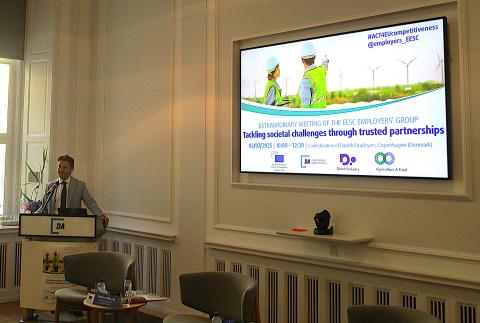
The EESC Employers’ Group held an Extraordinary Meeting in Copenhagen entitled Tackling societal challenges through trusted partnerships, under the Danish Presidency of the Council of the EU. The event offered a platform to examine how trust-based cooperation between governments, employers and social partners can enhance Europe’s competitiveness in the face of structural transformation. The message is clear: Europe cannot afford to treat competitiveness, security and sustainability as separate tracks. They are interdependent pillars.
By Stefano Mallia, President of the EESC Employers’ Group
The EESC Employers’ Group held an Extraordinary Meeting in Copenhagen entitled Tackling societal challenges through trusted partnerships, under the Danish Presidency of the Council of the EU. The event offered a platform to examine how trust-based cooperation between governments, employers and social partners can enhance Europe’s competitiveness in the face of structural transformation. The message is clear: Europe cannot afford to treat competitiveness, security and sustainability as separate tracks. They are interdependent pillars.
Denmark’s leadership sets an example in reconciling climate ambition with economic dynamism and labour market cohesion. The deeper lesson lies in governance: the Danish model shows what is possible when trust, dialogue and long-term planning replace fragmentation and short-termism.
The first panel focused on Denmark’slabour market model, widely seen as a benchmark for balancing flexibility and security, while the second panel examined Denmark’s green transition, exploring how early stakeholder involvement and strong public–private partnerships have allowed Denmark to decouple growth from emissions.
A recurring theme was the role of technology and lifelong learning. As AI reshapes workplaces, Denmark’s system of autonomous training rights — ten days per year negotiated via collective agreements — was cited as an innovative response.
Regarding the green transition, there was scepticism about consumers’ willingness to absorb higher costs associated with sustainable products. While Danish surveys show high support for climate action, 'at the supermarket checkout, price still wins,' one participant noted.
Denmark’s experience offers a source of transferable lessons. Social trust, mutual accountability and regulatory coherence emerged as essential ingredients to navigate the green and digital transitions while remaining competitive.
The event was also a call to strengthen the role of social partners in shaping EU policy. We must stop asking whether social dialogue and competitiveness are compatible. They are inseparable. If we want a strong Europe in a changing world, we must build it on cooperation, not confrontation.