
European Economic
and Social Committee
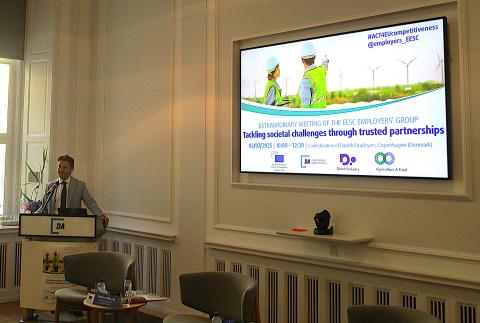
By Stefano Mallia, President of the EESC Employers’ Group
The EESC Employers’ Group held an Extraordinary Meeting in Copenhagen entitled Tackling societal challenges through trusted partnerships, under the Danish Presidency of the Council of the EU. The event offered a platform to examine how trust-based cooperation between governments, employers and social partners can enhance Europe’s competitiveness in the face of structural transformation. The message is clear: Europe cannot afford to treat competitiveness, security and sustainability as separate tracks. They are interdependent pillars.
Denmark’s leadership sets an example in reconciling climate ambition with economic dynamism and labour market cohesion. The deeper lesson lies in governance: the Danish model shows what is possible when trust, dialogue and long-term planning replace fragmentation and short-termism.
The first panel focused on Denmark’s labour market model, widely seen as a benchmark for balancing flexibility and security, while the second panel examined Denmark’s green transition, exploring how early stakeholder involvement and strong public–private partnerships have allowed Denmark to decouple growth from emissions.
A recurring theme was the role of technology and lifelong learning. As AI reshapes workplaces, Denmark’s system of autonomous training rights — ten days per year negotiated via collective agreements — was cited as an innovative response.
Regarding the green transition, there was scepticism about consumers’ willingness to absorb higher costs associated with sustainable products. While Danish surveys show high support for climate action, 'at the supermarket checkout, price still wins,' one participant noted.
Denmark’s experience offers a source of transferable lessons. Social trust, mutual accountability and regulatory coherence emerged as essential ingredients to navigate the green and digital transitions while remaining competitive.
The event was also a call to strengthen the role of social partners in shaping EU policy. We must stop asking whether social dialogue and competitiveness are compatible. They are inseparable. If we want a strong Europe in a changing world, we must build it on cooperation, not confrontation.