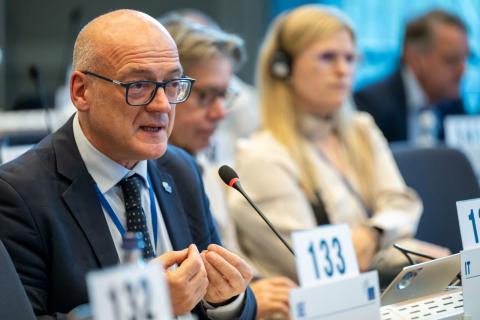
By Giuseppe Guerini EESC Civil Society Organisations’ Group
Last year, the European Commission and the European Council tasked Mario Draghi and Enrico Letta with drafting reports on EU competitiveness and on improving the single market, respectively. These reports set out an ambitious political agenda for the European Union, serving as both a roadmap and a benchmark for assessing the commitment of institutions and policymakers to shaping the EU’s future and their ability to do so.
By Giuseppe Guerini EESC Civil Society Organisations’ Group
Last year, the European Commission and the European Council tasked Mario Draghi and Enrico Letta with drafting reports on EU competitiveness and on improving the single market, respectively. These reports set out an ambitious political agenda for the European Union, serving as both a roadmap and a benchmark for assessing the commitment of institutions and policymakers to shaping the EU’s future and their ability to do so.
These reports can be used to gauge how effectively institutions and leaders are responding to today’s complex challenges.
The EESC’s opinion on the reports provides a valuable tool for evaluating the early steps of this new political cycle. The first of these steps is reflected in the Competitiveness Compass, launched by the European Commission on 29 January. It includes several high-priority proposals that are also highlighted in our opinion, such as closing the competitiveness gap, completing the single market, simplifying regulations without deregulation and recognising that competitiveness depends on people and skills.
However, beyond the competitiveness gap, there is also a lack of concrete action. So far, the Commission has presented strategic documents, communications and commitments, but tangible measures are still months away. This delay underscores the need, as noted in our opinion, for EU institutions and Member States to also initiate a debate on the EU’s fundamental rules and the relevance of the current Treaties in addressing today’s challenges, which require swift action.
Acting quickly does not mean compromising on quality. The European Commission demonstrated this in 2020 when it swiftly implemented the Next Generation EU initiative. It should show the same agility today.
Achieving these goals requires a multifaceted approach. Rapidly completing the single market is crucial, but it must go hand in hand with a strong commitment to environmental sustainability, economic prosperity and social and territorial cohesion, as these are key drivers of competitiveness.
This vision also calls for a cohesive industrial policy that moves beyond fragmented national approaches, supported by strategic fiscal and customs incentives. At the same time, reducing bureaucratic burdens and compliance costs through smarter regulation and streamlined administrative processes is essential to fostering a more dynamic business environment.
In the energy sector, narrowing price disparities between Member States and other global economies is vital. This will require increased investment in renewable energy, ensuring a more competitive and sustainable energy market.
To support these ambitions, the EU must also develop a common policy on European public goods, clearly defining its strategic priorities and reinforcing its role on the global stage.
The EESC will continue to monitor the implementation of these policies, ensuring that the voice of European civil society is heard and taken into account.
On 13 and 14 March 2025, the European Economic and Social Committee (EESC) will host its annual youth event, Your Europe, Your Say! (YEYS), bringing together more than 130 participants from across Europe and beyond. This unique event unites secondary school students, representatives of youth organisations, and delegates from national youth councils, all aged 16 to 25, from all 27 EU Member States, nine candidate countries, and the UK.
On 13 and 14 March 2025, the European Economic and Social Committee (EESC) will host its annual youth event, Your Europe, Your Say! (YEYS), bringing together more than 130 participants from across Europe and beyond. This unique event unites secondary school students, representatives of youth organisations, and delegates from national youth councils, all aged 16 to 25, from all 27 EU Member States, nine candidate countries, and the UK.
With an array of workshops, panels, and discussions, the event will provide a platform for young people to actively contribute to shaping the future of Europe. This year, the event is entitled ‘Giving Youth a Voice’ and the participants will address crucial topics such as sustainability, social inclusion, digital transformation, and more.
The outcomes of these discussions and the insights gathered will be channelled into the EESC’s second Civil Society Week and will also be promoted at the European Youth Event (EYE) in June 2025, organised by the European Parliament in Strasbourg.
The YEYS event emphasises the importance of transposing youth engagement into civic action, participatory democracy, and the formation of European policies.
Stay tuned for the outcomes and initiatives coming out of this important gathering. (kc)
With artificial intelligence reshaping the workplace, it is crucial to continue promoting human-centric AI and advocating for policies that balance strong AI development in Europe with social justice and workers’ rights, a high-level debate at the EESC heard.
With artificial intelligence reshaping the workplace, it is crucial to continue promoting human-centric AI and advocating for policies that balance strong AI development in Europe with social justice and workers’ rights, a high-level debate at the EESC heard.
At its January plenary session, the EESC held a debate on the deployment of artificial intelligence in the workplace, with statements by EESC President Oliver Röpke, European Commission Executive Vice-President Roxana Mînzatu, and Deputy Minister of Family, Labour and Social Policy of Poland Katarzyna Nowakowska, among others.
Opening the debate, Mr Röpke stated that: ‘Artificial intelligence is one of the most transformative trends of our time, offering immense potential while presenting critical challenges. Today’s debate reaffirmed the importance of anchoring AI policy in the principles of the European Pillar of Social Rights.’
Ms Mînzatu highlighted that: ‘When we think about AI, in particular in the workplace, we should look into ways to boost our investment in research and innovation, and how to simplify the ways in which European companies can develop in this area so that we have our own technologies trained according to European data and based on European values. Abiding by our values on social rights and equality, we ensure that European workers have the same rights in a world with or without AI – that they are protected, and that human-centric control is implemented.’
Ms Nowakowska stated that artificial intelligence in the world of work offered tremendous opportunities to increase productivity and competitiveness for businesses, but also raised a number of questions about its potential impact on jobs and employment, worker health and safety, working conditions, overall job quality, and the role of social dialogue.
Adoption of Pro-Worker AI opinion and the appended counter-opinion
In the opinion, the EESC stresses that social dialogue and worker involvement play a crucial role in preserving workers’ fundamental rights and promoting ‘trustworthy’ AI in the world of work. It adds that current rules should address the gaps in the protection of workers’ rights at work and ensure that humans remain in control in all human-machine interactions.
The counter-opinion by the Employers’ Group was appended to the opinion. The Group members explained that, in their view, the EU already has the tools to embrace the AI revolution, and the existing legal framework would ensure its smooth deployment. (lm)
Artificial intelligence is transforming the world of work at an unprecedented pace, bringing both opportunities and challenges for workers, businesses, and policy-makers. On 3 February, the European Economic and Social Committee (EESC) and the International Labour Organization (ILO) held a joint high-level conference entitled ‘Social Justice in the Digital Era: AI’s impact on work and society’.
Artificial intelligence is transforming the world of work at an unprecedented pace, bringing both opportunities and challenges for workers, businesses, and policy-makers. On 3 February, the European Economic and Social Committee (EESC) and the International Labour Organization (ILO) held a joint high-level conference entitled ‘Social Justice in the Digital Era: AI’s impact on work and society’.
The high-level conference saw prominent leaders – including several EU labour ministers – deliberate on strategies to harness AI’s potential while addressing the risks it poses to workers’ rights and labour markets. This event marked a major contribution to the Global Coalition for Social Justice, highlighting the need for a coordinated approach to AI governance at both European and global level. This joint high-level conference was jointly organised by the EESC's Section for Employment, Social Affairs and Citizenship (SOC) and the ILO.
A call for ethical and inclusive AI development
Opening the conference, EESC President Oliver Röpke underscored the urgent need for a human-centric approach to AI, stating that: ‘Artificial intelligence is already reshaping our societies and labour markets, bringing both opportunities and challenges. The EESC and its partner organisations are committed to ensuring that AI serves as a force for social justice, strengthening workers’ rights, promoting inclusion, and preventing new inequalities. A fair and human-centric AI future requires collective action – from policy-makers to the social partners and civil society – to ensure that technology works for people and not against them.’
ILO Director-General Gilbert F. Houngbo emphasised the importance of proactive policies to mitigate AI’s disruptive impact on jobs and workplaces: ‘We have to ensure that we shape AI in ways that advance social justice. This means several actions: supporting workers, including with skills and social protection; facilitating access by enterprises of all sizes and in all parts of the world to AI technology to harness productivity benefits; and ensuring that AI’s integration into the workplace protects workers’ rights and promotes social dialogue in the digital transition.’
Over the course of two panels, high-level speakers shared their insights on the challenges and opportunities they perceive in leveraging AI to promote decent work and inclusive labour markets and contribute to gender equality in the years to come. Panellists included EU labour ministers Agnieszka Dziemianowicz-Bąk (Poland), Yolanda Díaz (Spain) and Níki Keraméos (Greece) and Maria do Rosário Palma Ramalho (Portugal), as well as the delegate of the French Government to the ILO and to the G7-G20, Anousheh Karvar (among others).
The discussions held highlighted the fact that, although there is a risk associated with the rollout of AI, there is no need to be luddites in the face of this new technology. It is essential, however, to focus on social dialogue and include workers in the deployment of AI, while paying particular attention to re-skilling and up-skilling efforts. Proper, controlled rollout and regulation of AI will help avoid major shocks and enable this technology to reduce repetitive tasks without necessarily leading to large-scale layoffs.(lm)