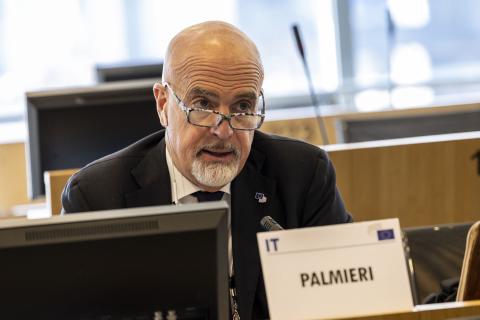
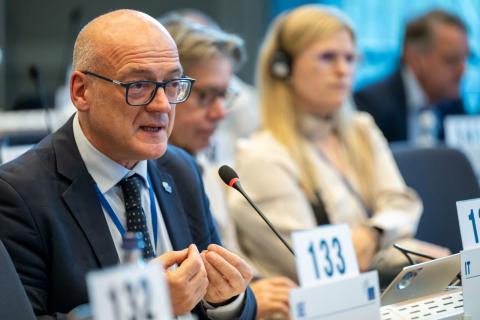
The first and foremost recommendation that the EESC gives in its opinion is to urgently take action to implement the recommendations of the Letta and the Draghi reports. In my view, this should be done in a comprehensive way; the two reports cannot be cherry-picked. They must be implemented as a whole, without limiting the proposals and attention to comfort zones, and without avoiding the most critical and divisive issues, such as investments.
The first and foremost recommendation that the EESC gives in its opinion is to urgently take action to implement the recommendations of the Letta and the Draghi reports. In my view, this should be done in a comprehensive way; the two reports cannot be cherry-picked. They must be implemented as a whole, without limiting the proposals and attention to comfort zones, and without avoiding the most critical and divisive issues, such as investments.
Starting from the Draghi Report, and given the obvious importance of his focus on EU competitiveness as a whole, I consider his recommendations on the EU industrial policy pivotal. In particular, his insistence on the need to adopt an industrial policy able to overcome the current fragmented approach. Today we have 27 national industrial policies that are not always coordinated. In this regard, only a structured European effort would allow us to ensure the right balance of tax, regulatory and trade/customs provisions and financial incentives that characterise the most recent industrial policies of the United States and China, with huge benefits for the single market.
This, however, should go hand in hand with a drastic reduction of bureaucratic burdens for businesses, for which I particularly appreciate Letta's call for 'a single market to go fast and go far'. Among his key recommendations, Letta advocates streamlining the bureaucratic burden, simplifying administrative procedures, and further actions to 'cut the red tape', especially for small and medium-sized enterprises (SMEs). In this context, in its opinion the EESC welcomes the Commission's proposal to reduce the reporting burden by 25% for all businesses and setting a target of at least 50% for SMEs. In addition, developing and elaborating on Letta's recommendation to consider a mechanism that will assist co-legislators with a dynamic impact assessment (DIA), the EESC strongly supports the idea of a competitiveness check to be carried out during the legislative iter.
There is considerable overlap between the Letta and Draghi reports, even though they differ significantly in their analysis and proposed strategies.
Take cohesion policy, for example. In the Letta report, it plays a central role by ensuring that the benefits of the Single Market are shared among all citizens and regions of the Union. It also highlights the link between cohesion policy and services of general interest, which are essential for enabling Europeans to live and work where they choose. In contrast, the Draghi report seems to downplay the importance of cohesion policy and the social and territorial dimensions of competitiveness. It discusses European competitiveness without considering territorial disparities, implying that simply boosting the EU’s overall competitiveness would solve regional issues. It overlooks the fact that, for many regions, low competitiveness and territorial disadvantage are two sides of the same coin.
Both reports recognise that ‘business as usual’ is no longer an option for the Union. The urgency and complexity of today’s crises require a significant shift in European policymaking, possibly even through Treaty changes. Can we really discuss enlargement without addressing the need for deeper political integration? This shift must also involve a change in scale. The current Multiannual Financial Framework (MFF) is insufficient, anchored at just over 1% of the EU’s GNI and constrained by the outdated logic of ‘juste retour’. A new approach is needed, inspired by the Next Generation EU model. Extraordinary challenges must be met with bold solutions, including issuing ‘common safe assets’ as seen during the pandemic.
The upcoming 2028-2034 MFF will test the EU’s true intentions, as it sets priorities for the next seven years. In that context, it is reasonable to expect an open debate on the challenges facing the EU, given the multiple ongoing crises, as well as on its key objectives and the common European goods it aims to deliver to its citizens.
When considering regulatory reform, as recommended in both reports, it’s important to remember that the EU is the world’s most advanced ‘social market economy’. Its high economic, social, and environmental standards are essential to this model’s success, not obstacles to it. Therefore, comparing the EU’s regulations with those of the US or China is fundamentally flawed. Any effort to simplify EU rules must still protect labour conditions, worker safety, consumer rights, social and economic cohesion, and sustainable growth.
Europe has come to understand, albeit belatedly, that being a large market is no longer enough. To move forward, it must strive for greater unity, including deeper political integration and truly unified policies on economy, industry, trade, foreign affairs, and defence. The coming months will be decisive in shaping the future of Europe.
By Giuseppe Guerini EESC Civil Society Organisations’ Group
Last year, the European Commission and the European Council tasked Mario Draghi and Enrico Letta with drafting reports on EU competitiveness and on improving the single market, respectively. These reports set out an ambitious political agenda for the European Union, serving as both a roadmap and a benchmark for assessing the commitment of institutions and policymakers to shaping the EU’s future and their ability to do so.
By Giuseppe Guerini EESC Civil Society Organisations’ Group
Last year, the European Commission and the European Council tasked Mario Draghi and Enrico Letta with drafting reports on EU competitiveness and on improving the single market, respectively. These reports set out an ambitious political agenda for the European Union, serving as both a roadmap and a benchmark for assessing the commitment of institutions and policymakers to shaping the EU’s future and their ability to do so.
These reports can be used to gauge how effectively institutions and leaders are responding to today’s complex challenges.
The EESC’s opinion on the reports provides a valuable tool for evaluating the early steps of this new political cycle. The first of these steps is reflected in the Competitiveness Compass, launched by the European Commission on 29 January. It includes several high-priority proposals that are also highlighted in our opinion, such as closing the competitiveness gap, completing the single market, simplifying regulations without deregulation and recognising that competitiveness depends on people and skills.
However, beyond the competitiveness gap, there is also a lack of concrete action. So far, the Commission has presented strategic documents, communications and commitments, but tangible measures are still months away. This delay underscores the need, as noted in our opinion, for EU institutions and Member States to also initiate a debate on the EU’s fundamental rules and the relevance of the current Treaties in addressing today’s challenges, which require swift action.
Acting quickly does not mean compromising on quality. The European Commission demonstrated this in 2020 when it swiftly implemented the Next Generation EU initiative. It should show the same agility today.
Achieving these goals requires a multifaceted approach. Rapidly completing the single market is crucial, but it must go hand in hand with a strong commitment to environmental sustainability, economic prosperity and social and territorial cohesion, as these are key drivers of competitiveness.
This vision also calls for a cohesive industrial policy that moves beyond fragmented national approaches, supported by strategic fiscal and customs incentives. At the same time, reducing bureaucratic burdens and compliance costs through smarter regulation and streamlined administrative processes is essential to fostering a more dynamic business environment.
In the energy sector, narrowing price disparities between Member States and other global economies is vital. This will require increased investment in renewable energy, ensuring a more competitive and sustainable energy market.
To support these ambitions, the EU must also develop a common policy on European public goods, clearly defining its strategic priorities and reinforcing its role on the global stage.
The EESC will continue to monitor the implementation of these policies, ensuring that the voice of European civil society is heard and taken into account.
On 13 and 14 March 2025, the European Economic and Social Committee (EESC) will host its annual youth event, Your Europe, Your Say! (YEYS), bringing together more than 130 participants from across Europe and beyond. This unique event unites secondary school students, representatives of youth organisations, and delegates from national youth councils, all aged 16 to 25, from all 27 EU Member States, nine candidate countries, and the UK.
On 13 and 14 March 2025, the European Economic and Social Committee (EESC) will host its annual youth event, Your Europe, Your Say! (YEYS), bringing together more than 130 participants from across Europe and beyond. This unique event unites secondary school students, representatives of youth organisations, and delegates from national youth councils, all aged 16 to 25, from all 27 EU Member States, nine candidate countries, and the UK.
With an array of workshops, panels, and discussions, the event will provide a platform for young people to actively contribute to shaping the future of Europe. This year, the event is entitled ‘Giving Youth a Voice’ and the participants will address crucial topics such as sustainability, social inclusion, digital transformation, and more.
The outcomes of these discussions and the insights gathered will be channelled into the EESC’s second Civil Society Week and will also be promoted at the European Youth Event (EYE) in June 2025, organised by the European Parliament in Strasbourg.
The YEYS event emphasises the importance of transposing youth engagement into civic action, participatory democracy, and the formation of European policies.
Stay tuned for the outcomes and initiatives coming out of this important gathering. (kc)