As winter reluctantly gives way to spring, the EESC is welcoming March with a set of dynamic events, shining a spotlight on the voices of young people and civil society.
As winter reluctantly gives way to spring, the EESC is welcoming March with a set of dynamic events, shining a spotlight on the voices of young people and civil society.
The curtain raiser is the 16th edition of the ‘Your Europe Your Say’ event. On 13-14 March 2025, the YEYS event, as it is widely known, will bring together nearly 100 young participants from youth organisations, national youth councils and secondary schools, as well as 37 teachers from EU Member States, candidate countries and the UK. All of them will share a unique experience, uniting their voices to shape the Europe they want to live in.
Their recommendations could feed into the EESC’s second Civil Society Week, following just a few days later, as a basis for youth-focused discussions. and be shared with high-level representatives from the European institutions.
After its promising start in 2024, this year’s Civil Society Week take place on 17-21 March and will focus on Strengthening cohesion and participation in polarised societies. Social instability, economic downturns and widespread discontent, particularly among those who feel unheard and left behind, have further deepened societal divisions.
To address these pressing concerns, the Civil Society Week 2025 will gather a diverse range of civil society stakeholders from Europe and beyond, providing a unique platform to engage in critical debates, share best practices, and collaborate to develop solutions that foster social cohesion and strengthen democratic engagement.
This year the agenda will bring together three major initiatives: the European civil society organisations and networks (EESC Liaison Group panels), discussing how a European Civil Society Strategy could foster greater cohesion; the European Citizens’ Initiative Day (ECI) and its role in tackling polarisation; and the Civil Society Prize award ceremony. The theme of the 15th Civil Society Prize, which rewards excellence in civil society initiatives, is combatting harmful polarisation of European society. The winners come from Belgium, represented by the civil society organisation ‘Diversity’; from France, with ‘Reporters of Hope’; and from Slovakia, with the ‘Slovak Debate Association’. The ranking will be announced during the ceremony!
Our Civil Society Week acts as a timely platform, calling organised civil society and citizens to express themselves on key issues, from the escalating challenges of climate change, the rising cost of living and widening income disparities, to the outcomes of the 2024 elections worldwide, which have all created a fertile ground for widespread polarisation.
I invite you to take part in this meaningful exchange by joining our discussions and seizing the opportunity to turn conversation into change. Our voices matter and they can be heard as long as we stand together, proactive and ready to contribute to a more cohesive and participatory Europe. Registrations are open! Don’t miss this opportunity!
The Civil Society Organisations’ Group has elected Cillian Lohan as its designated candidate for the 2025-2028 presidency of the Group. Mr Lohan will take office in the course of the European Economic and Social Committee’s renewal in October 2025. Prior to this, Members will officially confirm his appointment at the first meeting of the newly constituted Group.
Europe’s progress toward the Sustainable Development Goals (SDGs) has slowed significantly, raising concerns about meeting the 2030 targets. The Europe Sustainable Development Report 2025 (ESDR), published by the UN Sustainable Development Solutions Network (SDSN), reveals that progress on the SDGs from 2020 to 2023 was less than half the pace seen during the previous period.
Europe’s progress toward the Sustainable Development Goals (SDGs) has slowed significantly, raising concerns about meeting the 2030 targets. The Europe Sustainable Development Report 2025 (ESDR), published by the UN Sustainable Development Solutions Network (SDSN), reveals that progress on the SDGs from 2020 to 2023 was less than half the pace seen during the previous period.
Between 2016 and 2019, progress increased by 1.9 points, but this dropped to just 0.8 points in the following years. The slowdown comes amid growing environmental, social, and geopolitical challenges. SDG 2 (Zero Hunger) remains a major concern, as food security and sustainability issues persist across Europe.
A separate study for the European Economic and Social Committee (EESC) emphasises the need for dietary shifts to support sustainable agriculture and public health.
With a new EU leadership in place, experts are calling for stronger policies and investments to accelerate progress on the SDGs. Global cooperation and financing are seen as crucial, with the 4th International Conference on Financing for Development in Spain in June 2025 expected to focus on scaling up financial support for sustainability.
Guillaume Lafortune, SDSN Vice President and lead author of the report, warns that rising geopolitical tensions are complicating sustainability efforts, but he remains optimistic.
‘The world is increasingly dangerous, unstable, and uncertain,’ he said. ‘At the same time, people, especially young people, want sustainable development. With the size of the global economy and the technologies available, the world has the potential to fully achieve sustainable development.’
‘Sustainable food systems are a crucial driver for the implementation of the SDGs. To accelerate action, we need more ambitious mechanisms to safeguard the livelihoods of farmers, small-scale food producers, and other stakeholders across the food supply chain. But we must also tackle unfair distribution and ensure a just transition,’ said Peter Schmidt, president of the EESC’s Agriculture, Rural Development and the Environment (NAT) section, while also calling for greater civil society engagement.
With just five years left to go, the EU faces a critical decision: act decisively or risk falling short on its commitments to a sustainable and equitable future. (ks)
Promoting the Roma community's political participation at the local level and empowering them to become active members of society are two main aspects of the current EU Roma strategic framework. Whilst some members of the Roma community serve as mayors or deputy mayors, in most Member States the Roma are not represented in the local decision-making process, and are at times deprived by direct and indirect, legal and extralegal means from exercising their own political rights. The hearing will discuss the obstacles faced by the Roma community which hinder them from becoming active citizens, and the changes that are needed. It will also look at good practices from municipalities where actions are being taken to enhance the Roma community's representation and inclusion.
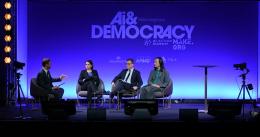
Artificial Intelligence is reshaping governance, democracy, and the workplace, bringing both vast opportunities and significant challenges. On 10 February, the European Economic and Social Committee (EESC) participated in the AI Action Summit in Paris, a global gathering of policymakers, business leaders, social partners and civil society representatives to discuss AI’s impact on fundamental rights, economic justice, and international regulatory frameworks. EESC President Oliver Röpke took centre stage to advocate for ethical AI governance, international regulatory cooperation, and a human-centric approach to AI policy.
Senior European Defence Agency (EDA) officials briefed members of the defence industry community on 11 February 2025, ahead of a new European strategy to strengthen the European Union’s defence industrial base.