
European Economic
and Social Committee
No more ‘national preference’: fragmentation is threat to security, EDA tells EESC forum
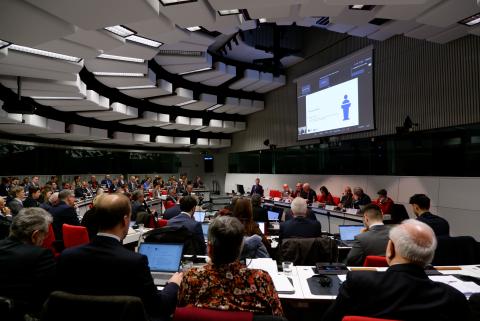
Senior European Defence Agency (EDA) officials briefed members of the defence industry community on 11 February 2025, ahead of a new European strategy to strengthen the European Union’s defence industrial base.
The forum, hosted at the European Economic and Social Committee (EESC), came as the EU institutions, with input from EDA, prepares a ‘White Paper on the Future of European Defence’, which is expected in mid-March 2025. The EESC, as the voice of organised civil society, ensures that economic and social considerations are integrated into EU policymaking, and fosters dialogue between institutions and stakeholders.
“The European defence base remains fragmented, characterised by a lack of joint procurement and national preferences for defence spending. This results in small, localised markets with relatively low production numbers,” EDA Chief Executive Jiří Šedivý said. “It is only by cooperating more that Member States can strengthen the defence technological and industrial base, create economies of scale, and develop the defence capabilities our Member States need.”
The white paper will outline strategies for funding, improving industrial competitiveness, supporting Ukraine, and addressing critical investment needs. Negotiations over the EU's next long-term budget, the EU Multiannual Financial Framework, are also due to start at the end of 2025. Pietro de Lotto, President of the EESC Consultative Commission on Industrial Change, said: “We need to come together to protect our common security, common values and common future.” De Lotto called for a dedicated €100 billion in the next seven-year MFF and stressed the need for public understanding and support, noting that a strong defence strategy in a democratic society requires citizens to see the European defence industry as a force for peace and security, not conflict.
Katarzyna Ananicz, the European Council’s chairwoman of the Council’s working party on defence industry, said that the current interpretation of defence investment in the EU fiscal rules governing national budgets was too narrow. Ananicz stresssed that investment should not only include the purchase of military equipment but capital support for arms, ammunition factories, investment in infrastructure used by the armed forces and the construction of shelters.
In 2024, Member States are projected to have spent €326 billion on defence, equivalent to 1.9% of the EU’s GDP. EDA officials warned that it is still insufficient to meet security threats. Countries must work together to develop the European defence industrial base. “The defence industry is our partner, and we cannot develop military capabilities without industry,” said Baudouin Heuninckx, EDA’s deputy director for industry.
EDA briefed the EESC on some of the obstacles, particularly for small and medium-sized enterprises (SMEs) in the defence sector. These companies face significant barriers to financing, despite the Union’s efforts to boost military spending, Šedivý told the forum. De Lotto warned that sidelining SMEs would weaken the EU and stressed the need to better integrate them into future defence projects and funding. The Commission’s Fabio Liberti, giving an update on industry support, urged that joint procurement is the best way forward.
EDA outlined its 18 collaborative opportunities that were identified in its 2024 Coordinated Annual Review on Defence (CARD), the EU’s ‘State of the Union’ on defence. Four of these projects have already won political backing, including initiatives on integrated air and missile defence and electronic warfare.
EDA’s Federica Valente also briefed the forum on EDA’s Hub for EU Defence Innovation (HEDI). HEDI is helping to identify and address future technological and operational needs of European armed forces, ensuring that they remain at the forefront of innovation and preparedness. EDA explained its revised Memorandum of Understanding with the European Investment Bank, which aims at improving financing access for defence projects. “They have financial knowledge; we have military expertise. This collaboration can help identify projects needing investment,” Šedivý.
Work organisation
Recommended for you
Mario Monti at the EESC: "Tell the European Council to care more about the integrity of the single market"
News
Speaking at an event marking 30 years of the single market, Mr Monti said this anniversary afforded an opportunity for EU institutions to call out the European Council and expose national governments…
Security is more than defence, stresses EESC
News
At its January plenary session, the EESC debated the EU's "Strategic Compass" vision for security and defence, pointing out that security should be understood broadly, far beyond military defence.…
EESC urges tougher EU action to curb single market fragmentation
News
Europe’s single market is facing ongoing challenges due to fragmentation, unfair commercial practices and the accelerating pace of technological change. In a series of recent opinions, the…
Fragmentation of supply chains and impact on the cost of living
News
BackgroundThis opinion is part of a wider package of EESC opinions on the cost-of-living crisis. With this package the EESC is examining the different components of this policy challenge…
The Fragmentation of supply chains and the impact on the cost of living
News
The world order is transitioning to a new multipolar era, accompanied by escalating challenges to socioeconomic and environmental sustainability. The global economy is undergoing significant systemic…