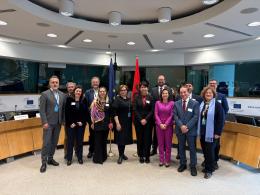
Albania remains firmly committed to EU integration, advancing accession negotiations and implementing the growth plan for the Western Balkans, with reforms in the rule of law, digitalisation and the green transition. However, anti-corruption and media freedom require further robust efforts. These topics were at the centre of discussions during the 2nd meeting of the EU-Albania Civil Society Joint Consultative Committee on 21 November 2025.
calls for a pragmatic, well-funded strategy with a concrete action plan, timeline, and dedicated budget to address accumulated challenges and outline long-term cooperation;
urges the development of a common vision for regional cooperation, leveraging EU-level policies and international treaties, and working with regional organizations like the Organisation for Security and Co-operation in Europe (OSCE) and the Black Sea Economic Cooperation (BSEC);
highlights the need to counter hybrid threats, especially in Moldova and Georgia, and calls for more action from the EU and NATO;
stresses that achieving a lasting peace is a necessary and essential pre-condition for sustainable economic development.
warns against excessive reactivity and insists on transparency, accountability, and meaningful engagement of stakeholders in budget planning and evaluation;
stresses the need for consistency between foreign policy, development, trade and competitiveness to maximise the EU’s global impact;
calls for meaningful and more inclusive participation of civil society in decision-making and monitoring as well as for predictable and stable funding, notably to strengthen democracy, civic space and gender equality;
calls on the Commission to extend its Inequality Marker, a valuable instrument for measuring and mainstreaming the fight against inequalities, to all Global Gateway projects.
The European Affordable Housing Advisory Board, an independent expert body advising the European Commission, has just published 75 recommendations for the upcoming European Affordable Housing Plan — the first-ever EU-level housing strategy aimed at addressing Europe’s acute housing crisis. Advisory Board expert Ivana Katurić has detailed the recommendations that align with the EESC’s calls to stop treating housing as a commodity and to recognise affordable, decent homes as a fundamental right.
The European Affordable Housing Advisory Board, an independent expert body advising the European Commission, has just published 75 recommendations for the upcoming European Affordable Housing Plan — the first-ever EU-level housing strategy aimed at addressing Europe’s acute housing crisis. Advisory Board expert Ivana Katurić has detailed the recommendations that align with the EESC’s calls to stop treating housing as a commodity and to recognise affordable, decent homes as a fundamental right.
By Ivana Katurić
On 20 November, the European Affordable Housing Advisory Board published a report detailing its affordable housing policy recommendations for the European Commission. The Housing Advisory Board was established in June 2025 as an independent group of experts to provide recommendations for the Commission to take into account when preparing the European Affordable Housing Plan, which is scheduled to be presented before the end of this year.
The European Economic and Social Committee has worked intensively on affordable and sustainable housing in recent years, and the Board’s 75 recommendations – in areas such as housing inclusion, spatial planning and land management, environmental sustainability of housing, investment principles and multi-level governance – echo many of the priorities set by the EESC in its opinions and public hearings.
Both the Advisory Board and the EESC are calling for a paradigm shift in European housing policy, treating housing as essential social and economic infrastructure rather than a commodity, and recognising decent, affordable and accessible housing as a fundamental right.
A major shared concern is the need to address market failure in the housing sector. The Advisory Board recommends tax, investment and land policy measures to curb financialisation and speculation and to prioritise homes as places to live, not vehicles for investment. Both bodies also highlight the critical importance of securing accessible, affordable housing for vulnerable groups, including people experiencing homelessness, young people, low-income earners, and especially people with disabilities. The Board’s recommendation of promoting the Housing First approach across all Member States to end homelessness and earmarking EU funds for this purpose mirrors long-standing advocacy by the EESC for robust action to be taken on this issue.
In its recommendations on financing the expansion of the affordable housing stock, the Housing Advisory Board also aligns with the EESC in the its call for targeted investment approaches to be devised. It promotes the cost-rental model as a core pillar of the future housing system, with new homes primarily developed and managed by public, cooperative and other limited‑profit housing providers. Financing would combine grants with long-term financing from the EIB and other international financial institutions. It should be designed to crowd in patient private capital, whereby affordability would be safeguarded by requirements for capped returns, obligatory reinvestment into renovation and new supply, and clear eligibility criteria for the selection of tenants, which should include vulnerable groups.
Both the Advisory Board and the EESC are calling for the removal of fiscal barriers that currently discourage public investment in affordable housing. The Advisory Board recommends reforms to State aid rules that broaden eligibility beyond the narrowest income groups. The report also calls for clarity on balance sheet classification under ESA 2010 rules, proposing that housing providers with independent operations and financial sustainability not be counted toward public debt – a reform that would reduce disincentives for Member States to invest in long-term affordable housing.
As the European Commission prepares to present its first-ever European Affordable Housing Plan, the convergence between the Board’s report and EESC positions demonstrates that the path forward must be based on rights, participation and coordinated action at every level, with the voices of civil society and those most affected at the forefront.
Ivana Katurić is director of Urbanex, an independent Croatian think tank, research and consultancy organisation dedicated to sustainable urban development and spatial policy. She is also an associate professor at University of Rijeka. Ivana is a member of the Housing Advisory Board, appointed in June 2025 to advise the Commission on the European Affordable Housing Plan. The Advisory Board has 15 qualified members who are experts in the various relevant areas.
When finding a place to live becomes a luxury, something is deeply wrong. To tackle Europe’s acute housing crisis, the EU is preparing its first plan for affordable housing. The EESC’s recent opinion on this issue – entitled For a European Affordable Housing Plan – the contribution of civil society – calls for a bold, investment-heavy and socially just approach. Its rapporteurs, John Comer and Thomas Kattnig, outline here the core ideas behind the opinion, which calls for a response that puts people, not markets, first.
When finding a place to live becomes a luxury, something is deeply wrong. To tackle Europe’s acute housing crisis, the EU is preparing its first plan for affordable housing. The EESC’s recent opinion on this issue – entitled For a European Affordable Housing Plan – the contribution of civil society – calls for a bold, investment-heavy and socially just approach. Its rapporteurs, John Comer and Thomas Kattnig, outline here the core ideas behind the opinion, which calls for a response that puts people, not markets, first.
By John Comer and Thomas Kattnig
Europe is facing one of the biggest social challenges of the decade: securing the fundamental right to adequate, accessible and affordable housing. Rising prices, increasing financialisation and growing social inequalities have led to a housing crisis that now affects more than 50 million citizens in the European Union. People with disabilities, single parents, older people and young people, who are increasingly being pushed out of cities, are particularly affected.
In response to these developments, the European Economic and Social Committee (EESC) has presented a comprehensive opinion at the request of the Danish presidency. It serves as a strategic guide for organised civil society ahead of the forthcoming publication of the European Commission’s Affordable Housing Plan.
Key challenges
We identify three structural risks that are exacerbating the crisis:
1. Speculation, and the financialisation of housing markets.
2. Insufficient long-term investment.
3. The growing gap between incomes and housing costs.
The EESC emphasises that the housing crisis is not a law of nature, but the result of political decisions. Decisive action at European, national and local level can reverse the trend. At the heart of this is the conviction that housing is not merely a commodity, but a basic social requirement for participation, economic stability and democratic trust.
Expectations for the European Plan for Affordable Housing
The opinion sets out clear expectations as regards the Commission’s plan. While responsibility for housing lies with the Member States, under the principle of subsidiarity, we stress that a European framework is necessary to address the complex challenges on the ground.
The EESC calls for the EU plan to include the following elements:
• A coherent European framework that supports local and national measures and strengthens cooperation.
• A robust investment strategy to close the estimated annual investment gap of EUR 270 billion in social and affordable housing. This requires both public and private investment.
• A strong role for the European Investment Bank, whose new pan-European platform for housing investment is intended to provide long-term, low-interest loans for social and non-profit providers.
• A pooling of existing EU funds into a specialised European instrument for affordable housing.
• An exemption from EU fiscal rules for public investment in social housing, as this must be considered strategic social infrastructure – comparable to investment in education or health.
We think the plan must be more than a signal – it must be a political turning point that matches the scale of the challenge.
Key proposals in the opinion
The opinion offers a comprehensive policy strategy to restore affordability, strengthen social justice and ensure long-term resilience.
One focus is on reforming EU State aid law. Social, non-profit and limited-profit housing serves the common good, is territorially bound and should not be considered a distortion of competition. We propose the model of non-profit and limited-profit housing associations as a European benchmark: adopting this model would involve cost-based rents, re-investment, long-term price stability and social diversity. At the same time, the overly narrow definition of social housing, focused solely on vulnerable groups, must be broadened, as the crisis has long since reached the middle class.
In order to counter speculation and financialisation, the Member States need a broad, legally compliant package of measures in line with subsidiarity: vacancy taxes, clear rules for short-term rental platforms, rent caps in tight markets and stricter transparency requirements for institutional property owners.
The opinion also calls for binding EU accessibility standards, improved support for accessible renovations and the expansion of housing assistance for people with disabilities. Accessible housing is a prerequisite for participation, self-determination and dignity.
In the fight against homelessness, the EESC clearly advocates ‘Housing First’ as the European standard. Homelessness causes people to become alienated from society leading to major inequalities and deprivation in society. Finland has shown that stable housing conditions are a prerequisite for social integration and cost reduction in social and health care. Young people should receive special support through programmes such as ‘Housing First for Youth’.
Another key area is affordable land policy. Rising land prices have accounted for around 80% of property price increases since the 1950s. The EU should support land reserves for social housing, sustainable spatial planning and anti-speculation rules.
New technologies should also be used: digitalisation, AI, modular construction methods, harmonised standards and accelerated approval procedures can increase productivity in the construction industry, reduce costs and promote climate-friendly, energy-efficient construction methods – a decisive lever in the fight against energy poverty.
Finally, the EESC combines affordability with sustainability: future-oriented housing projects should include quotas for affordable, accessible and energy-efficient housing. EU initiatives such as the ‘Renovation Wave’ and the ‘New European Bauhaus’ provide an important framework for this.
Involvement of European stakeholders
A central part of the work is intensive dialogue with the most important European stakeholders. We held talks with the EU Commissioner for Housing, Dan Jørgensen, brought the views of civil society to the Commission’s Housing Task Force and presented the EESC’s position to the European Parliament’s Special Committee on Housing. The Danish presidency has also actively sought our expertise. These exchanges have enabled our opinion to have a direct influence on European policy-making.
A European promise
The forthcoming plan offers a historic opportunity. We want to emphasise that the EU is more than a market: it is the promise of a good, secure and inclusive life – and a home for all is the cornerstone of that promise.
This debate, hosted by the EESC, will feature a presentation by FAO of its recent report on the State of Food Security and Nutrition in the World 2025, including latest data and analysis, and updated estimates on the cost and affordability of healthy diets.