Proposal for a REGULATION OF THE EUROPEAN PARLIAMENT AND OF THE COUNCIL establishing the Union support for internal security for the period from 2028 to 2034
Proposal for a REGULATION OF THE EUROPEAN PARLIAMENT AND OF THE COUNCIL establishing the Union support for asylum, migration and integration for the period from 2028 to 2034
Proposal for a REGULATION OF THE EUROPEAN PARLIAMENT AND OF THE COUNCIL establishing the Union support for the Schengen area, for European integrated border management and for the common policy on visas for the period from 2028 to 2034
With more than 1.6 billion users globally, including over 200 million across Europe, TikTok has become a major space for political expression and information-sharing and a main source of news for a significant share of young people. As a result, it has come under growing scrutiny from regulators and civil society. The European Commission opened formal proceedings in 2024 to examine whether TikTok is adequately assessing and mitigating systemic risks related to election integrity and civic discourse. We asked Francesca Scapolo, TikTok's Election Integrity Expert for Public Policy in Europe, how TikTok understands its responsibility for these risks in practice, how it cooperates with authorities, and what safeguards it has in place to protect democratic processes.
With more than 1.6 billion users globally, including over 200 million across Europe, TikTok has become a major space for political expression and information-sharing and a primary source of news for a significant share of young people. As a result, it has come under growing scrutiny from regulators and civil society. The European Commission opened formal proceedings in 2024 to examine whether TikTok is adequately assessing and mitigating systemic risks related to election integrity and civic discourse. We asked Francesca Scapolo, TikTok's Election Integrity Expert for Public Policy in Europe, how TikTok understands its responsibility for these risks in practice, how it cooperates with authorities, and what safeguards it has in place to protect democratic processes.
Given TikTok’s scale and its growing role as a source of political information for millions of users across the EU, how does the company approach accountability for systemic risks on the platform more broadly, such as the spread of disinformation, coordinated behaviour, or fake and inauthentic accounts? How do these efforts translate into cooperation with national authorities and EU institutions, particularly during sensitive moments like elections?
TikTok is adiscovery platform where more than 200 million Europeans come to connect, share their passions, and find inspiration. We recognise that with scale comes responsibility, and we work continually to protect our platform and maintain a civil place for people to express themselves and build community, including during elections. We’ve invested significantly in systems, specialised teams and partnerships to address systemic risks such as harmful misinformation, fake and inauthentic accounts, coordinated inauthentic behaviour, and deceptive behaviours.
Across the EU, our work includes proactive enforcement of our Community Guidelines, investment in features, tools and resources to empower our community, including media literacy initiatives, and partnerships with external experts. In fact, through TikTok's global fact-checking programme, we work closely with more than 20 IFCN-accredited fact-checking organisations, including AFP in France, DPA in Germany and Newtral in Spain.
Our technical and enforcement work is complemented by ongoing cooperation with national authorities and EU regulators. Under the Digital Services Act (DSA) and the Code of Conduct on Disinformation, we engage with Digital Service Coordinators and the European Commission. We also provide regular updates on our content moderation efforts through our transparency reports.
During high‑stakes periods, such as elections, we also collaborate with national authorities and electoral commissions, and participate in the Code’s rapid response system, which enables swift, coordinated information-sharing between civil society organisations, fact‑checkers and platforms to address urgent or emerging threats, a critical capability during elections.
Taken together, these efforts demonstrate how we blend proactive risk mitigation, user‑empowering tools, and regulatory cooperation to help safeguard democratic discourse across the EU, especially during sensitive electoral moments.
From your perspective, are the measures TikTok currently has in place sufficient to address systemic risks to democratic processes during elections, particularly those linked to recommendation algorithms, visibility dynamics, and coordinated campaigns? Or do you see a need for stronger or more proactive safeguards?
During elections, we work continually to protect our platform and maintain a civil place for people to express themselves and build community. Thousands of trust and safety and security professionals have safeguarded TikTok through over 200 elections around the world over the last five years. Our comprehensive strategy is based on three key pillars:
Protecting election integrity: Removing harmful misinformation, disrupting attempts to influence our community, including covert influence operations, collaborating with fact-checkers to assess content accuracy, and labelling unverifiable claims.
Empowering users: Providing access to reliable information through Election Centres, enabling users to separate fact from fiction.
Collaborating with experts: Partnering with electoral commissions and fact-checking organisations to counter emerging threats.
Through these efforts, in 2025, we disrupted more than 75 covert influence networks, and removed tens of thousands of accounts for violating our covert influence policies. We stay accountable to our community with regular updates on how we protect election integrity and frequent reports on the covert influence operations we have disrupted.
Looking ahead, we remain committed to strengthening these pillars and to evolving our safeguards as risks change.
Project Clover has been presented as a key pillar of TikTok’s European data-governance strategy, including a long-term investment of around EUR 12 billion, yet it remains relatively unknown to the public. How does this initiative concretely change how TikTok handles European user data, and what relevance does it have for election integrity and democratic safeguards in the EU?
Project Clover is one of the most advanced and comprehensive data protection programmes to be found anywhere. Its core tenets include storing European user data in a dedicated European enclave by default and putting additional safeguards and restrictions around that data, building on our existing controls on who can access data.
We've also engaged a respected European cybersecurity firm, NCC Group, to independently monitor and verify these safeguards. NCC Group's oversight provides third-party accountability over our work to protect European user data. We've also deployed tools to further protect European user privacy called 'privacy enhancing technologies'.
These measures go further than regulatory requirements, while being aligned with principles in the GDPR, and our general efforts towards safeguarding our platform and users through robust processes, policies, and procedures.
Francesca Scapolo oversees TikTok’s Europe-wide election integrity public policy efforts, coordinating among product, trust and safety, and policy teams. Collaborating with internal and external stakeholders, she implements regional public policy strategies that reinforce civic trust and safeguard electoral integrity. Before joining TikTok, she worked at the Meta Oversight Board and the European Commission.
The EESC is calling for a larger EU budget than proposed in the Commission’s draft 2028-2034 multiannual financial framework (MFF), which totals EUR 1.816 trillion. The EESC discussed the draft during its plenary session in December as part of the preparations for an opinion that is due in January 2026 and builds on the EESC’s April 2025 mid-term revision assessment.
The EESC is calling for a larger EU budget than proposed in the Commission’s draft 2028-2034 multiannual financial framework (MFF), which totals EUR 1.816 trillion.
The EESC discussed the draft during its plenary session in December as part of the preparations for an opinion that is due in January 2026 and builds on the EESC’s April 2025 mid-term revision assessment. The debate saw the participation of Commissioner for Budget, Anti-Fraud and Public Administration Piotr Serafin, MEP Carla Tavares and former Italian minister in the Draghi government and Scientific Director of the Italian Alliance for Sustainable Development (ASviS) Enrico Giovannini.
‘Our Union can only remain resilient if those closest to the grassroots level – regional and local actors, social partners and organised civil society – remain fully involved in shaping where and how funds are spent,’ EESC President Séamus Boland said.
During the debate, EESC members warned that merging cohesion, agricultural and fisheries funding into new national and regional partnership plans (NRPPs) could risk centralising fund management. They also highlighted the need to avoid repeating the consultation shortcomings seen with the recovery and resilience plans. Concerns were raised about linking NRPPs to European Semester priorities, which could impose undue macroeconomic conditionality.
The Committee supported using revenue from the emissions trading system and the carbon border adjustment mechanism, but opposed a new corporate levy, recommending a digital services tax instead. It called for increased funding for the European Social Fund Plus, the Just Transition Fund, Horizon Europe and the Connecting Europe Facility. The new AgoraEU programme was welcomed as a boost for culture, media pluralism, democratic participation and civil society.
Clearer targets, transparency and greater local involvement would bolster democratic governance and improve the MFF proposal.
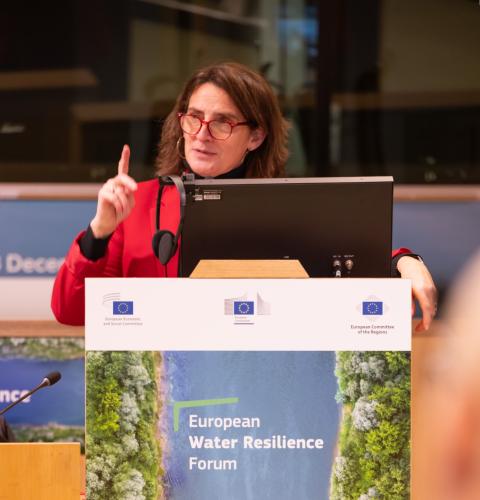
The first EU Water Resilience Forum, co‑organised by the EESC, the Committee of the Regions and the European Commission, gathered policymakers and stakeholders to chart solutions for Europe’s growing water challenges.
The first EU Water Resilience Forum, co‑organised by the EESC, the Committee of the Regions and the European Commission, gathered policymakers and stakeholders to chart solutions for Europe’s growing water challenges.
Commissioner Jessika Roswall warned that ‘water is no longer an infinite resource’ and called for urgent collective action, while Executive Vice‑President Teresa Ribera underlined that ‘water connects everything we care about… water is life, a shared responsibility.’ The Forum also launched the new Water Resilience Stakeholder Platform, designed to turn shared ideas into coordinated implementation.
Water resilience at the heart of EU priorities
For the EESC, the Forum reinforced momentum behind its EU Blue Deal, which has helped push water security up the EU’s political agenda and inspired the creation of a dedicated Commissioner portfolio. The updated Blue Deal Declaration now includes 31 specific actions, including an EU Water Test to assess the impact of new legislation on water resources and pollution. EESC President Séamus Boland stressed the social dimension of water: ‘Fair access to water is a matter of justice… Europe’s water future is ultimately about protecting people, livelihoods and future generations.’
Local action, shared responsibility
Cities and regions play a pivotal role. The President of the European Committee of the Regions, Kata Tüttő, reminded participants that ‘water is everywhere in our lives… and we feel the anxiety of water every day.’ She stressed that cross‑border collaboration is essential, noting how pollution in one city affects communities far downstream. Forum participants exchanged concrete solutions on restoring the water cycle, improving water efficiency, deploying digital tools and ensuring equitable access, especially for vulnerable groups.
From commitment to action
The Forum concluded with a shared determination to translate political ambition into practical measures and investments in order to achieve water resilience by 2050. With the launch of the Water Resilience Stakeholder Platform, the EESC reaffirmed its readiness to help connect policymakers with workers, businesses, farmers and communities. ‘This platform is a chance to turn ideas into practical, people‑centred solutions and ensure that no one is left behind’,the EESC Presidentconcluded. (gb)
At its December 2025 plenary, the EESC adopted an own‑initiative opinion urging the EU to formally recognise permanent materials – steel, aluminium and glass – as key to a truly circular economy.
At its December 2025 plenary, the EESC adopted an own‑initiative opinion urging the EU to formally recognise permanent materials – steel, aluminium and glass – as key to a truly circular economy.
These materials retain their properties through endless recycling, delivering major climate and resource savings: recycling aluminium cuts energy use by 95% and reduces emissions from 15.1 tonnes of CO₂ per tonne of primary aluminium to just 0.52 tonnes. Rapporteur Andrea Mone highlighted the social dimension of the transition, stating ‘We need access to up‑skilling and re‑skilling to facilitate smooth job transitions and enable workers to benefit from the circular economy.’ Co‑rapporteur Michal Pintér called for stronger policy action, saying ‘We need concrete legislation to move from slogans to practical and viable models.’
Why permanent materials matter
Permanent materials allow circular, closed‑loop recycling without quality loss, unlike materials that degrade with each cycle. High recycling rates already show their potential: tinplate packaging exceeds 80% recycling in several Member States, and every 10% rise in recycled glass content cuts energy use by 3% and CO₂ emissions by 5%. These gains make permanent materials key to meeting EU climate‑neutrality goals while reducing dependence on virgin raw materials.
What must change
The EESC stresses that the EU needs clearer legislation to distinguish permanent from non‑permanent materials and set ambitious recycling and collection targets. Achieving 90% separate collection of packaging waste by 2030, harmonising extended producer responsibility systems, investing in modern recycling infrastructure and improving consumer participation are key priorities. The Committee also emphasises that the circular transition must be socially fair, ensuring access to training, job‑to‑job support and strong social dialogue as new circular business models emerge. (gb)