At its June plenary, the EESC adopted the opinion on the Digital Networks Act (DNA), drawn up by Maurizio Mensi. The opinion throws its support behind the European Commission proposal to boost the EU’s connectivity and says that the Digital Networks Act will only be successful if it delivers secure, resilient and inclusive connectivity that truly works for Europe’s people, businesses and regions.
At its June plenary, the EESC adopted the opinion on the Digital Networks Act (DNA), drawn up by Maurizio Mensi. The opinion throws its support behind the European Commission proposal to boost the EU’s connectivity and says that the Digital Networks Act will only be successful if it delivers secure, resilient and inclusive connectivity that truly works for Europe’s people, businesses and regions.
The EESC underlines that the telecommunications sector plays a vital role and, with the Commission’s proposal, the EU is carrying out a much needed and proportionate update of its framework for electronic communications.
‘The Digital Networks Act is a strategic intervention with direct implications for competitiveness, security and the ability of organised civil society to operate in a genuine single market,’ said Mr Mensi. ‘It is a significant step in the reform process of European connectivity, with the end goal of setting a more modern, harmonised and investment-friendly regulatory framework for the Union’s digital networks.’
The EESC singles out three points in particular:
1) Security and simplification
First, the Digital Networks Act must offer both security and simplification through a proportionate and risk-based approach which updates and strengthens resilience. Simplification is not the opposite of security but a prerequisite for effectively putting it into practice.
2) Governance
Second, to avoid overlaps and institutional duplication, the Committee calls for a clear allocation of competences between the Office for Digital Networks (ODN), the Body of European Regulators for Electronic Communications (BEREC), the Radio Spectrum Policy Body (RSPB) and the national regulatory authorities (NRAs).
3) Transparency
Third, the governance framework must ensure transparency and participation, a structured dialogue with social partners and civil society, and a consistent implementation across the EU Member States. (mp)
Ahead of the UN Water Conference 2026, the European Economic and Social Committee (EESC) held a plenary debate with the EU Commissioner for Environment and Water Resilience, Jessika Roswall. The EESC calls for water to be treated as a strategic resource for Europe’s economy, security and global role.
Ahead of the UN Water Conference 2026, the European Economic and Social Committee (EESC) held a plenary debate with the EU Commissioner for Environment and Water Resilience, Jessika Roswall. The EESC calls for water to be treated as a strategic resource for Europe’s economy, security and global role.
The debate comes as water stress increases across Europe, putting pressure on supply chains, infrastructure and industrial production. In response to this, the Committee is calling for a shift in how water is framed in EU policy, from a mainly environmental concern to a strategic resource for competitiveness and resilience.
European Commissioner for Environment, Water Resilience and a Competitive Circular Economy Jessika Roswall echoed this broader approach, saying: ‘Water is not only an environmental priority, but also a vital ingredient for our competitiveness, preparedness, resilience and overall security. We need a sustained and cross-sectoral effort to solve our water challenges in Europe with all partners around the table.’
From a broader development perspective, Member of the European Parliament, vice-chair of the Committee on Development (DEVE) and chair of the MEP Water Group Hildegard Bentele, added: ‘Water must be treated as a cross-cutting issue at the heart of sustainable development. It underpins health, food security, energy and economic growth, yet water insecurity is already a major constraint in many regions. We know what needs to be done, but we are still not acting at the pace required.’
At EU level, the EESC has been pushing for this shift for several years through its EU Blue Deal initiative, which seeks to place water at the centre of industrial, economic and climate policy.
This work was reinforced at the Committee’s June plenary, where it adopted two opinions aimed at strengthening water resilience in Europe and clarifying the EU’s role in global water governance:
EESC President Séamus Boland underlined the urgency of this agenda: ‘The Committee has delivered multiple opinions to help develop a comprehensive EU water policy. Without water, there is no life, no economy and no other policy to defend. This is why we call for a water test in EU legislation and for water to be made a strategic priority in the next multiannual financial framework.’
In December 2026, the EESC will join the EU delegation to the UN Water Conference for the first time, marking a new phase in its role in global water governance.
UN Special Rapporteur on the human right to safe drinking water and sanitation, Pedro Arrojo-Agudo, said: ‘The UN Water Conference should become a more regular process. The UN has been too weak in this area, leaving space for private interests. At a time of growing attacks on multilateralism, Europe must promote the institutionalisation of this conference and ensure a human rights-based approach to water.’
To support the preparatory process, the EESC will host a dedicated civil society event on 15 September 2026 to gather input ahead of the conference.
The Committee will continue working with EU institutions and international partners to ensure the EU arrives at the UN Water Conference with a clear, ambitious and practicable agenda. (gb)
The European Economic and Social Committee (EESC) held an experts’ debate on the European battery industry. It called for urgent, coordinated action to strengthen Europe's battery ecosystem and secure its industrial future. By combining strategic investment, innovation, industrial capacity and social responsibility, the battery transition could become a genuine European success story.
The European Economic and Social Committee (EESC) held an experts’ debate on the European battery industry. It called for urgent, coordinated action to strengthen Europe's battery ecosystem and secure its industrial future. By combining strategic investment, innovation, industrial capacity and social responsibility, the battery transition could become a genuine European success story.
The goal was to advance policy discussions on making Europe’s battery manufacturing industry stronger, with a focus on the strategic potential of sodium batteries.
Alain Coheur, President of the EESC's Consultative Committee for Industrial Change (known by its French abbreviation, CCMI), pointed out that ‘Europe’s battery industry faces significant challenges, including intense global competition, high production costs, vulnerabilities in the supply chain and growing technological rivalry. Yet batteries are not just another industrial product. They are a key enabling technology for industrial change, whether from the perspective of decarbonisation, energy security or industrial leadership.’
Sodium batteries are emerging as an alternative to traditional lithium-ion systems in various strategic sectors. They are crucial for EU energy independence and competitiveness in the global market. Not only are sodium batteries a more environmentally friendly option, but they also offer Europe the opportunity to create an ecosystem that integrates research, industry and workforce development.
However, participants in the CCMI debate cautioned against viewing sodium-ion batteries as the immediate answer to Europe’s battery needs, noting that widespread deployment was still some way off.
Although China is currently far ahead of its competitors, accounting for nearly 99% of global production capacity, speakers argued that the race was far from over. This was because the technology behind sodium batteries was still in the early stages of development and the foundations of future industrial leadership had yet to be firmly established.
This leaves Europe with a rare opportunity. Unlike in the lithium-ion sector, where Asian manufacturers secured a dominant position early on, the sodium-ion industry has yet to produce a clear long-term winner. Europe is in a position to carve out a leading role if it acts decisively.
Achieving that EU ambition for sodium batteries will depend on more than technological progress alone. Speakers emphasised the need for a coherent European battery roadmap. This would transform the goals set out in the European Commission’s Battery Booster Strategy into tangible measures across the entire value chain, from innovation and manufacturing to recycling and skills development.
The speakers also strongly felt that this Strategy had to be backed by a credible long-term financing plan, with stronger support from both the Commission and Member States, including through the next Multiannual Financial Framework. Moreover, the ‘Made in Europe’ label should stand for high-quality products and robust social and environmental standards, as well as for industrial competitiveness. (at)
The United Nations' Sustainable Development Goals (SDGs) must continue to serve as the compass for Europe's future well beyond 2030. Civil society organisations and policymakers must prepare for the end of the decade, when the SDGs should be strengthened. The energy transition and the circular economy agenda must play a central role in this process.
The United Nations' Sustainable Development Goals (SDGs) must continue to serve as the compass for Europe's future well beyond 2030. Civil society organisations and policymakers must prepare for the end of the decade, when the SDGs should be strengthened. The energy transition and the circular economy agenda must play a central role in this process.
By the Civil Society Organisations' Group
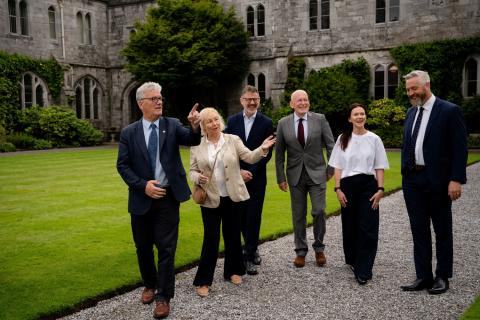
Representatives of civil society, academia and public authorities gathered at University College Cork (UCC) on 30 June for a conference entitled Civil society driving the EU sustainability agenda, organised by the European Economic and Social Committee’s (EESC) Civil Society Organisations’ Group. Participants from across Europe discussed how civil society can help advance and shape sustainable development, strengthen democratic participation and support Europe's long-term resilience.
In his inaugural remarks, Cillian Lohan, President of the Civil Society Organisations’ Group, reaffirmed the group’s longstanding commitment to sustainable development and called for renewed ambition as Europe looks beyond the UN’s 2030 Agenda for Sustainable Development. He stressed that sustainability remains essential not only for environmental protection, but also for economic prosperity, democratic resilience and strategic autonomy. Public engagement and countering negative narratives on the energy transition are key. 'The aim of this conference was to give fresh momentum to the European sustainable development agenda - at a time when sustainability policy is coming under increasing pressure, despite being urgently needed. Our event also highlighted the role of local communities and civil society organisations in designing, implementing and monitoring sustainability measures that make our communities more resilient.'
Professor John O’Halloran, UCC President, welcomed participants and highlighted the university’s commitment to addressing global sustainability challenges through research, education and engagement with communities. 'We are honoured to host this prestigious event at University College Cork, and to welcome partners from across Europe to engage in these important discussions. Through our research and education, UCC is focused on addressing the most pressing global sustainability challenges and on working with communities and stakeholders to help shape a more resilient and sustainable society.'
The conference took place on the eve of the start of the Irish Presidency of the Council of the EU. Participants examined key challenges, including climate change, biodiversity loss, energy independence, competitiveness, democratic resilience and implementation of the 2030 Agenda with its 17 SDGs.
Addressing the conference, Christopher O’Sullivan, Irish Minister of State for Biodiversity, underlined the importance of restoring nature and ensuring that Ireland is prepared to implement the EU Nature Restoration Law. 'Delivering on the Nature Restoration Law is my top priority as Minister for Nature. I am currently working with colleagues across government to put the necessary resources and supports in place so that Ireland is ready to grasp this once-in-a-generation opportunity and ensure we can all share in the benefits of a healthy, thriving natural environment.'
The keynote address was delivered by Frans Timmermans, former Executive Vice-President of the European Commission and architect of the European Green Deal. Reflecting on the multiple challenges facing Europe and the world, he emphasised the importance of an empowered and engaged civil society.
'Never before has humanity faced so many challenges at the same time. Climate change, industrial revolution, geopolitical upheaval, social disruption: all these challenges need to be addressed at the same time. Because this affects societies at every level, civil society will play a crucial role in determining whether we succeed or fail in tackling all these challenges. Empowering civil society is essential'. He underlined that civil society should be part of every step. The energy transition andenvironmental policies could only succeed if they had a strong socio-economic dimension that guaranteed a just transition.
A panel discussion entitled 'Civil society at the steering wheel of the sustainability agenda' brought together experts from the fields of sustainable development, public health, youth engagement and environmental advocacy to explore how civil society organisations could continue to contribute to EU policymaking and implementation.
Among the speakers, Karen Ciesielski, Chief Executive Officer of the Irish Environmental Network, highlighted the indispensable role of civil society organisations in connecting citizens and policymakers.
'We bring local knowledge, practical experience and public trust into conversations that can otherwise feel remote or technical. We help connect communities to decision-making and keep long-term environmental and sustainable development goals in view, even when the political climate is difficult. In order to have strong civil society networks and institutions, we need them to be sufficiently funded and supported, with clear pathways for engaging with decision-makers.'
The conference forms part of a broader series of initiatives led by the EESC Civil Society Organisations' Group, including events in Larnaca (in the framework of Cyprus’ EU Council Presidency) and Brussels and recent work on the circular economy. The results of the conference will inform the work of the group, which focuses in its current term on empowering resilient communities, defending democracy, contributing to peace and promoting the sustainable agenda. The group is also advocating a long-term EU budget for 2028-2034 that is guided by a clear European ambition and delivers what is needed for democracy, civil society and social inclusion.
By Sandra Parthie, President of the EESC Employers’ Group
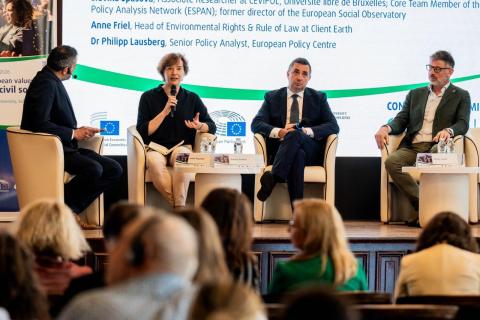
This fundamental question was at the heart of the roundtable discussion at the EESC Connecting EU seminar on ‘Made in the EU: competitive, social and sustainable’, held in Sofia on 6 July 2026. The discussion highlighted a simple but often overlooked reality: Europe’s economic strength, social cohesion and environmental ambitions are deeply interconnected.
This fundamental question was at the heart of the roundtable discussion at the EESC Connecting EU seminar on ‘Made in the EU: competitive, social and sustainable’, held in Sofia on 6 July 2026. The discussion highlighted a simple but often overlooked reality: Europe’s economic strength, social cohesion and environmental ambitions are deeply interconnected.
By Sandra Parthie, President of the EESC Employers’ Group
As Europe’s social model depends on Europe’s productive capacity, the ‘Made in the EU’ strategy must keep investment, production, jobs and value creation in Europe. Companies must be able to invest and scale up in Europe if we want to maintain quality jobs, finance social protection and deliver on the green transition.
This can happen only if companies have the right framework conditions: affordable energy, modern infrastructure, efficient telecommunications networks, faster permitting, and a truly integrated single market.
As businesses increasingly relocate investment and production outside the EU, Europe must create the conditions that encourage them to stay, grow and manufacture here. Recent investment decisions also demonstrate the value of strengthening Europe’s industrial base through cross-border cooperation. For example, German company Rheinmetall has announced plans to invest in Romania to manufacture tanks, creating industrial capacity and jobs within the EU while deepening cooperation between Member States. This shows how a strong European industrial ecosystem can combine investment, production and innovation across borders, reinforcing both competitiveness and resilience.
In addition, without profitable and innovative companies creating value, there is little to redistribute and little capacity to finance social progress.
This is why competitiveness and sustainability are not opposing goals, but mutually reinforcing pillars of a sustainable and modern European economy. This means that Europe does not need to choose between competitiveness and its social and environmental ambitions. Rather, competitiveness is what makes those ambitions achievable. A credible ‘Made in the EU’ strategy should therefore support strategic production, innovation and investment while maintaining Europe’s high standards and values.
Europe’s future prosperity will depend on its ability to create the conditions for businesses to succeed, workers to thrive and sustainable growth to flourish. A stronger, more competitive Europe is not an alternative to a Social Europe, it is its precondition.