As part of European Youth Week 2026, the European Economic and Social Committee (EESC) highlighted its long-standing commitment to meaningful youth participation through direct engagement with young people and a range of concrete policy tools designed to strengthen their influence on decision making.
As part of European Youth Week 2026, the European Economic and Social Committee (EESC) highlighted its long-standing commitment to meaningful youth participation through direct engagement with young people and a range of concrete policy tools designed to strengthen their influence on decision making.
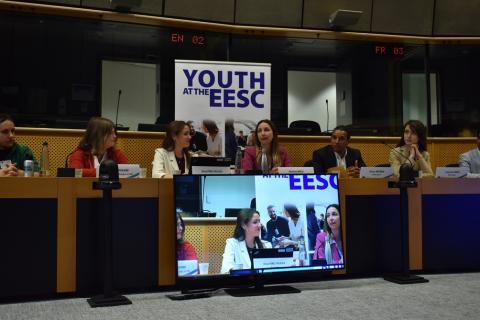
A key moment of the EESC’s contribution was the interactive breakout session 'Meaningful youth participation in action!', held on 24 April as part of the official programme. The roundtable brought together more than 40 young participants to reflect on how youth engagement can move beyond consultation and lead to tangible impact at local, national and European levels.
The discussion highlighted concrete tools and pathways developed by the EESC to support youth engagement, including the EESC Youth Test, which integrates youth perspectives into EU legislative processes, and the Youth Delegate to COP initiative, enabling young people to contribute directly to international climate negotiations. Youth organisations are also actively involved in the EESC’s work through platforms such as Your Europe, Your Say!, the Liaison Group, the European Circular Economy Stakeholder Platform, and Fundamental Rights and Rule of Law country visits, as well as through cooperation with youth organisations from EU candidate countries.
Young leaders and experts already shaping policy shared their experiences during the session, including President of the EESC Youth Group Nicoletta Merlo, former EESC Youth Delegate to COP Sophia Wiegand and youth participation experts Bruno António and Françeska Muço. Discussions focused on access to decision-making spaces, the barriers young people continue to face, and the difference between meaningful and tokenistic participation. Participants underlined that genuine involvement requires early engagement, clear roles, long-term support and visible follow-up.
Taking place from 24 April to 1 May under the theme 'Solidarity and Fairness', European Youth Week 2026 offered an opportunity to reaffirm that youth participation at the EESC is a core, long-term institutional priority.
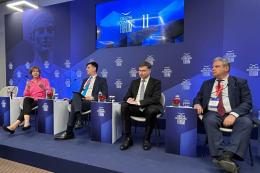
At this year’s Delphi Economic Forum, an EESC Employers' Group delegation, led by President Sandra Parthie and composed of members Winand Quaedvlieg, Marcin Nowacki, Michal Pinter, Kristi Sober, and Katalin Sule, joined political, business, and academic leaders to talk about economic growth, geopolitics, and sustainability.