On 10 May, step into the heart and house of European organised civil society at the European Economic and Social Committee, at the Jacques Delors building, Rue Belliard 99, 1040 Brussels.
On 10 May, step into the heart and house of European organised civil society at the European Economic and Social Committee, at the Jacques Delors building, Rue Belliard 99, 1040 Brussels.
This year’s Europe Day is extra special as we commemorate the 75th anniversary of the Schuman Declaration – the historic foundation of European unity and cooperation. On this momentous occasion, the EESC is opening its doors for a full day of engaging, informative and entertaining activities and a discovery tour. From policy enthusiasts to curious young minds, there is something for everyone.
Stamp your way through the EESC with our Discovery Tour:
Complete fun challenges at all the thematic stands.
Collect a stamp at each one in the dedicated passport.
Return your completed passport and claim your special reward!
Don’t miss the chance to meet and chat with EESC President Oliver Röpke at a dedicated stand! He’ll be there to welcome visitors, answer your questions and share his vision for European civil society – a unique opportunity to connect directly with the EESC’s leadership.
Enjoy even more fun with:
a caricaturist to take your portrait;
a playful kids’ corner;
a funky photo booth;
a spinning Wheel of Fortune with surprises;
and a real-time voting simulation where you can step into the shoes of an EESC member!
Plus, find out how our sections and groups help shape EU policy and values.
Let’s celebrate the ideas that unite Europe. Come with your friends, family or on your own – but DON’T MISS IT!
It’s more than a visit – arrive curious, leave inspired!
It’s April, and we’re still reflecting on the energy and insights sparked by our flagship events in March—events that once again demonstrated the power and determination of civil society.
It’s April, and we’re still reflecting on the energy and insights sparked by our flagship events in March—events that once again demonstrated the power and determination of civil society.
March was indeed an intense and inspiring month at the European Economic and Social Committee. We hosted our annual youth event, Your Europe, Your Say (YEYS), where we hand the mic to Europe’s future: young people, many still in secondary school, from across the continent, including the UK and EU candidate countries.
We also held our second Civil Society Week, bringing together over 800 civil society representatives from across Europe to engage in lively discussions, exchange best practices, and co-create solutions aimed at strengthening democratic participation. This year we held it under the banner of Strengthening cohesion and participation in polarised societies.
In today’s turbulent times, there’s no shortage of pressing issues. So why focus on polarisation?
Polarisation—the sharpening of opposing views—can be a normal part of democratic discourse, often rooted in ideology. In fact, vibrant debate and the expression of diverse, even clashing opinions are vital to any open and pluralistic society like ours. As the EESC has often underlined, open and unrestricted debate is 'the foundation of a participatory society, without which democracy cannot function properly'.
Yet, the kind of polarisation we are seeing today is different. We are witnessing the rise of negative polarisation and populism that reject dialogue, erode trust, and undermine democratic values. In politics and public life, space for compromise is shrinking. When polarisation turns hostile—when it feeds hate or resentment—it disrupts social cohesion, fuels division, and in the worst cases, leads to violence.
By dedicating our event to polarisation, we wanted to point to the troubling rise of its toxic traits, which are slowly creeping into all pores of European societies.
This worrying trend is amplified by a number of threats: foreign interference in democratic processes, the spread of disinformation, and the manipulation of social media to silence opposing voices and promote extreme views. We are also seeing growing pressures on media freedom—whether through monopolisation, government interference, or attacks on journalists—at a time when free and pluralistic media are more essential than ever.
At the EESC, we are deeply concerned about the rise in hate-based crimes across Europe, including those targeting religion, sex, and gender. Hatred undermines democracy, weakens our institutions, and sows mistrust among citizens.
This is where civil society plays a crucial role. Civil society organisations have the drive and courage to defend democratic spaces, uphold fundamental rights, and strengthen the fabric of our communities. That includes pushing back against the toxic effects of negative polarisation.
Civil Society Week was our way of supporting that effort. It offered a space for meaningful dialogue, fresh ideas, and collaborative problem-solving aimed at fostering participation and social cohesion. We had Liaison Group panels on different topics, and a day dedicated to the European Citizens' Initiative (ECI) – the EU's ultimate tool for direct democracy.
As part of the week, the EESC also awarded its 15th Civil Society Prize to three outstanding initiatives combatting polarisation across Europe. Chosen from over 50 entries from 15 Member States, these projects show both the scale of the challenge and the deep commitment of civil society actors to meet it head-on.
I hope this year’s Civil Society Week and our prize winners will inspire renewed optimism and belief in the role civil society can play in defending and promoting European democratic values.
And while we are still reviewing the ideas, proposals, and takeaways from our March events, in this April issue we decided to give the floor to some of the voices from Civil Society Week and YEYS. I hope you enjoy the read.
Tatiana Povalyaeva represented Ukraine at this year's Your Europe, Your Say! (YEYS)alongside her students. A teacher at a secondary school in Kharkiv, she last stood in front of her class in February 2022 and has been teaching online ever since. She describes the challenges of being an educator in a town just 40 kilometres from the Russian border, which has endured relentless strikes since the start of the war.
Tatiana Povalyaevarepresented Ukraine at this year's Your Europe, Your Say! (YEYS)alongside her students. A teacher at a secondary school in Kharkiv, she last stood in front of her class in February 2022 and has been teaching online ever since. She describes the challenges of being an educator in a town just 40 kilometres from the Russian border, which has endured relentless strikes since the start of the war.
As an educator, as a teacher, how has the war impacted your ability to teach and the education system in general in Ukraine?
Today in Kharkiv, almost all schools have moved to online learning because we don't have enough shelters to keep our students safe during in-person classes. We have been doing that for three years now and the last time I saw my students in class was on 23 February 2022. Many students have left the country — they had to. They are now living in many European countries and as a teacher, I feel deep sorrow. I miss my students and I know they have to struggle with many things. They sometimes have to study in both European and Ukrainian schools. That's a huge burden for them. Meanwhile, those of us still in Ukraine live in constant danger. Nobody deserves to go through this.
Teaching and supporting students during wartime is something we've never faced before. One of the biggest challenges for me is feeling powerless to help some students. My knowledge and experience are sometimes not enough to handle their health problems caused by stress and its effects. I've seen serious changes in students' personalities due to post traumatic stress disorder, where a doctor's help is more urgently needed than a teacher's. It's painful to realise you can't shield your students from these hardships. Still, we stay close to our students, ready to help and support them and care for them.
Another difficulty is staying resilient myself and being a good resource for my students, not only in my school subject area but also in other aspects of life. A strong, resilient teacher can offer more to students, but the question is: how do we maintain that strength? Teachers living and working through war need just as much support as anyone else because we are supporting the children who are our future. The more positive a teacher feels, the more support and care students receive.
Why do you think it's important to encourage your students to be interested in politics or in civic life or to participate in international events like this one?
Encouraging our students to be active doers is one of the essential tasks of teachers. Inspiring them to stay engaged in political life is even more important, as politics has a significant impact on people’s lives. It offers a valuable opportunity to come up with ideas and solutions to many of the problems we face today.
By attending international events such as Your Europe, Your Say!, students can find companions and supporters to share their ideas, work together towards the best solutions, and exchange valuable experiences. Without a doubt, meeting peers allows students to reflect on how progressive they are, what plans, goals, and perspectives they have, and what kind of personal growth they may still need.
If you could say anything to other teachers or other schools, what would you like to say as a teacher in Ukraine at the moment?
I have just three points I would like to share with my colleagues and their students. First, if you truly want to know the truth about the war, ask the people who are living through it.
Second, realise the importance of being united to help others and be ready to prevent catastrophic events. Also, understand how significant it is to be a part of a strong community with shared moral values, interests and prospects for the future.
The third and I think the most life-affirming fact is that we are alive. We live our life, we struggle and we get results. We improve ourselves; we hope for the better and we do a lot to prove that even in the hardest times, there is hope and thirst for life. We respect those who sacrifice their lives for our independent future, and we help them as much as we can. We feel gratitude to everyone who helps.
The students of Ukraine take part in many domestic and international events, competitions, and the Olympics, where they achieve great results and earn world recognition. At the same time, we are learning to survive physically, intellectually and emotionally in the hardest living conditions, forming our lived experiences in the middle of Europe.
Tatiana Povalyaeva has been teaching English at Kharkiv Lyceum 99 in Ukraine for almost 26 years. She took part in this year's Your Europe, Your Say! (YEYS) where she accompanied her students.
The dysfunctions of the single market are having a direct impact on the cost of living and the EESC regrets that the situation is getting worse. The cost of living is more than ever the primary concern of our fellow citizens, especially young people. Most affected are the 94.6 million Europeans living at risk of poverty or social exclusion.
The dysfunctions of the single market are having a direct impact on the cost of living and the EESC regrets that the situation is getting worse. The cost of living is more than ever the primary concern of our fellow citizens, especially young people. Most affected are the 94.6 million Europeans living at risk of poverty or social exclusion.
The IMF estimates that non-tariff barriers within the EU are equivalent to customs duties of around 44% for goods, which is three times as much as the barriers between US states, to use the now-customary comparison. For the services market, the figure is 110%!
Food, housing, energy, healthcare, education: many areas are affected, and European initiatives exist. We all need to step up: Member States, private operators and the European Commission in its role as Guardian of the Treaties. I will cite three of the key recommendations made in our report.
Firstly, we urgently need to address territorial supply constraints and national segmentation by private operators, which restrict competition and lead to higher prices for consumers. Fourteen billion dollars: this is the extra cost to consumers every year, according to a 2020 JRC study. Taking inflation into account, it makes sense that their main goal now is to improve the single market. The Commission, primarily through the SMET, is working on this. Though the problem is complex, proposals have been put forward. Let us assess their impact and make quick progress on the issue.
We also propose speeding up proceedings against national rules that infringe EU law. We should examine the possibility of interim injunctions against clear breaches of EU rules. We must not allow barriers to be put in place. The protectionism of certain Member States has direct consequences. What are we to make of the fact that medicines can expire before they can be redirected to where they are needed?
Finally, we have a duty to find a balanced approach between preventing erosion of high standards for sustainability, well-being and protection of workers, reducing unnecessary administrative burdens and facilitating cross-border trade to foster a fair and competitive single market.
Fragmentation of the single market is directly impacting the cost of living in the EU, pushing many Europeans to the brink of poverty. We asked Emilie Prouzet, rapporteur for the opinion on this topic, what the EESC recommends to address this issue and create a fair and competitive single market.
Fragmentation of the single market is directly impacting the cost of living in the EU, pushing many Europeans to the brink of poverty. We asked Emilie Prouzet, rapporteur for the opinion on this topic, what the EESC recommends to address this issue and create a fair and competitive single market.
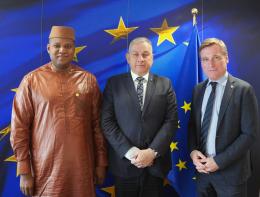
EESC President Röpke met on 10 April 2025 with European Commissioner for International Partnerships Síkela and the Presiding Officer of the African Union's Economic, Social and Cultural Council (AU ECOSOCC), Sissoko, to reinforce joint efforts in enhancing civil society engagement in the EU-Africa partnership.
Proposal for a DIRECTIVE OF THE EUROPEAN PARLIAMENT AND OF THE COUNCIL amending Directives 2006/43/EC, 2013/34/EU, (EU) 2022/2464 and (EU) 2024/1760 as regards certain corporate sustainability reporting and due diligence requirements
Proposal for a REGULATION OF THE EUROPEAN PARLIAMENT AND OF THE COUNCIL amending Regulation (EU) 2021/1057 establishing the European Social Fund + (ESF+) as regards specific measures to address strategic challenges