
European Economic
and Social Committee
EU Organic Awards 2026: Applications open to celebrate Europe’s organic excellence
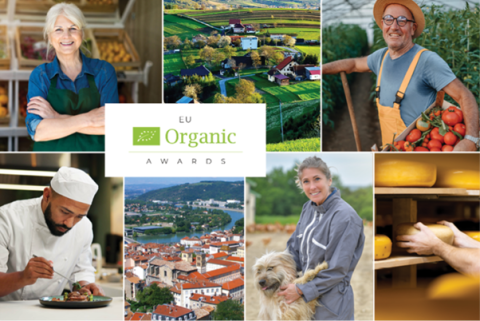
The 5th edition of the EU Organic Awards is now open for applications from 10 February to 26 April 2026. These awards celebrate leaders in the organic value chain who develop inspiring projects that enhance organic food production and consumption.
This year’s winners will be celebrated at the Awards Ceremony on the EU Organic Day, 23 September in Brussels.
The EU Organic Awards are jointly organised by the European Commission, the European Economic and Social Committee, the European Committee of the Regions, COPA-COGECA and IFOAM Organics Europe, with the participation of the European Parliament and the Council in the evaluation.
Seven awards will be presented across six categories:
- Best organic farmer (female and male)
- Best organic region/bio-district
- Best organic city
- Best organic food processing SME (EESC)
- Best organic food retailer (EESC)
- Best organic restaurant/food service (EESC)
In line with its role in representing organised civil society and promoting sustainable food systems, the EESC takes a leading responsibility for the final three award categories, highlighting excellence across the organic value chain, from processing and retail to food services.
Who can apply?
Any EU actor or institution with a noteworthy project that contributes to greater affordability and accessibility of organic products in the EU can apply. This includes not only organic farmers, regions or bio-districts, unique businesses like organic shops or restaurants, but also cities offering for instance, organic meals to local school pupils, or actively promoting organic production.
How to apply
Applications are welcome in all official EU languages via an online form available until 26 April 2026. Eligible applications will be reviewed by the EU Organic Awards jury against the criteria of excellence, innovation, sustainability and potential to replicate the project elsewhere in the EU. Winning projects will play a key role in raising public awareness about organic production within the EU.
Background
The Vision for Agriculture and Food underlines that sustainability and farming can go hand in hand, and organic farming serves as a prime example of this. Its environmental credentials are clear: Organic farming encourages the responsible use of energy and natural resources, the preservation of regional ecological balances, the enhancement of soil fertility, the maintenance of water quality, rich biodiversity and high standards of animal welfare.
The economic and business case of organic farming is equally important. The share of land farmed organically in the EU has been growing steadily to attain currently around 17 million hectares (11% of the total agriculture land).
Organic farming has also become a driver for generational renewal as underscored in the Commission’s Strategy for generational renewal in agriculture and the organic share among young farmers is far higher (20.7%) than for all farms combined (11.9%). EU initiatives in favour of organic farming not only create the conditions for the long-term and sustainable competitiveness of rural areas but also open up new opportunities for the generation renewal in agriculture.
Work organisation
Recommended for you
Celebrating the best of Europe’s organic sector: Apply now to win the 2024 award!
News
With 2024 marking the third year of the EU Organic Awards, the European Economic and Social Committee (EESC) is urging businesses to put themselves forward for these prestigious prizes and take…
Launch of the first EU organic awards
News
Today, as a true pan-European collaborative venture, the European Commission, the European Economic and Social Committee (EESC), the European Committee of the Regions (CoR), COPA-COGECA and IFOAM…
EU Organic Awards 2022: the EESC finalists are in!
News
The European Economic and Social Committee (EESC) is proud to announce the finalists, by category, for the first ever EU Organic Awards, co-organised with the European Commission and other partners…
Finalists announced for the 2024 EU Organic Awards
News
The names of the finalists for the 2024 EU Organic Awards have been revealed today. For each of the eight categories, the top three projects have been selected, representing 24 finalists from 12 EU…
EU organic awards 2025: Apply now!
News
The European Economic and Social Committee (EESC) announces that applications for the fourth edition of the EU Organic Awards open today, 11 February 2025. The application period runs until 27 April…