
European Economic
and Social Committee
Apply AI Strategy: Building trustworthy AI can be Europe's competitive advantage
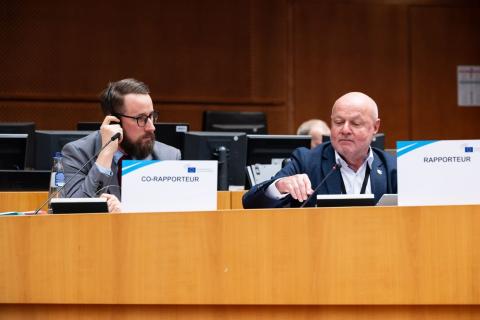
EESC called for swift, concrete action to accelerate AI deployment across the EU, especially for SMEs and scale-ups. In a global AI race driven by speed and scale, Europe must position reliability and trustworthiness as its defining strengths.
At its January plenary session, the European Economic and Social Committee (EESC) gave its backing to the European Commission's Apply AI Strategy, which seeks to move AI from research and hype to real use in business and public services.
Promoting an ‘AI first’ policy approach, the Apply AI Strategy encourages EU companies and the public sector to always first consider AI solutions when making strategic decisions.
However, Europe is lagging far behind the United States and China, which invest heavily in developing AI, and the consensus is that the EU is late to the table and slow in developing AI at scale.
It now faces the dual challenge of accelerating innovation while ensuring AI systems align with European values and regulatory standards.
During a plenary debate with the European Commission and AI experts before the adoption of the EESC's opinion on the strategy, the EESC stressed that AI must be trustworthy, transparent and human-centric. Europe’s competitive advantage lies in an approach to AI that considers both technological progress and the protection of human dignity, workers’ rights and fundamental freedoms.
SLOW AI IMPLEMENTATION IN EUROPE
Opening the debate, EESC President Seamus Boland said: ‘As AI evolves rapidly, Europe cannot afford fragmented approaches or uneven capabilities across Member States and sectors. The gap between technological innovation and practical deployment is still significant, and we must address it collectively.’
Lucilla Sioli, Director of the Artificial Intelligence Office at the European Commission, said that the slow progress in governance implementation across Member States risks undermining the development of trustworthy and compliant AI: ‘We call on the Member States to revise their AI strategies and align them with the visions and ambitions of the Apply AI Strategy.
AI infrastructure is costly, and the public sector cannot shoulder this burden alone. Unlike the US, Europe lacks comparable private investment. ‘The “AI gigafactories” initiative aims to involve the private sector, with companies expected to cover around one third of the total cost’, Ms Sioli said.
EESC CALLS FOR RAPID AND INCLUSIVE DEPLOYMENT OF TRUSTWORTHY AI
In its opinion, the EESC calls for swift, concrete action to accelerate AI deployment across the EU, particularly for SMEs and scale-ups. It urges simpler access to funding, lighter administrative requirements and clearer intellectual property rules, alongside stronger regional AI ecosystems built on European digital innovation hubs and the inclusion of key sectors such as finance, tourism and e-commerce.
The Committee also stresses the need for sustained investment in AI skills, proportionate and clear regulation, inclusive governance and long-term funding and strategic public procurement under the 2028–2034 EU budget to strengthen Europe’s AI ecosystem, competitiveness and digital sovereignty.
Rapporteur of the opinion, Rudolf Kolbe, outlined several elements that the EESC considers relevant for the implementation of the AI Apply Strategy: ‘Governance must be inclusive and implementation-oriented, involving civil society from the outset. We are convinced that targeted measures, for example in healthcare, industry and construction, as well as security could create real demand for European solutions. The EU needs reliable investment and hands-on SME support, including via AI experience centres. AI literacy must be clearly defined and taught in practice.’
Co-rapporteur, Miroslav Hajnoš, said: ‘Artificial intelligence is often presented as a challenge for the labour market, public services and public trust, but in Europe, it must be clearly understood as a tool, not an end in itself. The deployment of AI must not happen without the proper involvement of those that represent all people – social partners, workers, SMEs and civil society must be actively involved in decision-making. Only through inclusive governance can AI become a driver of growth, inclusion and better public services, rather than a source of new inequalities.’
Andrea Renda of the Centre for European Policy Studies (CEPS) cautioned against a one-size-fits-all approach, arguing that AI should not be replicated identically across all regions and sectors, and should instead develop through centres of excellence for specific types of AI. Europe, he warned, should avoid replacing dependence on cloud providers with dependence on large data centres.
‘AI first should not mean EU only’, Mr Renda said, stressing that digital sovereignty must be pursued pragmatically.
FRONTIER AI INITIATIVE – EU'S CHANCE TO BUILD ADVANCED AI MODELS ALIGNED WITH EU VALUES
Max Reddel, Advanced AI Director at the Centre for Future Generations, commended the EESC’s emphasis on building sovereign European AI capabilities and avoiding dependence on foreign AI systems, including non-European frontier models.
‘The numbers tell the story: ChatGPT has 800 million weekly users. Europe’s best models? In the low millions,’ Mr Reddel said, warning that this gap creates concrete risks, including data theft, service restrictions and unfavourable terms of trade.
He pointed to the Apply AI Strategy’s frontier AI initiative as a key step towards enabling Europe to build advanced AI models on its own foundations. The initiative aims to support the development of frontier models — large, general-purpose systems that can underpin sectoral applications such as healthcare or finance, where Europe still relies heavily on US and Chinese models. Announced by France, Germany and the European Commission, it is expected to combine public and private funding to develop models that are not only more capable, but also reliable and aligned with European values.
‘An AI that is trustworthy, transparent and human-centric is Europe’s competitive advantage,’ Mr Reddel said. ‘Europe’s strength is reliability. We build technology that doesn’t break. ASML’s lithography machines. Airbus aircrafts. Technologies so precise and dependable that we lead markets others pioneered. We can replicate this in AI.’