
European Economic
and Social Committee
Fulfilling our collective responsibility to eradicate poverty by 2050
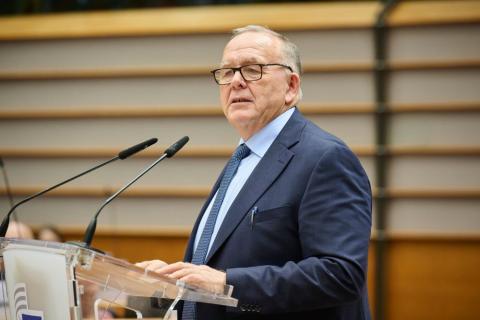
Statement by Séamus Boland, President of the European Economic and Social Committee (EESC), welcoming EU's first Anti-Poverty Strategy
It is with immense pleasure that I welcome the European Commission's (EC) ambitious social package and in particular, the first EU Anti-Poverty Strategy. I very much look forward to the European Economic and Social Committee's (EESC) concrete role in its implementation, through the cooperation agreement to be signed with the European Commission (EC).
It is with immense pleasure that I welcome the European Commission's (EC) ambitious social package and in particular, the first EU Anti-Poverty Strategy. I very much look forward to the European Economic and Social Committee's (EESC) concrete role in its implementation, through the cooperation agreement to be signed with the European Commission (EC).
Taking steps towards the eradication of poverty is a political choice. Changing the narrative on poverty is also a political choice. Involving people experiencing poverty in the design and governance of poverty eradication, as recommended by the EU Anti-Poverty Strategy, is simply common sense and something that the EESC has repeatedly requested.
Today, with more than 93 million people at risk of poverty and social exclusion within the EU, including almost one in four children, this strategy could not have come soon enough. Although quality jobs are the best way out of poverty, there are today too many working poor. With Europeans facing the housing, energy, cost of living and environmental crises, it is crucial that the entire EU comes together. To jointly combat social exclusion and to maximise opportunities for all, including the marginalised, homeless and persons with disabilities. It is in this context that my work programme, 'Civil Society at the Heart of Europe', includes as the first objective 'Providing opportunities through poverty eradication'.
Without doubt, child and inter-generational poverty must be at the centre of those efforts. Consequently, it is imperative that Member States make maximum use of available EU funding and I reiterate the call of the European Parliament for at least 5% of the European Social Fund + to be earmarked for projects aimed at combatting child poverty. A figure that should increase to 10% in countries where levels of child poverty and social exclusion are higher than the EU average. Clearly, the ongoing negotiations on the next Multi-annual Financial Framework (MFF) are an opportunity to rebalance the Union's economic and social priorities, for the benefit of all.
Similarly, I cannot stress enough the importance of anchoring the implementation of the Affordable Housing Plan, within the EU Anti-Poverty Strategy. It is essential that the two instruments operate in a complementary manner, ensuring people-centred solutions and avoiding the most extreme forms of poverty, namely: homelessness. In this context, the EC proposal for a Council Recommendation on fighting housing exclusion is very welcome.
Finally, I would like to highlight that the banking sector in its entirety, needs to be part of the solution to poverty eradication. This is particularly important during the current climate of curtailment of funding to civil society organisations (CSOs). I welcome the proposal for structured cooperation with multi-lateral investment banks and for a 'Coalition Against Poverty'. However, we also need incentives for mainstream national banks to actively support CSOs, including the social economy. Similarly, we need targeted actions to enhance the capacities of ethical and cooperative banks within the EU.
The EESC already published an exploratory Opinion on the EU Anti-Poverty Strategy in July 2025. Numerous relevant Opinions will also be adopted over the coming months, alongside the publication of the study 'Breaking the Cycle of Disadvantage – reviewing EU policy through the lens of poverty'. Moreover, the Committee will organise a high-level conference on poverty on 22 October and dedicate the 16th edition of the EESC Civil Society Prize to 'Combatting Poverty in the EU'.
Séamus Boland
President of the EESC