
European Economic
and Social Committee
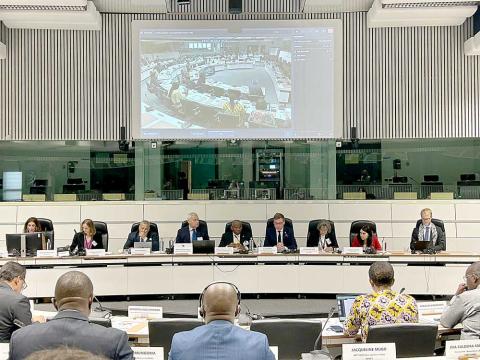
The European Union Africa Economic and Social Stakeholders' Network meeting
Your Excellencies,
Distinguished guests,
Ladies and gentlemen,
I am honoured to stand before you today as we gather to reflect on the African Union-European Union partnership and how we can better work together towards a sustainable future.
First of all, let me thank all of you for joining this event today, for travelling from so many places in Africa. In particular, I would like to thank the African Union Economic, Social and Cultural Council for its contribution in the organisation of this event. A warm welcome to Mr Boudali, Presiding Officer of the AU ECOSOCC and to the delegation of AU ECOSOCC members with us today. We are glad to work with you and are looking forward to further cooperate with you.
Our partnership between the African Union and the European Union is rooted in shared values and a common vision of fostering cooperation, development, and sustainable growth. Today and tomorrow, this conference should serve as a platform for you, as economic and social stakeholders from Europe and Africa, to engage in a meaningful dialogue about our partnership and explore innovative solutions towards a prosperous and sustainable future for both our continents.
In particular, two critical themes, Water and Nutrition as well as Critical Raw Materials will be on the agenda.
First, we will delve into the issue of water and nutrition, focusing on the Zero Hunger objective and water sustainability. Water scarcity and malnutrition are pressing issues that demand our immediate attention. Access to safe water and adequate nutrition are fundamental human rights. It is unacceptable that in the 21st century, millions of people continue to suffer from hunger and lack of access to clean water.
Water is a scarce and precious resource that underpins food security and human well-being. Climate change threatens our access to this precious resource. Water is essential for agricultural production, and without sustainable water management, we cannot hope to achieve food security or eradicate hunger. Efforts towards reaching the water-related Sustainable Development Goals must be increased, as they are also essential to reach other SDGs, including Goal 2 "Zero Hunger".
By bringing these challenges to the forefront of our discussions today, the aim is to underline the importance of inclusive and participatory water and food policy-making. What we want to better integrate water and agriculture strategies, better support smallholder farmers, and work towards climate change resilience.
In this context, we decided in the EESC to work on water as a cross-cutting theme in 2023 with our initiative on a "Blue deal", to raise the attention on the situation and inform policy-making about water issues in all their dimensions and all their implications. The debate tomorrow will also be a contribution to our work.
Second, we will explore the theme of critical raw materials and their role in fostering sustainable development. As we transition to a low-carbon economy, the demand for critical raw materials is on the rise and it is essential that our partnership involves responsible and sustainable production, extraction and trade of critical raw materials. It is a common endeavour to promote sustainable extraction practices, enhance resource efficiency, and foster research and innovation, so that the exploitation of critical raw materials contributes to sustainable development while minimising negative environmental and social impacts.
Both topics, water and raw materials, can have important impacts on human rights and, as we are celebrating this year the 75th anniversary of the universal declaration of human rights, we should always remember that this is the basis of our shared values.
Now, allow me a word about the involvement on civil society in the Post-Cotonou agreement which will be the topic of the timely debate you will hold later today.
Let me be abundantly clear: one cannot co-create and implement solutions on the ground for 1.5 billion people without properly involving their civil society.
On the EU side, the ministers approved a 4 months extension period of the Cotonou agreement. We should not waist time and already prepare for the Post-Cotonou implementation before its signature, notably as regards the participation of civil society.
We welcome the fact that the negotiated agreement recognises the significant role of civil society and social partners in its implementation and monitoring.
The new agreement, although highlighting the significance of civil society engagement, delegates the task of establishing the institutional framework for civil society participation to the parties. In light of this, I would like to reiterate our stance: we believe it is crucial for all EU agreements to incorporate a robust civil society element, enabling social partners and civil society stakeholders to contribute to the public and democratic debate of their implementation, monitoring and review.
But we are also at a critical juncture and there is a risk. It is vital to persistently champion the inclusion of civil society, including social partners, in the ACP-EU framework.
This is the reason why I would like to make the position of our commitee clear: we strongly believe that the ACP-EU Follow-up Committee, with its more than 20-year experience as the only ACP-EU mechanism in place, will be the best place to contribute to and support the establishment of institutional mechanisms guaranteeing civil society participation within the scope of the new ACP-EU agreement.
For us, it is also imperative that all trade agreements between the EU and African countries, namely Economic Partnership Agreements, explicitly acknowledge and include provisions regarding the involvement of non-state actors in the implementation, monitoring, and evaluation of those agreements. This is essential to ensure fair and equitable trade, address the social dimensions of the EPAs, and move ACP countries up along the value-added chain.
The CARIFORUM Consultative Committee is an excellent example of good practice, which should be disseminated and replicated.
There is a good dynamic, I for example welcome the recent conclusion of the negotiations for an Economic Partnership Agreement between the EU and Kenya. For the first time, a trade agreement between the EU and an African country includes an ambitious trade and sustainable development chapter and requires the setting-up of civil society bodies - namely Domestic Advisory Groups that will advise both sides on the implementation of the Agreement, as well as a Consultative Committee gathering both EU and Kenyan civil society representatives.
This is a very positive development that, we hope, will pave the way for other Economic Partnership Agreements. Economic Partnership Agreements are important to generate new trade and investment prospects but they must also foster sustainable development, safeguard the environment, and uphold essential ILO conventions.
I am also happy that this meeting is an opportunity to collaborate with the ACP-EU Joint Parliamentary Assembly. Its 43rd session is coming to an end today in Brussels. This afternoon, you will have the possibility to follow activities organised by the Joint Parliamentary Assembly: a seminar on best practices to fight disinformation and the women's forum. These two topics are close to my heart and part of my political program: supporting civil society organisations in their fight to combat disinformation and defend democracy, as well as mainstreaming gender equality in all policies are two priorities of my Presidency.
Tomorrow, we will have the pleasure to hear the two co-Chairs of the Joint Parliamentary Assembly, Ms Sithole and Mr Zorrinho. I would like to warmly thank the Joint Parliamentary Assembly and its two co-Chairs for their very good collaboration.
Europe and Africa can lead the way in forging a sustainable future for generations to come. Our partnership is not only about addressing current needs but also about leaving a lasting legacy of collaboration, resilience, and prosperity.
This meeting provides an excellent opportunity for knowledge sharing, capacity building, and networking. Together, we can learn from each other's experiences, exchange best practices, and foster innovation.
We will close this eight meeting of EU-Africa economic and social stakeholders with the adoption of a political declaration, which will be addressed to the institutions of the European Union and of the African Union.
Thank you for your presence here today, and I wish you all a fruitful and inspiring meeting.
[check against delivery]