
European Economic
and Social Committee
Speech by President Séamus Boland, EESC plenary debate 'Ensuring a sustainable and just transition through people-centred climate and biodiversity action'
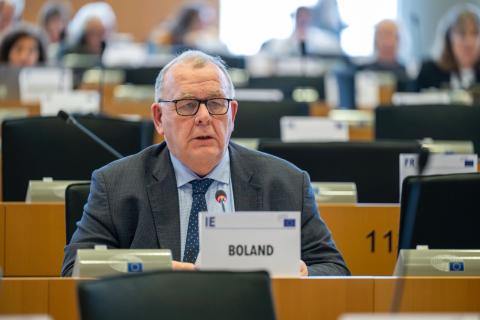
EESC plenary debate 'Ensuring a sustainable and just transition through people-centred climate and biodiversity action'
Esteemed speakers,
The topic of human-centred sustainable and just transition is one which is very close to my heart, having spent the majority of my adult life working on the cessation of peat extraction in the Irish Midlands;
What we have learnt over the years, is that the transition to net zero emissions in the Irish Midlands required profound changes in vision, attitudes and perceptions of the future;
The greatest challenge has been how to deliver a just transition for the many and not only for the few;
First and foremost, all just transitions must be about people, place, respect and partnership;
They are about building on the deep historical connections - in our case of peatland communities with the bog - and directly involving and empowering local communities in the long-term planning for the regeneration of the region;
It is essential that all local stakeholders are directly involved in a bottom-up process, identifying challenges and opportunities, jointly developing creative and sustainable solutions and actively participating in the decision-making and implementation of these solutions;
Civil society organisations are always key to delivering the just transition, through their interactions with local government and by their capacity to bring the topic out of the policy arena and into communities;
Respect, partnership and honest communication with communities on possible future options, must underlie this joint approach, which should aim to reduce, share and manage the risks of the transition in a just and fair way;
In the Irish Midlands, we came to learn that if not well managed, the transition to carbon neutrality through the cessation of peat extraction could lead to long-term and trans-generational disadvantage and marginalisation;
Consequently, it is imperative that the just transition does not leave behind any individual, community, economic sector or region;
It is also important that the environmental dimension of the just transition is addressed under the all-encompassing objective of the SDGs, of which poverty eradication is the principal objective;
This will necessitate specific and targeted actions, e.g. adapted life-long learning, re-training and upskilling opportunities, which should offer real economic opportunities and allow local communities to sustainably support their livelihoods;
In our region, we are also focussing on economic diversification, e.g. in tourism (recreation, heritage and biodiversity), in order to effectively manage the just transition;
The overall objective should be to create and attract a significant number of new jobs, as well as to successfully integrate into the labour market both young people and women, as well as vulnerable individuals, such as persons with disability and the long-term unemployed.
Ladies and gentlemen, anyone who tells you that the just transition, for any community, will be an easy and smooth process is quite simply lying;
It takes patience, perseverance and many conversations with the people involved;
It needs a vision, sustainable funding and long-term inclusive strategies to shape the future for all concerned;
But persevere and it can be successfully and fairly managed!
Thank you for your attention.
Work organisation
Downloads
-
Speech by President Séamus Boland