
European Economic
and Social Committee
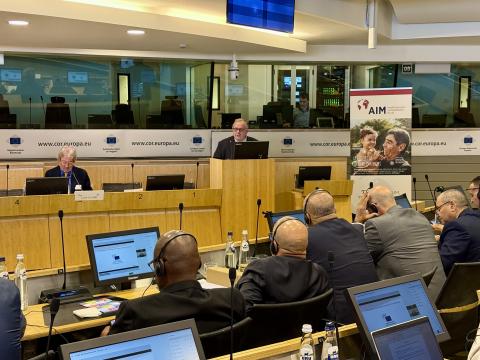
Speech by President Séamus Boland, AIM 75th Anniversary Event
Dear Mr Caubo, esteemed speakers, ladies and gentlemen,
It is with great pleasure that I would like to welcome you to the European Economic and Social Committee for your 75-year anniversary event;
When I look at the list of high-level speakers who are lined-up, I would even go so far as to say it is an honour to host you!
Of course, we have a long-standing relationship with the International Association of Mutual Health Funds (AIM), including through my dear friend Alain Coheur;
Alain has convincingly persuaded the Civil Society Organisations' Group to keep the topic of health high on our agenda;
Most notably last year in Liège, when we organised an extremely successful event with the very modest title 'The State of Health in the EU'!
I understand today's event as a celebration of the solidarity, shared values and actions of AIM over the last 75 years;
It is a celebration and a recognition, of the pivotal role of civil society organisations (CSOs) in ensuring more just and equal societies;
All of which is at the very centre of my personal beliefs and of my life's work;
In that context, I would like to make a few remarks on the topic of today's event, which is 'Building a Healthier Europe Tomorrow'.
Everyone in this room has their own memories of the Covid-19 pandemic, some of which I am certain, are very painful;
In contrast, at the macro-level, there were four good things that came out of that health crisis;
The first, was European cooperation in terms of research and distribution of the vaccines;
The second, was European solidarity on joint EU debt, specifically the Next Generation EU;
The third, was that CSOs successfully lived-up to the immense challenge that the crisis presented them with;
There is no doubt that CSOs played a pivotal role during that crisis, providing key services and working closely with communities to shelter vulnerable individuals during those very difficult months;
There is a fourth and final positive development from the Covid-19 pandemic and that was that health was catapulted to the very top of the Union's political, strategic and policy agenda.
The EU speeded ahead towards the creation of the EU4Health programme;
And it launched the European Health Union (EHU), which laid the foundations for an EU vision on health and healthcare systems;
Regrettably, the geo-political developments of the last three years have significantly waned those ambitions;
And although we all share the concerns for increasing the EU's security and defence capacities, I still maintain that health should remain a key EU strategic priority.
However, 'Building a Healthier Europe Tomorrow', which is the title of your conference, is also recognising that the health sector can only properly function, alongside accessible, adequate and high-quality social services and public social policies, which are staffed with sufficient numbers of well-trained health professionals;
Let me remind you that it is estimated that by 2030, there will be a global shortage of 10 million healthcare workers!
And without proper planning, financing, upskilling and reskilling of the health workforce, there is a very real risk of increasing poverty and inequality levels within our societies;
Access to quality healthcare will be reduced, starting with the most poor and vulnerable;
It is precisely this sense of urgency that we must continue communicate to the European Institutions and to our national governments.
'Building a Healthier Europe Tomorrow', also implies addressing the sustainability of health systems;
And this comes back to the usual debate on how health should be viewed as a social investment, rather than as a pure cost;
Within the EU every Euro invested in healthcare has an economic return of 14 Euros!
However, finding the right balance between quality care and the most appropriate use of resources will always be challenging.
Finally, I am certain that your discussions will focus on the importance of placing the patient and civil society organisations at the centre of the European health systems;
Here I refer to the four Ps, whereby healthcare should be predictable, preventive, personalised and participatory;
Coming from the civil society sector, I am strongly in favour of giving patients a degree of direct involvement and responsibility;
The same must apply to CSOs, active in the health and care sectors;
Clearly, the take up and success of European health initiatives and programmes are dependent on transparent, regular and structured dialogue with CSOs;
Their ability to carry out this work is in turn dependent on obtaining sustainable and predictable funding.
I will bring my comments to a close with a few words by the father of medicine, Hippocrates, who 2.500 years ago said that: "Healing is a matter of time, but it sometimes is also a matter of opportunity";
Within the EU, we still have many opportunities with regard to health and solidarity – we just have to seize them!
Thank you.
Work organisation
Downloads
-
Speech by President Séamus Boland