
European Economic
and Social Committee
Speech by Laurentiu Plosceanu at Connecting EU seminar
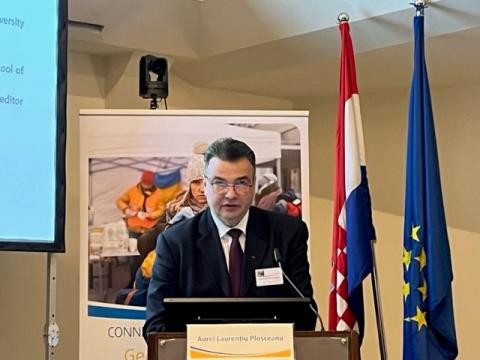
Dear President, dear members, dear guests,
It is a pleasure to stand before you to open a debate, which is not only timely, but also crucial in the way we manage accelerating change in media and politics. The way we communicate, the way we convince, in this time of multiple crisis, will determine how we get out of these difficult moment.
Since the invasion of Ukraine, the EU has been affected in every aspect of life and work by the war, not least the way we communicate. The reactivation of the crisis communication mode is evident in every aspect: from showing the EU's impact on the ground in full solidarity with Ukraine, to a renewed focus on disinformation in the battle of narratives.
We all know that Vladimir Putin’s time as Russian president has long featured a quiet campaign of disinformation and censorship at home. However, it is only since Russia began its all-out war on Ukraine that the world has sadly woken up to this.
In recent months, the Kremlin has shuttered the country’s last independent media outlets, banned platforms such as Facebook and Twitter, and implemented laws that make free speech – in the form of anti-war statements – punishable by as much as 15 years in prison.
So far, the regime has arrested more than 15,000 people for demonstrating against the war, which is acting as a powerful deterrent. For those willing to risk arrest, censorship makes it difficult to discover how many others share their opposition to the war, and hinders the organisation of protests.
The EU has promptly and surely reacted to the invasion of Ukraine. It seems we have learned the lessons from previous crisis. The last ten, fifteen years have been dominated by a series of crisis: the eurocrisis, the migration crisis, the terrorist attacks from 2015 onwards, then the Covid-19 crisis, and the permanent climate crisis. I could continue… But the Ukraine war is the crown of all crisis, because it hits at the heart of the European project: Peace.
Today, opening the debate on Communicating in times of crisis, I would like to highlight a few elements I noticed in the past months that lead me to believe we are on the right track to win the battle of narratives and continue to learn from crisis…
First: The strength and unity of the response to Russia’s invasion surprised everyone, including the Kremlin. Within a few days of the invasion, a large part of the assets of Russia’s central bank had been frozen. A range of Russian financial institutions and oligarchs were hit with sanctions. European airspace had been closed to Russian airlines. Tech exports to Russia were restricted. Russia had been kicked out of the football World Cup. The Nord Stream 2 gas pipeline to Germany had been suspended and Berlin had announced a historic increase in military spending. And western countries had agreed to supply Ukraine with heavy weaponry — with the EU making its first ever move into direct military assistance.
We have seen our leaders heading to Ukraine. We have seen EU countries mobilise, not only at the level of states but also at the level of civil society. We have seen the unthinkable happen: countries like Sweden and Finland, the bastion of European neutrality, warm up to NATO. All this has been paired by an unprecedented storytelling.
Some say a photo is worth 1000 words. The EU did not just talk solidarity. The EU showed solidarity. This change in communication in showing rather than telling is here to stay. It started with the pandemic, but became more prominent during the war in Ukraine. I am sure this new crisis-led storytelling has established a way of communicating the EU.
Second: Communicating in a crisis means we need to operate in a very unstable and fast-changing environment, so we need to be flexible in order to be fast. I think here there is room for improvement. The EU is still often stuck in processes. As employers, we have always pushed for cutting red tape. Well, that is true also for communication, as we all know, speed is crucial in communicating in times of crisis.
That calls for adapting processes to this new modus operandi. Maybe we should mainstream our communication to a new mode which is indeed the communication crisis.
Last but not least, a totally new and accelerated focus on disinformation. A lot of politicians refer to the battle of the narratives because it is at the core of the values' narrative. The Ukraine conflict has accelerated the war of narratives.
The EU is confronted to Russia's false narrative that tries to frame the west as a military aggressor, the US wanting to launch an attack and World War 3. Tools like EUdisinfo and Stratcom have launched a more robust offensive, since the beginning of the war.
But, despite some positive actions, much remains to be done to boost Europe’s societal resilience against disinformation. Institutional scrutiny at the EU level is focused on foreign disinformation actors. Counter-disinformation efforts mostly follow a ‘debunking approach’, which may not prevent hostile narratives from shaping the political discourse.
Some experts call for the adoption of prebunking strategy, meaning anticipating and preparing in order to strengthen resilience. This involves forming multiple stakeholders’ partnerships to monitor disinformation more systematically; intervening rapidly against disinformation; anticipating future narratives; and boosting the critical skills of those who are most susceptible to disinformation.
Indeed, at the moment we see disinformation on refugees from Ukraine used to sow uncertainty and division. In the current context marked by heightening geopolitical insecurity and the cost-of-living crisis, it could lead to resentment towards national governments and refugees and undermine public support for EU reception policies. By adopting a prebunking approach, the EU can promote more evidence-based and balanced discussions, avoid public backlash, and sustain welcoming and ambitious migration and asylum policies.
Finally, let me conclude by taking the big picture: Over the past 75 years, we have built a rules-based global governance system, with multilateralism as preferred format. However, what was long accepted as the established approach to global politics is now increasingly contested and under attack.
Fragmentation, renationalisation and protectionism are eroding global systems, and the rules-based approach to global governance is now under threat from geopolitical confrontation and great power rivalry.
This is jeopardising the institutions, rules and standards that are used to address planetary-scale challenges. It is also affecting the EU's potential to shape world politics. These developments call certainly for grand political strategies, but also for grand communication strategies. We cannot and should not take peace for granted.
And here I leave you with a graph (as seen at an event by the European Commission) showing Europe's development between war and peace over the past 4 centuries as a reminder and this is the reason why trust in the EU is at the highest level since 2009.
I look forward to the debate.
Thank you.
Delivered on 25/11/2022 at Connecting EU seminar in Zagreb
Work organisation
Recommended for you
Speech by Séamus Boland at the Connecting EU seminar 2022
News
Connecting EU seminar 2022 'Geopolitical turmoil at Europe's door: the perspective of civil society' Zagreb, 24-25 November 2022 Speech by Séamus Boland, President of the EESC Civil Society…
Connecting EU seminar 2021 - Speech by President Séamus Boland
News
Connecting EU seminar 2021 on 'What kind of Europe do you dream of?', panel on 'European democracy: how can we buttress press freedom in Europe against looming multiple threats?' Lisbon, 19…
EESC Connecting EU Seminar
Agenda
Participation in the "Connecting EU 2023" seminar
Agenda
Speaking in the EESC "Connecting EU" seminar
Agenda