
European Economic
and Social Committee
Inaugural Speech by President Séamus Boland on 'Promoting intergenerational solidarity in the EU''
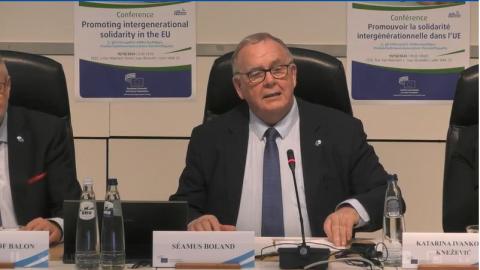
Conference on 'Promoting intergenerational solidarity in the EU', organised by the EESC Civil Society Organisations' Group, 10 October, Brussels
Ladies and gentlemen,
It is with great pleasure that I would like to welcome you to this conference on 'Promoting inter-generational solidarity in the EU'. This subject is as vast as it is topical. As you will be aware, the incoming European Commission will include a Commissioner for 'Inter-generational fairness', which is very welcome. What is perhaps less well known, is Article 3(3) in the Treaty on the European Union (TEU), which states that "The Union…shall promote…solidarity between generations". There is even a 'European day of solidarity between generations', which is celebrated on 29 April!
When I reflect on this topic, three principles come to mind: respect, equality and social cohesion. This is a discussion on how to break down stereotypes and promote mutual understanding and respect. It is a conversation on how to create more cohesive and resilient communities, where all age groups are valued, listened to and connected. It is a dialogue on how to balance the interests, needs and rights of different groups of people within our societies.
I have to admit that coming from a rural background, the concept of 'inter-generational solidarity' does seem to be more of an urban challenge. Arguably, that local rural communities are by their nature more cohesive, with different age groups regularly coming together and finding joint solutions to local problems.
But that would be to ignore the reality of how rural communities have changed, even during my lifetime. Regrettably today, many rural areas within the EU are bereft of young people. And the elderly are often left without the necessary services and infrastructure to remain autonomous. Community life across generations, is becoming more difficult to nurture and sustain. Social cohesion is waning.
The necessity for inter-generational solidarity affects us all. Rural and urban, the young and elderly. For each age group there are age-related barriers, for example, to employment, health services and political participation. Which explains why the subject is fundamental to maintaining balanced and healthy democracies. Put simply, inter-generational solidarity is central to strengthening our sense of joint responsibility for the common good.
Arguably, the most important common good to protect at the moment is our environment. Perhaps it is no surprise that the incoming Commissioner for 'inter-generational fairness' is called upon "…to ensure that decisions taken today do not harm future generations".
The fight against global climate change has become a conflictual topic, between current and future generations. We see this at the community level and all the way to the international level. Nonetheless, climate change is already affecting everyone.
We urgently need strategies to slow the rate of climate change, with minimum damage for the next generation. The reality is that greenhouse gas emissions eliminated today and 'worth more than in the future, simply because of the escalating risks of climate change. In other words, we need to start taking into account the time value of carbon in our individual choices and decisions. What we do today, will be less costly tomorrow.
Ladies and gentlemen, today's speakers will debate a selection of policy areas, ranging from care, agriculture, housing, etc. Obviously, the topic of inter-generational solidarity is much broader, but we had to make choices for today's half-day event.
This morning we are privileged to listen to a video message by Marzena Okła-Drewnowicz, Polish Minister for Senior Policy. This will be followed by a presentation by Krzysztof Balon, who is one of our Group's Vice-Presidents and rapporteur of the Committee's Opinion on 'Promoting European intergenerational solidarity'.
This Opinion was only adopted last month. It is fresh off the printing press and includes many concrete proposals on how to implement Article 3(3) of the TEU. The request for an EC Green Paper on inter-generational solidarity and the proposal to include inter-generational solidarity as an objective under the next European Social Fund, are among the recommendations in the Opinion. But I will leave Krzysztof to explain further.
I would also like to thank Katarina Ivanković Knežević, Director in DG Employment, Social Affairs and Inclusion, for her presence here today. I understand that to date, the Commission has not been very active on this subject. But things are about to change and I look forward to future cooperation with the Commission on this topic.
Allow me to add that this conference and Opinion are very much the culmination of the work by our Group. Over the last few years, we have called for a European Strategy for older persons, we have trumpeted the rights of young people and care workers, as well as focusing attention on the necessity for sustainable long-term care services and health systems. Affordable and sustainable housing has also been the focus of a recent study we commissioned, to be presented here at the Committee at our next event on 21 November.
Central to all of the above is an active and coordinated civil society. Civil society has a pivotal role to play in driving, designing and implementing cohesive local development and decision-making. They are key to supporting and representing all generations, helping to build age-friendly communities and actions.
This morning we will hear many concrete positive examples. It is precisely through sharing experiences and learning from each other, that we can become even more creative and reach out to where there are real needs. For example, I recently read that in Denmark, there is a scheme for substituting grandparents! They say that you cannot chose your family – well perhaps this is an innovative way of getting around that!
I would like to bring my comments to a close, by recalling that the topic of inter-generational solidarity goes to the very heart of our humanity and our societies. It is about people. It is about how we relate to one another emotionally and practically, during our entire life-cycle.
One reads of how within the EU, we are moving towards a 'longevity society'. Of how by 2050, there will be 27 million fewer people of working age. These demographic challenges are very real. And we will need to invest in careful planning, to ensure that individuals are able to live qualitative, equal and dignified lives, today and tomorrow.
However, I do think that it is time to change the narrative. It is time to consciously move from a negative viewpoint to a more positive one, in which we, civil society, are key actors. In my mind, this narrative includes inter-generational solidarity firmly at its centre.
Thank you for your attention.
Work organisation
Downloads
-
Inaugural Speech by President Séamus Boland
Recommended for you
EU and UK Domestic Advisory Groups to the EU-UK Trade and Cooperation Agreement
Document
Joint statement We, the Domestic Advisory Groups of the European Union and of the United Kingdom, having met on Monday, October 3, 2022, in Brussels and in advance of participating in the first…
Joint Declaration
Document
Workers' Group calls for decent work worldwide
News
Speaking on the occasion of the World Day for Decent Work, President of the EESC Workers' Group Oliver Röpke called for the EU to redouble its efforts to promote decent work worldwide. While…
The EESC gathers policy-makers, civil society representatives and economic experts to find ways out of low-growth and inflation
News
The European Economic and Social Committee (EESC) held a conference on the prospects for the European economy in times of crisis. The event gathered high-level policy-makers, civil society…
Rules of Procedure
Document