
European Economic
and Social Committee
EESC Fundamental Rights and Rule of Law Group concludes a visit to Germany
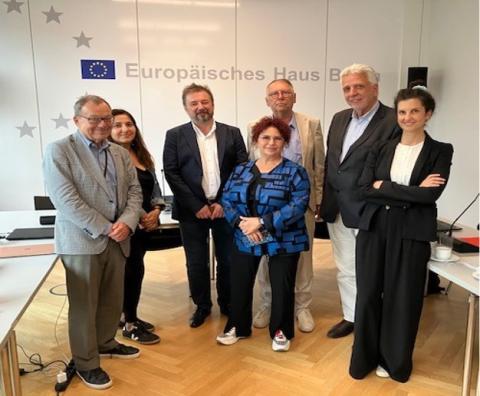
On 28-29 August 2025, the Fundamental Rights and Rule of Law (FRRL) Group of the European Economic and Social Committee (EESC) concluded a two-day visit to Berlin.
This visit formed part of the second cycle of FRRL Group country visits (2024–2029), following the first cycle (2018–2024). The methodology of the Group combines exchanges with civil society, national authorities, and representatives of the European Commission, ensuring that all relevant perspectives are heard.
This visit gave the opportunity to the group of six EESC Members to hear civil society representatives about key trends in Germany concerning fundamental rights of social partners, freedoms of association and assembly, freedom of expression (including media freedom), the right to non-discrimination, and the rule of law.
Participants in the discussions particularly highlighted:
- Decline in collective bargaining affiliation, as agreements are seen as complex and not flexible enough. Overall employment is rising, but there are still shortages of skilled labour due to gaps in qualifications and difficulties in attracting skilled migrants.
- Civil society faces shrinking space, with CSOs accused by the far-right of being "political" or "woke", risking loss of charitable status and funding, particularly those supporting migrants and LGBTIQ+ people. CSOs are also concerned about transparency, recent bureaucratic requirements and legal pressures, including the use of the criminal code against environmental groups.
- Journalists call for uniform protection standards, as they are increasingly targeted by right-wing movements seeking to discredit their work and erode trust in journalism. Public broadcasting also faces funding challenges, while the media sector is worried about declining revenues as big tech platforms and AI reduce readership of traditional media.
- Gaps in legislative protection remain, with concerns about racial profiling, discrimination against Roma and Sinti, and the gender pay gap. The rhetoric on migration and LGBTIQ+ persons has become more restrictive, with migration policy prioritising control over integration. Better use of the UNCRPD in courts is recommended to strengthen the protection of persons with disabilities.
- The justice system struggles with limited resources and difficulties in recruiting young lawyers and judges. Transparency remains a concern, with a weak Freedom of Information Act and poor implementation of lobbying footprint rules. Short deadlines are given to analyse draft laws. Safeguards against political interference in the justice system are still lacking at Länder level.
The visit was the second one of the FRRL Group to Germany, following a visit in April 2021 (Report). Compared to the first visit in 2021, participants noted both persistent challenges and new trends, particularly regarding the shrinking civic space and pressures on the media.
The EESC delegation also discussed with the representation of the European Commission and the authorities of Germany.
A report, including the observations of the German authorities, will be issued in the coming months and will be presented in the EESC.
Background
The EESC established in 2018 a Group on Fundamental Rights and the Rule of Law (FRRL Group), which is tasked to provide a forum for European civil society organisations to meet and discuss fundamental rights, democracy and the rule of law. The FRRL Group promotes respect for the European values listed in Article 2 TEU by raising awareness of and assessing the state of play of these values in the Member States and allowing for the exchange of good practices. To this end, the FRRL Group hosts hearings, conferences, and carries out country visits with the aim of identifying trends in Europe concerning fundamental rights and the rule of law, inasmuch as they develop in national contexts.
Country visit reports are issued along with the observations of the authorities, a few months after the visits (they can be accessed here). After a first cycle of visit to all EU Member States (2018-2024), the FRRL Group started a second cycle of visits in 2024 to the 27 Member States and candidate countries. The Report synthesising the first cycle of country visits led in 2018-2019, 2020-2021, 2022, and 2023-2024 are available, as is the report on the overall first cycle (2018-2024).
For more information about the EESC FRRL Group methodology, see this document.
The delegation of the FRRL Group to Germany was composed of:
- Benny JOHANSSON (Group II, Sweden)
- Cristian PÎRVULESCU (Group III, Romania)
- Christa SCHWENG (Group I, Austria)
- Paul SOETE (Group I, Belgium)
- Ákos TOPOLÁNSZKY (Group III, Hungary)
- Ozlem YILDIRIM (GRII, FR)
Work organisation
Recommended for you
EESC Fundamental Rights and Rule of Law Group concludes a visit to Austria
News
On 19-20 March 2025, the Fundamental Rights and Rule of Law (FRRL) Group of the European Economic and Social Committee (EESC) concluded a two-day visit to Vienna.This visit gave the opportunity to…
EESC Fundamental Rights and Rule of Law Group concludes a visit to Albania
News
On 2-3 April 2025, the Fundamental Rights and Rule of Law (FRRL) Group of the European Economic and Social Committee (EESC) concluded a two-day visit to Tirana.This visit gave the opportunity to the…
EESC Fundamental Rights and Rule of Law Group concludes a visit to Italy
News
On 16-17 October 2024, the Fundamental Rights and Rule of Law (FRRL) Group of the European Economic and Social Committee (EESC) concluded a two-day visit to Rome.This visit gave the opportunity to…
EESC Fundamental Rights and Rule of Law Group concludes a visit to France
News
On 27-28 November 2024, the Fundamental Rights and Rule of Law (FRRL) Group of the European Economic and Social Committee (EESC) concluded a two-day visit to Paris.This visit gave the opportunity to…
EESC Fundamental Rights and Rule of Law Group concludes a visit to Serbia
News
EESC Fundamental Rights and Rule of Law Group concludes a visit to SerbiaOn 27-28 November 2024, the Fundamental Rights and Rule of Law (FRRL) Group of the European Economic and Social Committee…