
European Economic
and Social Committee
Debate: Strengthening competitiveness paves the way for a winning green transition
Regulation and taxation must become more business-friendly. We do not need more burdens and bureaucracy, but policies that promote entrepreneurship and encourage companies to innovate, invest and trade, write Stefano Mallia, President, EESC Employers’ Group, Per Hidesten, CEO of Industrial Employers, Mats Åkerlind, Deputy CEO of Byggföretagen and Christian Ardhe, member of the EESC Employers’ Group.
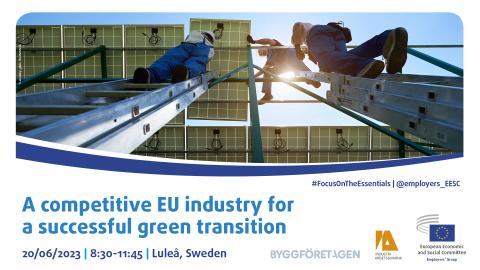
Representatives of employers from the 27 EU Member States have gathered in Luleå, in a two-day event organised by the Employers Group in the EU’s Economic and Social Committee, the EESC, together with the Construction Companies and Industrial Employers. The intention is to discuss on the ground the conditions for the green transition, sustainable growth and the new EU competitiveness agenda.
Sweden’s presidency of the European Union is coming to an end. During its Presidency, Sweden has succeeded in putting the competitiveness of businesses and the EU at the top of the political agenda. A new long-term competitiveness agenda has been launched, as well as a number of individual proposals aimed at improving the EU’s global situation. This is positive.
We must now ensure that this focus is not lost, because the lack of competitiveness is real. Europe’s share of the global economy has declined for a long time. In 1990, the EU accounted for around 25 % of the world’s GDP. The corresponding figure for 2020 was 15 per cent and by 2050 it is expected to be less than 10 per cent.
There is an urgent need to reclaim land. The green transition gives us such an opportunity. How successful it is, however, ultimately depends on how well our economy as a whole works.
Competitiveness is based on companies’ ability to succeed in a global market in a profitable way. Europe’s future economic growth outlook will increasingly depend on its ability to increase productivity. This requires a well-balanced policy to support innovation, increase skills, reduce rigidity in labour and product markets and allow for a better allocation of resources.
Calls for policy action in particular in three areas of action:
- First of all: Regulation and taxation must become more business-friendly. We do not need more burdens and bureaucracy, but policies that promote entrepreneurship and encourage companies to innovate, invest and trade. All EU policies must be guided from a regulatory improvement perspective, reducing the regulatory burden of businesses and fully implementing the “one in one out” principle. We welcome the fact that in the spring the European Commission has started to apply its new so-called competitiveness control, which we employers have called for over the past two years.
- Secondly: The single market is the EU’s main success factor and guarantees the free movement of people, goods, services and capital. A well-functioning single market, with free movement and a level playing field between companies, is a prerequisite for Europe’s global competitiveness and thus for the green transition.
The same applies to the ability to attract, hire and develop qualified employees. Today, skills shortages prevent companies from developing and selling their products and services. The free movement of labour and services and matching in the labour market can be improved by improving mutual recognition of diplomas and diplomas from schools and higher education. The EU can also help to facilitate labour from third countries.
- Thirdly, and not less important: Businesses need access to basic production resources at competitive prices. This is about energy, raw materials, labor, capital and data. Increased sustainability requires increased electrification. Raw materials such as cement, rock and construction materials are also required for mining, wind turbines and fossil-free industrial plants.
Currently, the EU is dealing with a couple of legislative proposals aimed at ensuring access in Europe to selected strategic raw materials, and accelerating environmental permit processes for selected so-called green projects. This is good as permit granting is often characterised by long processing times and unforeseeable processes. The green transition requires faster and more balanced permit processes. This helps to strengthen employment and can thus contribute to welfare.
However, the selective fast-track allocation for some specifically identified green activities proposed by the EU is problematic as other essential projects are at a lower priority. All raw materials are important. Industrial investments, mining, infrastructure, housing and electricity supply are interlinked and each individual condition in the value chain is relevant to the final product.
Sweden will hand over the Presidency on 1 July to Spain, which has chosen to focus on other issues. We will push in our networks to ensure that the competitiveness of businesses and the EU remains at the top of the EU’s policy agenda.
This article was first published in Dagens Industri: https://www.di.se/debatt/debatt-starkt-konkurrenskraft-avgor-den-grona-omstallningen/__;!!DOxrgLBm!DSPq-KKidSEOsyRW4yfqHSLkJLQMu_b_i_LZu7J3EgOqeJxlzj6J3e-mVNxAgAKWhm0zbGFkm0czWL8Jl3yHmFVqubOo-yhmifzGA3kY7b5nYl9XPFMB9zc$