
European Economic
and Social Committee
Businesses call for a more competitive and cohesive Single Market amid digital and inflation pressures
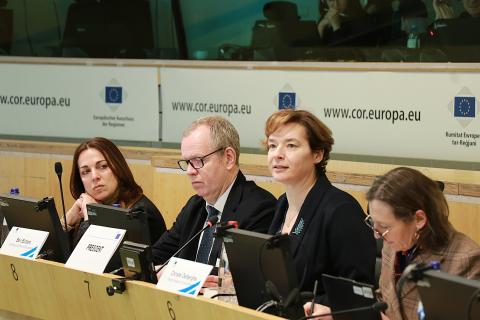
As Europe grapples with persistent inflation, fragmented regulation, and the accelerating impact of digital transformation, partner organisations of the Employers' Group, representing commerce and agriculture, are calling to join forces to urge the EU for a renewed focus and accelerated implementation to deliver competitiveness and coherence across the Single Market.
Speaking on behalf of their respective sectors, Christel Delberghe, Director General of EuroCommerce, Elli Tsiforou, Secretary General of COPA-COGECA, and Ben Butters, Chief Executive Officer of Eurochambres, expressed converging concerns about rising costs, mounting regulatory burdens, and barriers to innovation holding back Europe’s growth potential.
“Consumer confidence remains low while inflation remains high,” said Christel Delberghe. “Our priority is to strengthen the Single Market, remove territorial supply constraints, and ensure fair competition.”
EuroCommerce is working with other employers' organisations towards a roadmap for the Single Market, stressing that maintaining affordability for consumers depends on open and efficient supply networks. She pointed to the arrival of the digital euro as a key opportunity to future-proof retail in Europe’s digital economy.
From agriculture, Elli Tsiforou of COPA-COGECA argued that farmers face structural obstacles preventing them from investing in the green and digital transitions. “EU permitting rules hold back investment at the very moment when we need it most,” she said. Tsiforou called for reciprocity in trade agreements to ensure that European farmers compete on equal terms, and flagged the risk that the Carbon Border Adjustment Mechanism (CBAM) could dramatically increase nitrogen prices by 2030.
She added that making digitalisation affordable to all farmers remains a challenge: “EU legislation today prevents us from using drones. We need data security and coherent policies that allow scaling up across Member States instead of multiplying divergences,” she insisted.
Echoing this call for pragmatism, Eurochambres' Ben Butters noted that companies across Europe continue to face excessive red tape and skill shortages. “There’s been no meaningful progress in cutting administrative burden over the last year,” he said. “We also need to ensure Europe’s regulatory framework, particularly in data and AI, supports rather than restricts innovation.”
Butters highlighted that access to data for AI training is increasingly constrained by overlapping rules such as the GDPR, urging a review of the EU’s data governance regime.
Despite their sectoral differences, all three business leaders converge on a shared message: Europe’s regulatory and economic frameworks must become more agile, predictable, and innovation-friendly.
For retailers, farmers, and entrepreneurs alike, a stronger Single Market, one that empowers businesses to invest, digitise, and compete globally, is essential to preserve Europe’s prosperity and the affordability of goods and services for its citizens.