
European Economic
and Social Committee
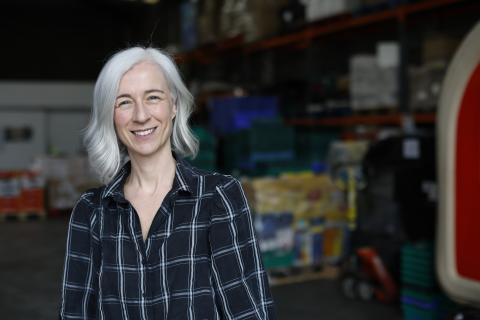
Food insecurity and reliance on food banks are on the rise, yet thousands of tonnes of perfectly good food continue to go uneaten every day. In the EU alone, around 58 million tonnes of food waste is generated annually. We spoke to Angela Ruttledge, Head of Policy at FoodCloud, an Irish organisation that connects businesses with food charities to coordinate donations and reduce waste. She told us about FoodCloud’s work, the growing demand for food support, and what Europe needs to do to significantly reduce food waste and poverty.
How does food that would otherwise go to waste reach someone who needs it through FoodCloud? Could you walk us through the process and give us a sense of its scale? How much food do you save, and how many people does it help feed?
Internationally, FoodCloud uses its digital platform to connect businesses with over 3 800 charities and charitable community groups across six different countries. In Ireland, we also have three hubs in Dublin, Cork and Galway, where donations and collections are carried out.
Our app gives food banks and charities access to surplus uploaded via the platform from retailers.
Since 2013, we’ve redistributed around 500 million meal equivalents, or around 212 thousand meals a week. This has also saved 558 thousand tonnes of CO2 equivalent.
Our digital platform allows us to scale up our operations with food banks around the globe. For example, we work in Kenya with local partner Food Banking Kenya, and will be launching projects with two more countries in Africa next year, along with two additional countries in Europe.
Our ambition is to redistribute 1 billion meals by 2030. As we expand our geographical reach connecting more surplus with the communities that need it most, we’re confident that our impact will continue to grow exponentially towards our vision of a world where no good food goes to waste.
What do the charities and organisations you work with tell you about the trends that they are observing with regard to food poverty today?
Our community partners tell us that demand for food support is growing, and that financial pressures are affecting people across different circumstances. In our July 2026 survey of our community partners, 66% reported increased demand over the previous six months.
Organisations describe supporting older people struggling on pensions, families facing rising rents, and people working full time who still cannot make ends meet. One parent supported by Waterford Food Bank described skipping meals so that their children could eat, highlighting the difficult choices households face.
According to the Barnardos Cost of Living – Impact on Children 2026 report, 20% of parents said that they or their children had to go without or cut back on food, with 44% skipping meals. Globally, an estimated 2.1 billion people – 25.8% of the population – experienced moderate or severe food insecurity.
Meanwhile, we know that there are thousands of tonnes of perfectly good food that go uneaten. This is a wasted opportunity; a missed opportunity to make our food system more sustainable, and a missed chance to use food to bring people together and build resilience.
Partners also stressed that having enough food and being able to eat healthily are closely connected. Some 64% find it challenging to help service users eat healthily, while 89% believe people would benefit from a greater knowledge of nutrition. They identified limited cooking skills, dietary awareness and health conditions as barriers.
Food support also sits alongside wider needs: 70% of surveyed partners provide additional services beyond food. Community meals offer connection as well as nourishment, particularly for people experiencing isolation.
For these organisations, surplus food helps stretch limited resources. Again, 64% said that savings from accessing surplus food allow them to redirect funding towards other essential services, helping them respond to the broader pressures affecting the people they support.
From your experience, what is stopping more surplus food from reaching people who cannot afford enough to eat? What needs to change, both in business practices and public policy, to waste less food and help more people?
Getting safe, nutritious surplus food to people experiencing food insecurity requires much more than a willingness by food businesses to donate surplus food.
Public policy must support both donors of surplus food and the organisations receiving food.
Businesses need to make food waste prevention and redistribution part of everyday operations. This means measuring waste, improving forecasting, training staff and establishing reliable donation partnerships. Edible surplus should be assessed for donation before it goes to recovery or disposal. Clear targets and consistent reporting would help businesses identify opportunities and demonstrate progress.
We recognise the effort involved in donating perfectly good surplus food. Therefore, we recommend tax incentives covering donated food and associated logistics, clear official food safety guidance and liability protection for businesses and redistributors complying with safety requirements. We believe the donation provision set out in the EU’s revised Waste Framework Directive represents a valuable opportunity to create a robust national donation programme.
But donation at scale cannot happen without the organisations that connect these donations to community groups, or efforts to increase the capacity of these groups to make use of surplus food.
Food needs to be identified, collected, stored and redistributed safely, often within tight timeframes. Our research highlights gaps in transport, cold storage, staffing and funding that limit how much food community organisations can accept.
How can governments and EU institutions work more effectively with civil society organisations like yours to tackle food poverty? What support would make the biggest difference?
Governments and EU institutions should involve civil society organisations in designing, implementing and evaluating food poverty policies, drawing on our practical experience and the voices of people using community services. Regular dialogue must translate into coordinated action across social protection, health, agriculture and environmental policies.
Groups need fridges, freezers, vehicles and suitable buildings. They also need money for electricity, fuel, insurance, maintenance and staff. Buying a van is only part of it. Someone has to drive it, organise the collections and pay to keep it on the road.
Short-term project funding can help something get started. But people also need to know how they will keep it going once that funding ends. We therefore recommend multiannual core funding for community food organisations. It gives them some certainty and allows them to plan.
We also recommend funded local food coordinators and shared infrastructure to strengthen connections between donors and community groups. Importantly, EU funding should be easier for smaller organisations to access, with proportionate application and reporting requirements.
Food support should connect people with wider services and entitlements through innovative models like social supermarkets offering wraparound services. Redistribution can ease immediate pressures, but effective partnership must also address the underlying causes of food poverty and protect people’s dignity.
Angela Ruttledge is Head of Policy at FoodCloud. An Eisenhower Fellow, solicitor, non-executive director and former restaurateur, Angela is a passionate advocate for food sharing, food justice and circular economy solutions.