
European Economic
and Social Committee
Europe cannot tackle poverty it fails to see. Measures focused on income alone risk hiding the hardship linked to gender, age and disability and leaving those who experience it out of the picture. If Europe is serious about reducing poverty and advancing social inclusion, everyone’s experience must count, writes Joanna Pradella, who heads Equality Insights, the International Women’s Development Agency’s flagship programme to redefine how poverty is understood and measured.
Poverty is often described in financial terms: how much money someone earns, whether their household can afford basic necessities, or whether they live above or below an established income threshold.
But what if a household is above the poverty line but one person within it cannot access sufficient food? What if they have a roof over their head but have little control over decisions affecting their lives, or spend so much time caring for others that paid work is out of reach?
These experiences are not always visible in conventional poverty statistics, yet they shape people’s realities and ability to participate fully in society.
Equality Insights, the flagship data programme of the International Women’s Development Agency (IWDA), is helping to change how we understand and measure poverty.
Beyond income
Equality Insights measures 15 dimensions of life: food, water, shelter, health, education, energy, sanitation, clothing, safety, family planning, environment, relationships, voice, time use and work. These dimensions were identified through participatory research involving more than 3 000 people with lived experience of poverty across six countries. The approach reflects what people in poverty themselves felt to be important to improve their circumstances.
Different forms of deprivation are connected. Limited access to electricity, for example, can mean relying on polluting fuels for cooking. Exposure to these fuels can affect health while the time required to collect fuel can reduce opportunities for education or paid employment. Lack of influence over local decision-making may make it harder to address these problems.
Looking at one indicator in isolation misses these connections – a point made recently by the World Bank about the high cost of fragmented poverty data. Multidimensional measurement of individual situations helps reveal how disadvantages accumulate and reinforce one another and where interventions could make the greatest difference.
It also challenges the assumptions embedded in conventional measures. As I have argued elsewhere, the choices made in designing poverty measures determine whose experiences become visible and whose are overlooked. Measures that focus narrowly on income but not gender, age and disability present an incomplete picture of poverty and inequality.
Why the individual matters
For too long, the unit of analysis has not been aligned with the unit of experience. Household measures simply cannot account for how everyone within the house experiences their circumstances.
Consider a household with two adults. One person may have access to paid work, control over household spending and time for rest or further education. The other may carry most of the unpaid care work, have limited control over financial decisions and face safety concerns during paid employment. Household measurement may capture their total income but their individual experiences are markedly different.
The distribution of resources and responsibilities within households matters and that distribution is heavily shaped by things like gender, age, disability and other personal characteristics that limit or enhance people's access to opportunities and decision-making power.
It is estimated that one third of global poverty exists within households (Haddad, L., & Kanbur, R. 1990, pp. 866-881). Equality Insights addresses this gap by surveying all eligible adults in a sampled household, asking them questions about their own experience rather than treating them as a proxy for another. This makes it possible not only to disaggregate the data but also to analyse it intersectionally.
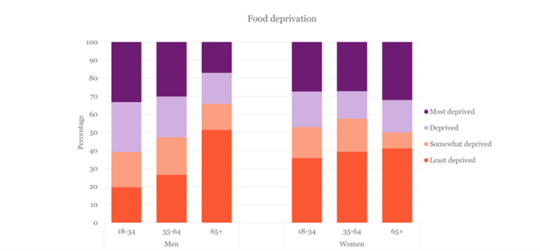
Findings from a 2020 study in the Solomon Islands showed that individuals could experience deprivation in particular dimensions even when their household was classified as not poor. The Asian Development Bank recently demonstrated the same. Analysis of individual situations also revealed that while young men aged 18-24 were the most food insecure group by age and gender, over the course of their lives the rate of food insecurity dropped by nearly half for men. For women the risk of food insecurity grew with age. This has implications for how we target social protection measures and design policy interventions that tackle this shifting pattern of need.
Digital exclusion
The importance of this approach extends to newer areas of deprivation, including access to digital technology.
Digital access and skills increasingly influence whether people can connect to education, employment and government services. When essential services move online people experiencing digital exclusion face additional barriers.
A person with insufficient income to meet basic needs may also lack the digital access to apply for a job, access social security payments or participate in online learning. A person with a disability may encounter inaccessible websites or services that are not compatible with assistive technology. In a remote area, unreliable internet infrastructure may compound existing barriers to healthcare, education and employment.
Equality Insights is exploring the impact of digital exclusion on poverty through its current data collection in Bangladesh. We start from the premise that not every form of digital exclusion produces the same outcome. We will collect the evidence needed to understand how digital barriers interact with other disadvantages and what responses are most likely to help.
Better data to better policy
For policymakers, the challenge is to ensure an understanding of poverty that keeps pace with the realities people face. This means investing in data that captures not only household income but also how resources, opportunities and deprivation are distributed between individuals. Integrating multidimensional evidence of the situations of individuals into social policy can strengthen the design of social protection, improve access to essential services and help direct public investment towards those most at risk of being overlooked. Ultimately, better measurement is a foundation for better decisions. If Europe is serious about reducing poverty and advancing social inclusion, everyone’s experience must count in the evidence that shapes policy.
To explore intersectional data on individual situations further, head to our Data Portal.
Joanna Pradela is an Australian feminist and social change practitioner. She is currently Director of Knowledge Translation and Equality Insights at the International Women’s Development Agency (IWDA). She leads IWDA’s work to turn research into action for gender equality. This includes overseeing Equality Insights, IWDA’s flagship programme to redefine how poverty is understood and measured. Joanna is the co-founder and co-convenor of the Australian Feminist Foreign Policy Coalition and Chair of the Board of the indigo foundation. She holds Master's degrees in International Relations and Diplomacy from the Australian National University.