
European Economic
and Social Committee
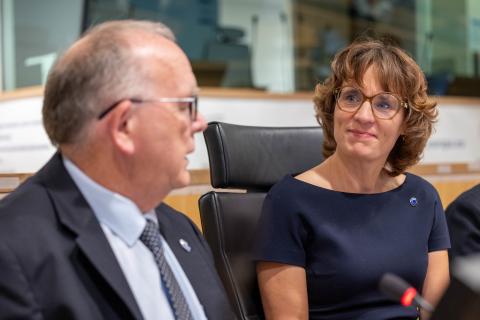
Ahead of the 2026 UN Water Conference, the European Economic and Social Committee (EESC) held a plenary debate with EU Commissioner for Environment and Water Resilience, Jessika Roswall. The EESC calls for water to be treated as a strategic resource for Europe's economy, security and global role.
The debate comes as water stress increases across Europe, putting pressure on supply chains, infrastructure and industrial production. In response to this, the Committee is calling for a shift in how water is framed in EU policy, from a mainly environmental concern to a strategic resource for competitiveness and resilience.
European Commissioner for Environment, Water Resilience and a Competitive Circular Economy Jessika Roswall echoed this broader approach, saying: 'Water is not only an environmental priority, but also a vital ingredient for our competitiveness, preparedness, resilience and overall security.'
At EU level, the EESC has been pushing for this shift for several years through its EU Blue Deal initiative, which seeks to place water at the centre of industrial, economic and climate policy. EESC President Séamus Boland underlined the urgency of this agenda, stating: 'The Committee has delivered multiple opinions to help develop a comprehensive EU water policy. Without water, there is no life, no economy and no other policy to defend. This is why we call for a water test in EU legislation and for water to be made a strategic priority in the next multiannual financial framework.'
Europe invests around EUR 55 billion in water annually but faces a EUR 23 billion yearly investment gap. Yet every euro invested generates an estimated EUR 2.35 in economic output. The EESC warns that inaction is already affecting supply chains and industrial production. In its opinion on the Blue Deal Accelerator – technology, skills and finance for a water-resilient future, the EESC calls for water to be fully integrated into EU industrial policy, including the Circular Economy Act and the Industrial Accelerator Act.
In a second opinion, EESC Contribution to the UN Water Conference 2026: from the EU Blue Deal and Water Resilience Strategy to global water action, the Committee warns that, at the current pace, sustainable water management will not be achieved before 2049. It calls for more circular water use, the recognition of water as a public good and stronger global governance involving civil society.
In December 2026, the EESC will join the EU delegation to the UN Water Conference for the first time, bringing civil society's perspectives into international discussions on water resilience. (gb)