
European Economic
and Social Committee
REFLECTIONS BY CIVIL SOCIETY PARTNERS: Building resilient communities
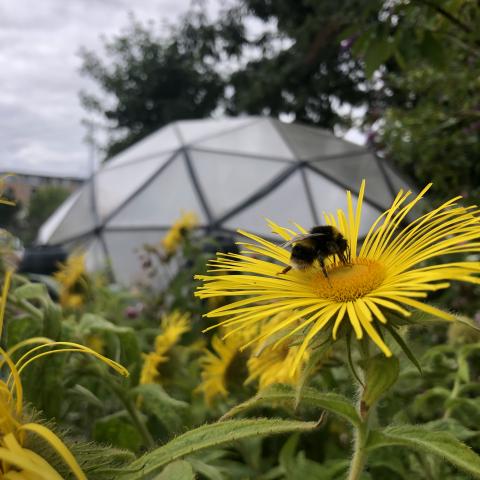
The GLAS Community Garden model: Community resilience through shared green space
On a summer morning, the GLAS community garden in Ballymun is a sensory feast; the scent of pollinator-friendly plants, the taste of a fresh strawberry, the sound of volunteers working together or children learning through play. This unique space is managed as a hub for biodiversity, environmental education and social inclusion.
The GLAS model is effective because it brings together a range of complementary actors. Foremost are the volunteers whose dedication brings the space to life. A horticulturalist welcomes and supports them to engage and learn, ensuring the inclusion of people with disabilities, those in temporary accommodation and individuals with no gardening experience. The Local NGO Global Action Plan (GAP) manages strategy and operations, obtaining funding for accessibility improvements, on-site projects and events; some funding is donated by local businesses whose employees volunteer. Finally, the garden is further strengthened by a vibrant network of local voluntary and community groups, which both contribute to and benefit from its activities.
GLAS enhances community resilience in a variety of ways. Inner-city communities in Dublin have less access to safe, useable green spaces than more affluent areas, with implications for mental and physical health; shared green spaces foster a sense of belonging and encourage the development of skills and values linked to participation and cohesion. Community voices are amplified and shared through education and workshops. The garden also hosts key services such as parent-and-toddler and rehabilitation groups, while supporting youth-led initiatives. Thus rooted in the local community, GAP is well-placed to contribute to wider campaigns for environmental, climate and social justice.
The Planning and Development Act, introduced by the Irish Government in 2024, formally recognised community gardens and placed a statutory duty on councils to provide them. Despite this, Ireland still has one of the lowest levels of provision in Europe. Government guidance, a national umbrella network and a legal framework for Community Land Trusts could enhance support for grassroots adoption of this model. Local authorities must commit to embedding community gardens into development plans, ensuring community groups have straightforward access to land, facilities, support and funding.
Community gardens offer a locally-situated, integrated approach to building community resilience and sustainability. The challenge for policymakers is to nurture these spaces so they can do the same for the communities and individuals they serve.

Community programme manager, Global Action Plan Ireland (GAP)