
European Economic
and Social Committee
NEWS ON OUR ACTIVITIES: Liberal Professions Day 2026
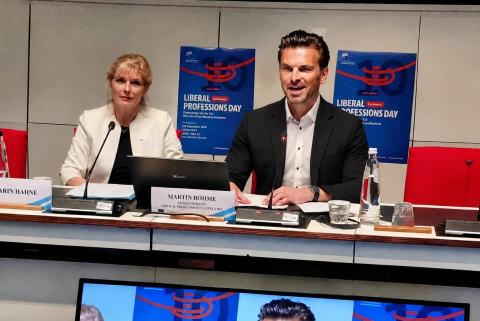
The crucial role of liberal professions in building the EU’s preparedness
On 29 September 2026, the European Economic and Social Committee (EESC) celebrated the tenth edition of the Liberal Professions Day. This event, organised annually by the EESC’s Liberal Professions Category, was the first edition under the leadership of category spokesperson Martin Böhme. The theme of this edition was ‘Preparedness in the EU: the role of the liberal professions’.
Mr Böhme opened the conference by stressing that the liberal professions are the pillars of Europe’s resilience: In recent years, we have witnessed a pandemic, a war on the EU’s border, energy shocks and cyberattacks. Each time, Europe has had to respond. And each time, one group stood on the frontline: the liberal professions
. In her keynote speech, Karin Hahne, Vice-President of the German Federal Association of Liberal Professions, shared that view.
During the first panel, which focused on preparedness in EU policy, Member of the European Parliament Grégory Allione, Alessandra Carrotta of the European Commission’s Directorate General for European Civil Protection and Humanitarian Aid Operations (DG ECHO) and the European Policy Centre’s Alison Hunter spoke about the important role that the liberal professions play in embedding preparedness into day-to-day services. Liberal professions act as multipliers, service providers and enablers, while also delivering highly specialised expertise that is essential for European preparedness. The EU’s legal framework should acknowledge and strengthen that important role.
The second panel focused on the practical side of preparedness. Heinrich Bökamp, President of the German Federal Chamber of Engineers, Daniel Fügenschuh, President of the Architects’ Council of Europe, Mary Codd, President of the Association of Schools of Public Health in the European Region (ASPHER) and Philippe Besset, President of the Federation of French Pharmaceutical Unions spoke specifically from their respective fields of expertise. But a common view became apparent quickly: whether one speaks about engineers, architects or public health workers, public authorities and the population rely heavily on the expertise of liberal professions for ensuring their resilience.
The third and final session delved into the topic of digital preparedness. Speakers were Elsa Veloso of the Portuguese National Association of Liberal Professions, Anna Maria Bardone of the Italian Committee of Professional Orders and Colleges and Helena Donato of the University of Coimbra. They all agreed that AI was here to stay, but that human oversight is paramount and needs to be enhanced. Professions should invest more in AI literacy to facilitate this process. The need for proper cybersecurity regulation is obvious, but such regulation should act as a guardrail that allows innovation to move forward with confidence, rather than as a gate that pushes all AI innovation overseas.
It was a very timely and successful jubilee edition of the Liberal Professions Day that saw a record turnout. On to the next ten years!