
European Economic
and Social Committee
EESC PLENARY: Youth Test showcases EESC’s commitment to young people, says Commissioner Micallef
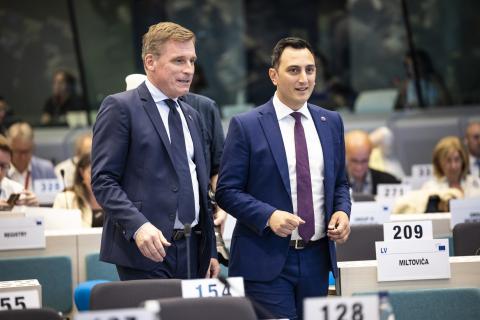
The European Economic and Social Committee (EESC) reaffirmed its commitment to youth inclusion in policy making during a high-level debate with European Commissioner Glenn Micallef at the EESC plenary session on 16 July. The debate brought together EU stakeholders, youth representatives and institutional leaders to discuss the future of youth participation, intergenerational fairness and the practical tools that make youth mainstreaming a reality, chief among them the EESC Youth Test.
Glenn Micallef, Commissioner for Intergenerational Fairness, Youth, Culture and Sport, praised the EESC for working with young people as equal partners in shaping policy, in addition to advocating for them. The Commissioner said that ‘The trust young people place in Europe is not automatic; it must be earned. That means giving them real responsibility, real power and real space to lead. From affordable housing to mental health action plans, the Commission is determined to turn participation into policy and ensure youth engagement from day one. And with the 50% budget increase for Erasmus+ proposed today, we will further strengthen our support for young people in Europe.’
Several members of the EESC’s Civil Society Organisations’ Group took the floor during the plenary debate:
Katrīna Leitāne, president of the EESC’s Youth Group, stressed that the EESC was the very first EU institution to implement the EU Youth Test at EU level. On behalf of the Committee, she thanked the European Youth Forum for helping develop this unique methodology for strengthening youth participation in policy making and said that ‘We can collectively build a Europe that young people can truly believe in and take part in’.
Since the Youth Test was launched in September 2024, 40 opinions have used it, with 27 of them already adopted. The network now includes 72 youth organisations from EU Member States and candidate countries.
Michael McLoughlin said that ‘In Europe, despite progress, we still need to move away from one-off events towards more meaningful youth engagement. Young people need to speak for others, not just for themselves. I support the idea of re-examining the concept of internships and we want to see a substantial Erasmus budget that maintains the youth chapter and youth participation initiatives.’
Neža Repanšek said that ‘Despite many efforts, the EU is still marked by youthwashing and tokenism. I truly hope that this Committee and the other EU institutions will commit to doing everything in their power to listen to the expertise of those working in the field of youth and meaningful participation and to making decisions together with young professionals and young people and not without them.'
Krzysztof Balon, group vice-president, said that ‘The EESC is considering hosting an Intergenerational Solidarity Forum to exchange information and experience and evaluate existing and develop new concepts and strategies for intergenerational solidarity. I hope that we can cooperate with you in this field.’
Louise Grabo said that ‘I hope that what we do here at the EESC could be an inspiration for other institutions. Young people must have the opportunity to be heard, but also be given the opportunity to follow up on what they start. What are you, as youth commissioner, going to do to improve the position of young people in the civil service and the EU institutions?’
Read the EESC’s press release: https://www.eesc.europa.eu/en/news-media/press-releases/youth-test-showcases-eescs-commitment-young-people-says-commissioner-micallef
Watch the debate at: https://webcast.ec.europa.eu/eesc-plenary-session-2025-07-16