
European Economic
and Social Committee
EESC PLENARY: Military mobility is a job for all of us: debate on civil-military cooperation
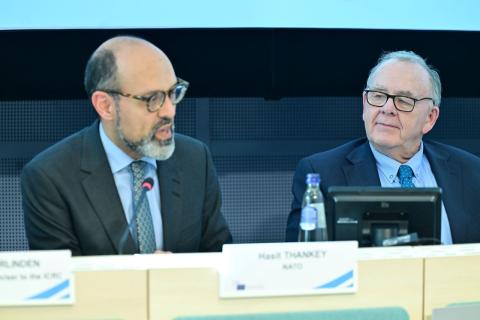
With war encroaching on EU borders and numerous calls for an increase in EU defence spending, the European Economic and Social Committee called for accelerated military mobility in Europe with civil-military cooperation at its core during a plenary debate on 19 March. Military mobility is essential for European independence and deterrence against aggressive adversaries. However, the protection of civilian lives must be paramount, and the Committee emphasised the importance of dual-use infrastructure, social respect and trust, as well as free and easy movement across borders to keep us safe.
Joining the debate were Maja Bakran, Deputy Director-General of the European Commission’s Directorate-General for Mobility and Transport (DG MOVE), Hasit Bhaskarrai Thankey, Head of the Defence Enablement and Logistics Defence Policy and Planning Division at NATO, Fabrizio Petrucci, CEO of Prometheus, and Nele Verlinden, Senior Legal Adviser to the International Committee of the Red Cross delegation to the EU, NATO and the Kingdom of Belgium.
EESC President, Séamus Boland, said that this was a job for all of us, highlighting the importance of cooperation – ‘the policymakers who write the rules, the military planners, the companies that build the networks, the transport operators who move more cargo in a week than some armies do in a year, the workers who keep everything running, the medics who must be on alert, the drivers who deliver and, above all, the citizens who depend on all of them’.
Members of the Civil Society Organisations’ Group engaged in the debate:
Baiba Miltoviča touched on the three angles of civil-military operation: infrastructure, social respect and borders. She said that mobility was about security, resilience and response time, and that in Europe, around 40% of military equipment still faced logistical delays at borders, and infrastructure gaps could slow down deployments by days. She also highlighted the importance of public awareness to ensure public trust.
Focusing on civil-military cooperation in infrastructure, Christian Moos called for Europe to scale up dual-use infrastructure, particularly at the east-west junction. He underscored the need for renewal while enabling innovation and building a resilient, sustainable transport system fit for future mobility and security needs.
Similarly, Simo Tiainen also spoke about dual-use infrastructure, drawing attention to the importance of vibrant rural areas in Europe’s security. He believes that a dual-use approach is necessary to support the vitality of rural areas and military requirements and said that ‘a region that is inhabited, economically active and connected is more resilient in the face of crisis’.
Rosario Valastro highlighted the urgent need for security and a return to international humanitarian law, stating that we were at a historic crossroads where rights were being voided of their meaning. He stressed the importance of rapid and efficient defence and a return to ‘the source of the development of international humanitarian law’.
‘We no longer effectively live in peace time’, Pavel Trantina stated as he called the initiative an important step forward, but unfortunately not sufficient. ‘Divorced from reality’ in a system that is not designed for wartime, he said that this package fell short of expectations. He called on EU institutions to pursue something more permanent, flexible, sustainable and predictable.