
European Economic
and Social Committee
EESC PLENARY: Interview with rapporteur Corina Andrea Murafa Benga on the Citizens' Energy Package
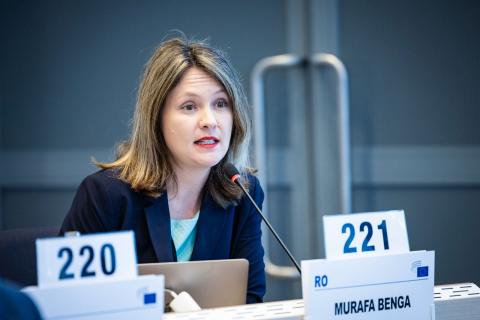
We spoke with the rapporteur for the EESC opinion TEN/854 'Citizens' Energy Package: citizens' engagement, energy communities and prosumerism'
What are the three main findings of this opinion?
One thing we clearly realised during the public hearings, and subsequent deliberations within the Committee about the opinion, is that the European Commission is not delivering properly on its intention set out in the Energy Union package to place the citizen at the heart of the energy system. To be honest, we are really far behind with this promise.
Secondly, 20 years after the onset of the energy market liberalisation, very few European citizens trust that the market is working correctly. And very few take advantage of what a free energy market has to offer them: less than a third of all Europeans change their supplier, thus missing potential savings on their energy bill of EUR 200/year.
Last but not least, some of the regulatory frameworks the Commission has been advancing in different directives and regulations have, in many Member States, remained unimplemented. One example involves energy communities – a European legislative concept which functions relatively smoothly in more developed Member States, but is completely missing in the daily lives of citizens in Eastern Europe. It is unfair for a Romanian citizen and a Dutch citizen not to be treated equally in the European energy market.
How could these issues be addressed? What are the main recommendations or proposals of the opinion?
It is regrettable that the Commission does not want to pass further legislation in order to fix these issues.
Moreover, the upcoming Citizens Energy Package (CEP), despite being mere guidance for Member States, must be really strong. We call for several dimensions to be included in this upcoming package. In order to empower citizens and establish the prerequisites to mitigate energy poverty, a prevalent phenomenon in the EU, the EESC urges the EU to urgently adopt a number of specific measures such as an immediate EU-wide ban on the disconnection of households; moving away from the merit order system, which links electricity prices to gas prices; adjusting the policy language by referring to ‘citizens’, instead of ‘consumers’, in relation to energy; linking any public funding scheme for energy projects to the participation of local communities as shareholders in energy projects and other forms of benefit-sharing; having distinct streams of funding in the new multiannual financial framework (MFF) - the EU's budget for 2028-2034 - for energy communities; and setting up a European energy ombudsperson, with local branches in each Member State.
After the adoption of this opinion, what have you done/will you do to promote it?
I attended a very successful bilateral meeting with the Commission, seeking to engage them further towards incorporating our recommendations in the upcoming Citizens Energy Package. I also exchanged bilaterally with Rescoop (the European federation of energy communities), was invited to several events and offered media coverage in my home country, Romania. I also conducted effective discussions with Rescoop to align further on the next steps.
I hope that our Committee, especially its Section for Transport, Energy, Infrastructure and the Information Society (TEN), will continue to engage with the Commission on these matters and even co-host an event, once the Citizens Energy Package is published. If not the EESC, then which other EU institution is better equipped to discuss energy matters from a citizens’ perspective?
As next steps, what I hope to do is to engage the Cyprus Presidency of the Council of the EU, as their input on the citizens’ energy agenda will be very important. I have also identified a couple of MEPs who have been working on the matter, and I plan to organise bilateral meet-ups with them at the earliest convenience, as the Parliament should also discuss the CEP as soon as it is published, despite not being a legislative initiative per se.
The EESC opinion on 'Citizens' Energy Package: citizens' engagement, energy communities and prosumerism' was presented and adopted at the EESC plenary session in September 2025. Read it at: https://link.europa.eu/BDXyNg
Corina Andrea MURAFA BENGA (Romania)
Member, EESC Civil Society Organisations' Group
Co-founder, Romanian Energy Poverty Observatory (ORSE) of the Centre for the Study of Democracy (CSD)